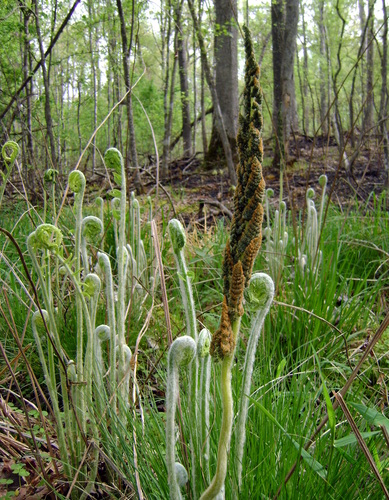
Osmundastrum cinnamomeum, commonly known as the cinnamon fern or the buckhorn fern, is a species of royal fern native to the Americas and Asia. It is the sole living representative of the genus Osmundastrum, which was separated from Osmunda after modern phylogenetic studies demonstrated that Osmunda was not monophyletic. In North America it occurs from southern Labrador west to Ontario, and south through the eastern United States to eastern Mexico and the West Indies; in South America it occurs west to Peru and south to Paraguay. In Asia it occurs from southeastern Siberia south through Japan, Korea, China and Taiwan to India, Myanmar, Thailand and Vietnam.
📌 Taxonomic history and classification
Historically, the cinnamon fern—now recognized as Osmundastrum cinnamomeum—was classified within the genus Osmunda as Osmunda cinnamomea L., along with other extant osmundaceous ferns. This broad circumscription of Osmunda was based primarily on general morphological similarities shared among royal ferns, such as large fronds, robust rhizomes, and a preference for moist habitats. However, the advent of molecular phylogenetics, combined with renewed morphological scrutiny, has significantly altered our understanding of relationships within the Osmundaceae.
Genetic analyses by Metzgar et al. (2008) utilized multiple chloroplast DNA regions to produce a comprehensive phylogeny of the Osmundaceae. Their results demonstrated that Osmunda cinnamomea occupies a unique and deeply diverging lineage, forming a sister group to the rest of the extant members of the family—including Osmunda sensu stricto, Todea, and Leptopteris. These findings were corroborated by Jud et al. (2008), who made detailed morphological assessments of fossil finds and morphological features. Their study further confirmed that O. cinnamomeum differs from other Osmunda species in several key traits, including soral structure, leaf development, and stem anatomy.
The phylogenetic position of Osmundastrum cinnamomeum as sister to all other living Osmundaceae has direct implications for classification. If Osmunda were to retain O. cinnamomeum within its limits, the genus would be rendered paraphyletic—a condition that violates the principle of monophyly required in modern systematic taxonomy. To resolve this, taxonomists have proposed two alternatives: (1) expanding the genus Osmunda to include Todea and Leptopteris, or (2) segregating Osmundastrum as a distinct genus to reflect its evolutionary independence. Under this treatment, Osmundastrum cinnamomeum is the sole extant representative of the genus, reflecting both its genetic distinctiveness and unique morphological character suite. These include simple, non-pinnatifid fertile fronds lacking differentiated sporangial clusters, as well as consistent anatomical traits in the rhizome such as ectophloic dictyoxylic siphonosteles and a homogenous pith composed of prosenchymatous cells. It is possible that some additional fossils should be assigned to Osmundastrum rather than Osmunda. Fossil species like Osmundastrum gvozdevae are known from the fossil record.
Formerly, some authors included the interrupted fern, Osmunda claytoniana, in the genus or section Osmundastrum, because of its gross apparent morphological similarities. However, detailed morphology and genetic analysis have proven that the interrupted fern is actually a true Osmunda. This is borne out by the fact that it is known to hybridize with the American royal fern, Osmunda spectabilis to produce Osmunda × ruggii in a family in which hybrids are rare, while Osmundastrum cinnamomeum has no known hybrids. The modern species has remained largely unchanged since the Late Cretaceous, a phenomenon scientists describe as punctuated equilibrium. Despite this some botanists classify Asian and American populations of the cinnamon fern as separate species, but most botanists generally agree that these are varieties of a single species.
Below is a cladogram showcasing the relationships of Osmundaceae.
|label2=Osmunda
|2=
}}
}}
}}
}}
📌 Distribution and habitat
The range of the cinnamon fern spans both the Old World and the New World, yet it is notably absent from western North America, despite the modern species having evolved there. This distribution makes the cinnamon fern a classic example of the eastern Asian–eastern North American disjunction, a biogeographic pattern in which plant lineages that once had widespread ranges in past geological periods become restricted to the eastern regions of North America and eastern Asia over time.
In Asia, its northern range extends into the Russian Far East, including Amur, Kamchatka, Khabarovsk, the Kuril Islands, Primorye, and Sakhalin. It is widespread in East Asia, occurring across the entire Korean Peninsula, Japan, and much of the People's Republic of China—particularly in Hunan, Henan, Hubei, Jiangxi, Anhui, Guangdong, Fujian, Zhejiang, Hong Kong, Macau, Jiangsu, Heilongjiang, Jilin, and Liaoning. The species is also present on Taiwan (ROC). In Southeast Asia, it is mainly found in Vietnam, Thailand, and Myanmar (Burma).
In South Asia, the cinnamon fern occurs in Bhutan and northeastern India, primarily in Arunachal Pradesh, Assam, Manipur, Meghalaya, Mizoram, Nagaland, Tripura, and Sikkim. and boggy coastal swamps The fern can grow in Organic soil but it can also grow in sand. It prefers shade but can be found to grow in areas with more direct sunlight.
📌 Ecology
The cinnamon fern typically grows in moist, acidic soils and shows a strong preference for wetland environments (although it does thrive in dry-mesic forests with seasonal sub-irrigation). The fern can grow in Organic soil but it can also grow in sand. It prefers shade but can be found to grow in areas with more direct sunlight.
The cinnamon fern plays a multifaceted ecological role in its habitats—from altering carbon and water dynamics to participating in complex reproductive signaling and hosting symbiotic fungi. In constructed wetlands treating aquaculture wastewater, cinnamon fern helped reduce pollutants such as total phosphorus, ammonia nitrogen, and turbidity. This shows potential for the fern's use in phytoremediation and nutrient cycling in wetland systems. Cinnamon fern-dominated understories in high-elevation Appalachian forests are strongly associated with higher soil respiration (Rs) during summer months, suggesting they influence carbon cycling more actively during the growing season.
Cinnamon ferns are known hosts to Mixia osmundae, a rare intracellular parasitic fungus. Like most ferns, the cinnamon fern is toxic to most herbivores in its adult stage and is generally avoided. Ferns of the Osmundaceae family tend to carry a high amount of lanthanum which is toxic to most mammals. Evidence indicates that these dinosaurs probably consumed ferns (including the Cinnamon fern) as part of their diet and were able to extract nutrients out of them. The Cinnamon fern was major part of the fern community in these Cretaceous aged formations and existed alongside many other ferns in a warm environment. It briefly coexisted with another species, O. precinnamomea, during the Paleogene. In South America, it is found alongside tree ferns, cycads, podocarps, Nothofagus trees, magnolias, Araucaria trees, Ocotea trees, and other species.
📌 Uses
Cinnamon fern has been historically used by the Abenaki and Menominee as a food source. The Iroquois and Cherokee tribes used the fern for a wide variety of medicinal purposes including as a cold remedy, gynecological aid, venereal aid, and as a remedy to snake bites.
The Cinnamon fern is often used in constructed wetlands for wastewater treatment, due to its ability to tolerate waterlogged conditions and contribute to nutrient removal.