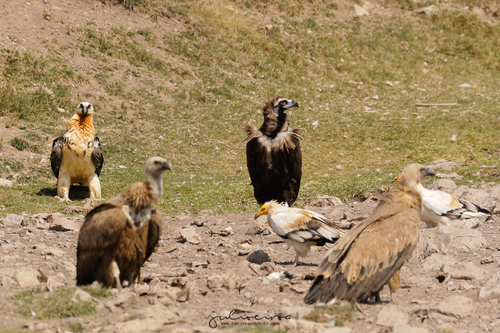
The cinereous vulture, also known as the black vulture, Eurasian black vulture, and monk vulture, is a very large raptor in the family Accipitridae distributed through much of temperate Eurasia. With a body length of 1.2 m, 3.1 m (10 ft) across the wings and a maximum weight of 14 kg (31 lb), it is the largest Old World vulture and largest member of the family Accipitridae.
🛡️ Conservation Status
near threatened
nt
📌 Taxonomy
The genus name Aegypius is a Greek word (αἰγυπιός) for 'vulture', or a bird not unlike one; Aelian describes the aegypius as "halfway between a vulture (gyps) and an eagle". Some authorities think this a good description of a lammergeier; others do not. Aegypius is the eponym of the species, whatever it was in ancient Greek.
It is most closely related to the lappet-faced vulture, with this pair then to the white-headed vulture and the red-headed vulture; all three have sometimes been included with it in a broader interpretation of the genus Aegypius.
This bird is an Old World vulture, and as such is only distantly related to the New World vultures, which are in a separate family, Cathartidae, of the same order. It is therefore not closely related to the much smaller American black vulture (Coragyps atratus) despite the similar name and colour.
📌 Distribution and habitat
The cinereous vulture is a Eurasian species. The western limits of its range are in Spain and inland Portugal, with a reintroduced population in southern France. They are found discontinuously to Greece, Turkey and throughout the central Middle East. Their range continues through Afghanistan eastwards to northern India to its eastern limits in central Asia, where they breed in northern Manchuria, Mongolia and Korea. Their range is fragmented especially throughout their European range. It is generally a permanent resident except in those parts of its range where hard winters cause limited altitudinal movement and for juveniles when they reach breeding maturity. In the eastern limits of its range, birds from the northernmost reaches may migrate down to southern Korea and China. A limited migration has also been reported in the Middle East but is not common. They are always associated with undisturbed, remote areas with limited human disturbance. They forage for carcasses over various kinds of terrain, including steppe, other grasslands, open woodlands, along riparian habitats or any kind or gradient of mountainous habitat. In their current European range and through the Caucasus and Middle East, cinereous vultures are found from in elevation, while in their Asian distribution, they are typically found at higher elevations.
📌 Behaviour
The cinereous vulture is a largely solitary bird, being found alone or in pairs much more frequently than most other Old World vultures. At large carcasses or feeding sites, small groups may congregate. Such groups can rarely include up to 12 to 20 vultures, with some older reports of up to 30 or 40.
📌 Breeding
In Europe, Eurasian black vultures return to the nesting ground in January or February. The huge nest is across and deep. The nest increases in size as a pair uses it repeatedly over the years and often comes to be decorated with dung and animal skins.
The nesting success is relatively high, with around 90% of eggs successfully hatching and more than half of yearling birds known to survive to adulthood. They are devoted, active parents, with both members of a breeding pair protecting the nest and feeding the young in shifts via regurgitation. There is a single case of a Spanish imperial eagle attacking and killing a cinereous vulture in an act of defense of its own nest in Spain. Golden eagles and Eurasian eagle-owls may rarely attempt to dispatch an older nestling or even adults in an ambush, but the species is not verified prey for either and it would be a rare event in all likelihood if it does occur. This species may live for up to 39 years, though 20 years or less is probably more common, with no regular predators of adults other than man.
📌 Feeding
Like all vultures, the cinereous vulture eats mostly carrion. The cinereous vulture feeds on carrion of almost any type, from the largest mammals available to fish and reptiles. Historically, cinereous vultures in the Iberian Peninsula fed mostly on European rabbit (Oryctolagus cuniculus) carcasses, but since viral hemorrhagic pneumonia (VHP) devastated the once abundant rabbit population there, the vultures now rely on the carrion of domestic sheep, supplemented by pigs (Sus domesticus) and deer. In Turkey, the dietary preferences were argali (92 carrion items), wild boar (Sus scrofa) (53 items), chickens (Gallus gallus domesticus) (27 items), wolves (13 items) and red foxes (Vulpes vulpes) (13 items). Unusually, a large amount of plant material, especially pine cones, was found in pellets from Turkey. Among the vultures in its range, the cinereous is best equipped to tear open tough carcass skins thanks to its powerful bill. It can even break apart bones, such as ribs, to access the flesh of large animals. It is dominant over other scavengers in its range, even over other large vultures such as Gyps vultures, bearded vultures or fierce ground predators such as foxes. Cinereous vultures frequently bully and dominate steppe eagles (Aquila nipalensis) when the two species are attracted to the same prey and carrion while wintering in Asia. A rare successful act of kleptoparasitism on a cinereous vulture was filmed in Korea when a Steller's sea eagle (Haliaeetus pelagicus) stole food from the vulture.
Its closest living relative is the lappet-faced vulture, which takes live prey on occasion. This species has hunted tortoises (which the vultures are likely to kill by carrying in flight and dropping on rocks to penetrate the shell; cf. Aeschylus#Death) and lizards. Species believed to be hunted by cinereous vultures have included argali, saiga antelope (Saiga tatarica), Mongolian gazelle (Procapra gutturosa) and Tibetan antelope (Pantholops hodgsonii).
📌 Status and conservation
on a rare visit in Israel (2016)]]
, Singapore]]
The cinereous vulture has declined over most of its range in the last 200 years in part due to poisoning by eating poisoned bait put out to kill dogs and other predators, and to higher hygiene standards reducing the amount of available carrion; it is currently listed as Near Threatened. Vultures of all species, although not the target of poisoning operations, may be shot on sight by locals. Trapping and hunting of cinereous vultures is particularly prevalent in China and Russia, More recently, protection and deliberate feeding schemes have allowed some local recoveries in numbers, particularly in Spain, where numbers increased to about 1,000 pairs by 1992 after an earlier decline to 200 pairs in 1970. This colony have now spread its breeding grounds to Portugal. Elsewhere in Europe, very small but increasing numbers breed in Bulgaria and Greece, and a re-introduction scheme is under way in France. Trends in the small populations in Ukraine (Crimea) and European Russia, and in Asian populations, are not well recorded. In the former USSR, it is still threatened by illegal capture for zoos, and in Tibet by rodenticides. It is a regular winter visitor around the coastal areas of Pakistan in small numbers. The worldwide population of cinereous vultures was estimated at 4,500–5,000 individuals at the turn of the 21st century.
📌 Culture and mythology
The Hebrew word for "eagle" is also used for the cinereous vulture. As such, Biblical passages alluding to eagles might actually be referring to this or other vultures.