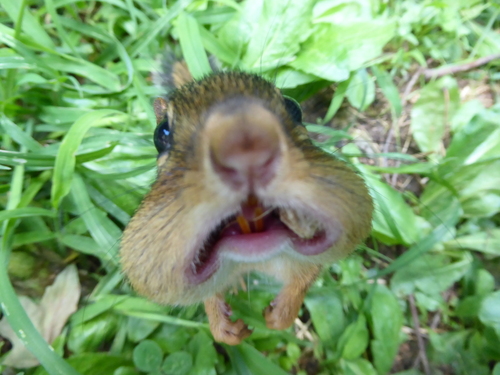
Chipmunks are small, striped squirrels of subtribe Tamiina. Chipmunks are found in North America, with the exception of the Siberian chipmunk which is found primarily in Asia.
== Taxonomy and systematics ==
Chipmunks are classified as four genera: Tamias, of which the eastern chipmunk (T. striatus) is the only living member; Eutamias, of which the Siberian chipmunk (E. sibiricus) is the only living member; Nototamias, which consists of three extinct species, and Neotamias, which includes the 23 remaining, mostly western North American, species. These classifications were treated as subgenera due to the chipmunks' morphological similarities. As a result, most taxonomies over the twentieth century have placed the chipmunks into a single genus. Joseph C. Moore reclassified chipmunks to form a subtribe Tamiina in a 1959 study, and this classification has been supported by studies of mitochondrial DNA.
The common name originally may have been spelled "chitmunk", from the native Odawa (Ottawa) word jidmoonh, meaning "red squirrel" (cf. Ojibwe αααα¨ ajidamoo). The earliest form cited in the Oxford English Dictionary is "chipmonk", from 1842. Other early forms include "chipmuck" and "chipminck", and in the 1830s they were also referred to as "chip squirrels", probably in reference to the sound they make. In the mid-19th century, John James Audubon and his sons included a lithograph of the chipmunk in their Viviparous Quadrupeds of North America, calling it the "chipping squirrel [or] hackee". Chipmunks have also been referred to as ground squirrels (although the name "ground squirrel" may refer to other squirrels, such as those of the genus Spermophilus).
== Diet ==
Chipmunks have an omnivorous diet primarily consisting of seeds, nuts and other fruits, and buds. They also commonly eat grass, shoots, and many other forms of plant matter, as well as fungi, insects and other arthropods, small frogs, worms, and bird eggs. They will also occasionally eat newly hatched baby birds. Around humans, chipmunks can eat cultivated grains and vegetables, and other plants from farms and gardens, so they are sometimes considered pests. Chipmunks mostly forage on the ground, but they climb trees to obtain nuts such as hazelnuts and acorns. At the beginning of autumn, many species of chipmunk begin to stockpile nonperishable foods for winter. They mostly cache their foods in a larder in their burrows and remain in their nests until spring, unlike some other species which make multiple small caches of food. Cheek pouches allow chipmunks to carry food items to their burrows for either storage or consumption.
== Ecology and life history ==
Eastern chipmunks, the largest of the chipmunks, mate in early spring and again in early summer, producing litters of four or five young twice each year. Western chipmunks breed only once a year. The young emerge from the burrow after about six weeks and strike out on their own within the next two weeks.
These small mammals fulfill several important functions in forest ecosystems. Their activities harvesting and hoarding tree seeds play a crucial role in seedling establishment. They consume many different kinds of fungi, including those involved in symbiotic mycorrhizal associations with trees, and are a vector for dispersal of the spores of subterranean sporocarps (truffles) in some regions.
Chipmunks construct extensive burrows which can be more than 3.5 m (11 ft) in length with several well-concealed entrances. The burrows are complex and include plugged entryways, separate compartments for nesting, multiple food chambers, side pockets and escape routes. The sleeping quarters are kept clear of shells, and feces are stored in refuse tunnels.
The eastern chipmunk hibernates in the winter, while western chipmunks do not, relying on the stores in their burrows.
Chipmunks play an important role as prey for various predatory mammals and birds but are also opportunistic predators themselves, particularly with regard to bird eggs and nestlings, as in the case of eastern chipmunks and mountain bluebirds (Siala currucoides). Movement or storage of seeds in soil caused by chipmunks leads to the germination of new plants.
Chipmunks typically live about three years, although some have been observed living to nine years in captivity.
Chipmunks are diurnal. In captivity, they are said to sleep for an average of about 15 hours a day. It is thought that mammals which can sleep in hiding, such as rodents and bats, tend to sleep longer than those that must remain on alert.
== Genera ==
Genus Eutamias
Siberian chipmunk, Eutamias sibiricus
Genus Tamias
Eastern chipmunk, Tamias striatus
Tamias aristus β
Genus Neotamias
Genus Nototamias β
Nototamias ateles β
Nototamias hulberti β
Nototamias quadratus β
== In popular culture ==
Alvin and the Chipmunks, an animated virtual band
Chip 'n' Dale, cartoon Disney chipmunks
== References ==
== Further reading ==
Gordon, Kenneth Llewellyn (1943). The Natural History and Behavior of the Western Chipmunk and the Mantled Ground Squirrel. Oregon State College Monographs. Studies in zoology, no. 5. Corvallis, Or.: Oregon State College. LCCN 44053700. OCLC 752445896.
== External links ==
Wildlife and Nature β Chipmunk at the Wayback Machine (archived April 24, 2008)
π Habitat & Distribution
Ecology and life history
Chipmunks in northern Wisconsin
Eastern chipmunk at the entrance of its burrow
Eastern chipmunks, the largest of the chipmunks,[1] mate in early spring and again in early summer, producing litters of four or five young twice each year.[2] Western chipmunks breed only once a year. The young emerge from the burrow after about six weeks and strike out on their own within the next two weeks.[3]
These small mammals fulfill several important functions in forest ecosystems. Their activities harvesting and hoarding tree seeds play a crucial role in seedling establishment. They consume many different kinds of fungi, including those involved in symbiotic mycorrhizal associations with trees, and are a vector for dispersal of the spores of subterranean sporocarps (truffles) in some regions.[4]
Chipmunks construct extensive burrows which can be more than 3.5 m (11 ft) in length with several well-concealed entrances.[5] The burrows are complex and include plugged entryways,[6] separate compartments for nesting, multiple food chambers, side pockets and escape routes.[7] The sleeping quarters are kept clear of shells, and feces are stored in refuse tunnels.[8]
The eastern chipmunk hibernates in the winter, while western chipmunks do not, relying on the stores in their burrows.[9]
Chipmunks play an important role as prey for various predatory mammals and birds but are also opportunistic predators themselves, particularly with regard to bird eggs and nestlings, as in the case of eastern chipmunks and mountain bluebirds (Siala currucoides).[10] Movement or storage of seeds in soil caused by chipmunks leads to the germination of new plants.[11]
Chipmunks typically live about three years, although some have been observed living to nine years in captivity.[12]
Chipmunks are diurnal. In captivity, they are said to sleep for an average of about 15 hours a day. It is thought that mammals which can sleep in hiding, such as rodents and bats, tend to sleep longer than those that must remain on alert.[13]
^ .mw-parser-output cite.citation{font-style:inherit;word-wrap:break-word}.mw-parser-output .citation q{quotes:"\"""\"""'""'"}.mw-parser-output .citation:target{background-color:rgba(0,127,255,0.133)}.mw-parser-output .id-lock-free.id-lock-free a{background:url("//upload.wikimedia.org/wikipedia/commons/6/65/Lock-green.svg")right 0.1em center/9px no-repeat}.mw-parser-output .id-lock-limited.id-lock-limited a,.mw-parser-output .id-lock-registration.id-lock-registration a{background:url("//upload.wikimedia.org/wikipedia/commons/d/d6/Lock-gray-alt-2.svg")right 0.1em center/9px no-repeat}.mw-parser-output .id-lock-subscription.id-lock-subscription a{background:url("//upload.wikimedia.org/wikipedia/commons/a/aa/Lock-red-alt-2.svg")right 0.1em center/9px no-repeat}.mw-parser-output .cs1-ws-icon a{background:url("//upload.wikimedia.org/wikipedia/commons/4/4c/Wikisource-logo.svg")right 0.1em center/12px no-repeat}body:not(.skin-timeless):not(.skin-minerva) .mw-parser-output .id-lock-free a,body:not(.skin-timeless):not(.skin-minerva) .mw-parser-output .id-lock-limited a,body:not(.skin-timeless):not(.skin-minerva) .mw-parser-output .id-lock-registration a,body:not(.skin-timeless):not(.skin-minerva) .mw-parser-output .id-lock-subscription a,body:not(.skin-timeless):not(.skin-minerva) .mw-parser-output .cs1-ws-icon a{background-size:contain;padding:0 1em 0 0}.mw-parser-output .cs1-code{color:inherit;background:inherit;border:none;padding:inherit}.mw-parser-output .cs1-hidden-error{display:none;color:var(--color-error,#d33)}.mw-parser-output .cs1-visible-error{color:var(--color-error,#d33)}.mw-parser-output .cs1-maint{display:none;color:#085;margin-left:0.3em}.mw-parser-output .cs1-kern-left{padding-left:0.2em}.mw-parser-output .cs1-kern-right{padding-right:0.2em}.mw-parser-output .citation .mw-selflink{font-weight:inherit}@media screen{.mw-parser-output .cs1-format{font-size:95%}html.skin-theme-clientpref-night .mw-parser-output .cs1-maint{color:#18911f}}@media screen and (prefers-color-scheme:dark){html.skin-theme-clientpref-os .mw-parser-output .cs1-maint{color:#18911f}}"National Geographic". National Geographic Society. 11 April 2010. Archived from the original on 2021-03-01.
^ Hazard, Evan B. (1982). The Mammals of Minnesota. University of Minnesota Press. pp. 52β54. ISBN 978-0-8166-0952-9.
^ Schwartz, Charles Walsh; Elizabeth Reeder Schwartz; Jerry J. Conley (2001). The Wild Mammals of Missouri. University of Missouri Press. pp. 135β140. ISBN 978-0-8262-1359-4.
^ Pyare, Sanjay; Longland, William S. (2001). "Patterns of Ectomycorrhizal-Fungi Consumption by Small Mammals in Remnant Old-Growth Forests of the Sierra Nevada". Journal of Mammalogy. 82 (3): 681β689. doi:10.1644/1545-1542(2001)082<0681:POEFCB>2.0.CO;2. ISSN 0022-2372. JSTOR 1383605.
^ Saunders, D. A. (1988). "Eastern Chipmunk". Adirondack Mammals. Adirondack Ecological Center. Retrieved 2015-09-19.
^ Thomas, Kim Rutherford (1974). "Burrow Systems of the Eastern Chipmunk (Tamias striatus pipilans Lowery) in Louisiana". Journal of Mammalogy. 55 (2): 454β459. doi:10.2307/1379017. ISSN 0022-2372.
^ "Chipmunks". extension.psu.edu. Retrieved 2025-11-27.
^ Leslie Day (October 2007). Field Guide to the Natural World of New York City. Johns Hopkins University Press. ISBN 978-0-8018-8682-9. Retrieved 2015-09-19.
^ Kays, R. W.; Wilson, Don E. (2009). Mammals of North America (2nd ed.). Princeton University Press. p. 72. ISBN 978-0-691-14092-6.
^ Sullivan, Janet. "WILDLIFE SPECIES: Sialia currucoides". Fire Effects Information System, [Online]. U.S. Department of Agriculture, Forest Service, Rocky Mountain Research Station, Fire Sciences Laboratory. Retrieved 23 January 2016.
^ Wiktorko, Ryann (2016-11-10). "Chipmunks in the Garden at Fort Ticonderoga". fortticonderoga.org. Retrieved 2025-11-27.
^ "Information on Chipmunks". Essortment. Essortment.com. 1986-05-16. Archived from the original on 2012-12-22. Retrieved 2012-12-07.
^ Jennifer S. Holland "40 Winks?" (July 2011). National Geographic Vol. 220, No. 1.
π½οΈ Diet
Diet
An eastern chipmunk placing food in its cheek pouch
Chipmunks have an omnivorous diet primarily consisting of seeds, nuts and other fruits, and buds.[1][2] They also commonly eat grass, shoots, and many other forms of plant matter, as well as fungi, insects and other arthropods, small frogs, worms, and bird eggs. They will also occasionally eat newly hatched baby birds.[1][2][3] Around humans, chipmunks can eat cultivated grains and vegetables, and other plants from farms and gardens, so they are sometimes considered pests.[1][4] Chipmunks mostly forage on the ground, but they climb trees to obtain nuts such as hazelnuts and acorns.[1][5] At the beginning of autumn, many species of chipmunk begin to stockpile nonperishable foods for winter. They mostly cache their foods in a larder in their burrows and remain in their nests until spring, unlike some other species which make multiple small caches of food.[1] Cheek pouches allow chipmunks to carry food items to their burrows for either storage or consumption.[2]
^ a b c d e Cite error: The named reference hazard was invoked but never defined (see the help page).
^ a b c .mw-parser-output cite.citation{font-style:inherit;word-wrap:break-word}.mw-parser-output .citation q{quotes:"\"""\"""'""'"}.mw-parser-output .citation:target{background-color:rgba(0,127,255,0.133)}.mw-parser-output .id-lock-free.id-lock-free a{background:url("//upload.wikimedia.org/wikipedia/commons/6/65/Lock-green.svg")right 0.1em center/9px no-repeat}.mw-parser-output .id-lock-limited.id-lock-limited a,.mw-parser-output .id-lock-registration.id-lock-registration a{background:url("//upload.wikimedia.org/wikipedia/commons/d/d6/Lock-gray-alt-2.svg")right 0.1em center/9px no-repeat}.mw-parser-output .id-lock-subscription.id-lock-subscription a{background:url("//upload.wikimedia.org/wikipedia/commons/a/aa/Lock-red-alt-2.svg")right 0.1em center/9px no-repeat}.mw-parser-output .cs1-ws-icon a{background:url("//upload.wikimedia.org/wikipedia/commons/4/4c/Wikisource-logo.svg")right 0.1em center/12px no-repeat}body:not(.skin-timeless):not(.skin-minerva) .mw-parser-output .id-lock-free a,body:not(.skin-timeless):not(.skin-minerva) .mw-parser-output .id-lock-limited a,body:not(.skin-timeless):not(.skin-minerva) .mw-parser-output .id-lock-registration a,body:not(.skin-timeless):not(.skin-minerva) .mw-parser-output .id-lock-subscription a,body:not(.skin-timeless):not(.skin-minerva) .mw-parser-output .cs1-ws-icon a{background-size:contain;padding:0 1em 0 0}.mw-parser-output .cs1-code{color:inherit;background:inherit;border:none;padding:inherit}.mw-parser-output .cs1-hidden-error{display:none;color:var(--color-error,#d33)}.mw-parser-output .cs1-visible-error{color:var(--color-error,#d33)}.mw-parser-output .cs1-maint{display:none;color:#085;margin-left:0.3em}.mw-parser-output .cs1-kern-left{padding-left:0.2em}.mw-parser-output .cs1-kern-right{padding-right:0.2em}.mw-parser-output .citation .mw-selflink{font-weight:inherit}@media screen{.mw-parser-output .cs1-format{font-size:95%}html.skin-theme-clientpref-night .mw-parser-output .cs1-maint{color:#18911f}}@media screen and (prefers-color-scheme:dark){html.skin-theme-clientpref-os .mw-parser-output .cs1-maint{color:#18911f}}"West Virginia Wildlife Magazine: Wildlife Diversity Notebook. Eastern chipmunk". Wvdnr.gov. Retrieved 2012-12-07.
^ .mw-parser-output .plainlist ol,.mw-parser-output .plainlist ul{line-height:inherit;list-style:none;margin:0;padding:0}.mw-parser-output .plainlist ol li,.mw-parser-output .plainlist ul li{margin-bottom:0}"Eastern Chipmunk - Tamias striatus - NatureWorks". Nhptv.org. Retrieved 2012-12-07.Cassola, F. (2017) [errata version of 2016 assessment]. "Neotamias minimus". IUCN Red List of Threatened Species. 2016 e.T42572A115190804. doi:10.2305/IUCN.UK.2016-3.RLTS.T42572A22267269.en.Tsytsulina, K.; Formozov, N.; Shar, S.; Lkhagvasuren, D.; Sheftel, B. (2017) [errata version of 2016 assessment]. "Eutamias sibiricus". IUCN Red List of Threatened Species. 2016 e.T21360A115161465. doi:10.2305/IUCN.UK.2016-3.RLTS.T21360A22268598.en.Cassola, F. (2017) [errata version of 2016 assessment]. "Neotamias townsendii". IUCN Red List of Threatened Species. 2016 e.T42584A115191888. doi:10.2305/IUCN.UK.2016-3.RLTS.T42584A22268822.en.
^ "Chipmunks | Living With Wildlife". Mass Audubon. Archived from the original on 2012-12-18. Retrieved 2012-12-07.
^ "Chipmunk at Animal Corner". Animalcorner.co.uk. 2004-01-01. Retrieved 2012-12-07.
π Taxonomy and systematics
Chipmunks are classified as four genera: Tamias, of which the eastern chipmunk (T. striatus) is the only living member; Eutamias, of which the Siberian chipmunk (E. sibiricus) is the only living member; Nototamias, which consists of three extinct species, and Neotamias, which includes the 23 remaining, mostly western North American, species. These classifications were treated as subgenera due to the chipmunks' morphological similarities. As a result, most taxonomies over the twentieth century have placed the chipmunks into a single genus. Joseph C. Moore reclassified chipmunks to form a subtribe Tamiina in a 1959 study, and this classification has been supported by studies of mitochondrial DNA.
The common name originally may have been spelled "chitmunk", from the native Odawa (Ottawa) word jidmoonh, meaning "red squirrel" (cf. Ojibwe ajidamoo). The earliest form cited in the Oxford English Dictionary is "chipmonk", from 1842. Other early forms include "chipmuck" and "chipminck", and in the 1830s they were also referred to as "chip squirrels", probably in reference to the sound they make. In the mid-19th century, John James Audubon and his sons included a lithograph of the chipmunk in their Viviparous Quadrupeds of North America, calling it the "chipping squirrel [or] hackee". Chipmunks have also been referred to as ground squirrels (although the name "ground squirrel" may refer to other squirrels, such as those of the genus Spermophilus).
π Ecology and life history
]]
Eastern chipmunks, the largest of the chipmunks, mate in early spring and again in early summer, producing litters of four or five young twice each year. Western chipmunks breed only once a year. The young emerge from the burrow after about six weeks and strike out on their own within the next two weeks.
These small mammals fulfill several important functions in forest ecosystems. Their activities harvesting and hoarding tree seeds play a crucial role in seedling establishment. They consume many different kinds of fungi, including those involved in symbiotic mycorrhizal associations with trees, and are a vector for dispersal of the spores of subterranean sporocarps (truffles) in some regions.
Chipmunks construct extensive burrows which can be more than in length with several well-concealed entrances. The burrows are complex and include plugged entryways, separate compartments for nesting, multiple food chambers, side pockets and escape routes. The sleeping quarters are kept clear of shells, and feces are stored in refuse tunnels.
The eastern chipmunk hibernates in the winter, while western chipmunks do not, relying on the stores in their burrows.
Chipmunks play an important role as prey for various predatory mammals and birds but are also opportunistic predators themselves, particularly with regard to bird eggs and nestlings, as in the case of eastern chipmunks and mountain bluebirds (Siala currucoides). Movement or storage of seeds in soil caused by chipmunks leads to the germination of new plants.
Chipmunks typically live about three years, although some have been observed living to nine years in captivity.
Chipmunks are diurnal. In captivity, they are said to sleep for an average of about 15 hours a day. It is thought that mammals which can sleep in hiding, such as rodents and bats, tend to sleep longer than those that must remain on alert.
π Genera
Genus Eutamias
* Siberian chipmunk, Eutamias sibiricus
Genus Tamias
* Eastern chipmunk, Tamias striatus
* Tamias aristus β
Genus Neotamias
* Allen's chipmunk, Neotamias senex
* Alpine chipmunk, Neotamias alpinus
* Buller's chipmunk, Neotamias bulleri
* California chipmunk, Neotamias obscurus
* Cliff chipmunk, Neotamias dorsalis
* Colorado chipmunk, Neotamias quadrivittatus
* Durango chipmunk, Neotamias durangae
* Gray-collared chipmunk, Neotamias cinereicollis
* Gray-footed chipmunk, Neotamias canipes
* Hopi chipmunk, Neotamias rufus
* Least chipmunk, Neotamias minimus
* Lodgepole chipmunk, Neotamias speciosus
* Long-eared chipmunk, Neotamias quadrimaculatus
* Merriam's chipmunk, Neotamias merriami
* Palmer's chipmunk, Neotamias palmeri
* Panamint chipmunk, Neotamias panamintinus
* Red-tailed chipmunk, Neotamias ruficaudus
* Siskiyou chipmunk, Neotamias siskiyou
* Sonoma chipmunk, Neotamias sonomae
* Townsend's chipmunk, Neotamias townsendii
* Uinta chipmunk, Neotamias umbrinus
* Yellow-cheeked chipmunk, Neotamias ochrogenys
* Yellow-pine chipmunk, Neotamias amoenus
Genus Nototamias β
* Nototamias ateles β
* Nototamias hulberti β
* Nototamias quadratus β
π In popular culture
* Alvin and the Chipmunks, an animated virtual band
* Chip 'n' Dale, cartoon Disney chipmunks