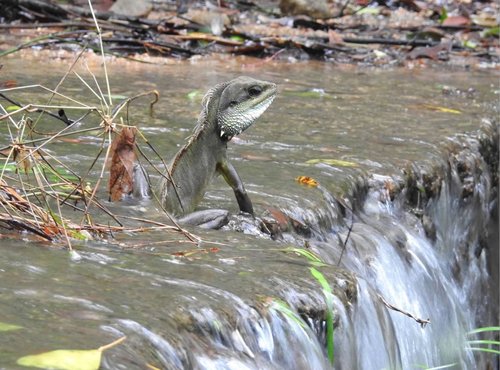
Physignathus cocincinus is a species of agamid lizard native to southern China and mainland Southeast Asia. It is commonly known as the Chinese water dragon, Indochinese water dragon, Asian water dragon, Thai water dragon, or green water dragon.
📌 Taxonomy
The species and genus were first described by Georges Cuvier in 1829. Cuvier's original spelling, Phyhignat,us cocincinus, is likely a printing error. The epithet cocincinus is from the French term , for the type locality Cochin-china (an exonym of Vietnam).
During the 19th and 20th centuries, several other species of agamid lizards were placed in Cuvier's genus Physignathus. These have been reclassified into separate genera, leaving Physignathus with only the original species P. cocincinus remaining. For example, the Australian water dragon (Intellagama lesueurii) was known as Physignathus lesueurii for much of its history.
According to most genetic analyses, Physignathus cocincinus is the sister taxon or the most basal (earliest branching) species of the agamid subfamily Amphibolurinae. All other amphibolurines are native to Australia or New Guinea, including bearded dragons (Pogona spp.), the frilled lizard (Chlamydosaurus kingii), the thorny devil (Moloch horridus), the Australian water dragon, and many others. A 2000 paper estimated that Physignathus cocincinus diverged from the Australasian amphibolurines up to 120 million years ago, though subsequent studies support a more recent divergence, around 30 million years ago.
📌 Distribution
=== Native range ===
Chinese water dragons are native to the subtropical forests of southern China (Guangdong, Guangxi, and Yunnan provinces) and Southeast Asia (Vietnam, Laos, portions of Cambodia, eastern Thailand).
📌 Introduced populations
in Hong Kong]]
An introduced population of Chinese water dragons has established itself in Hong Kong, probably from released pet animals. The first reports came from Tsing Yi Island in 2004, though the Hong Kong population likely originated from several releases. Since 2010, another breeding population has been established in New Taipei City, Taiwan. Hundreds of the lizards were culled from 2013 to 2017 over concerns about their impact on native Taiwanese wildlife. Introduced individuals (but not breeding populations) have also been reported from Malaysia and Florida.
📌 Behavior and ecology
, Thailand]]
Chinese water dragons are diurnal (active during the day) and forage for prey within small territories in the morning and midday. They are also semi-arboreal (spending much of their time in trees or plants). Adult males in particular tend to rest during the night on tree limbs overlooking streams. If threatened, a Chinese water dragon will leap or run to the nearest stream and either swim to safety or remain submerged for up to 90 minutes.
In Hong Kong, the average territory size is about 1800 m2, with a small daily range of about 5 meters on average. Male territories generally do not overlap with each other, arguing that males are much more territorial than females. Movement and range patterns appear to be similar between the hot and wet summer and the relatively cool and dry winter, unlike most other subtropical reptiles. This may be an unintentional artefact of the fact that Hong Kong's dry season during the study interval (2015–2016) was unusually warm and wet. Captive male water dragons are very aggressive towards each other while females and juveniles are more tolerant.
📌 Reproduction and life history
Chinese water dragons are oviparous, with a clutch of 5 to 16 eggs buried in sandy riverbanks near the end of the dry winter. The eggs hatch two or three months later in the early part of the wet summer. A female housed at the Smithsonian National Zoo produced viable offspring in 2016 and 2018, along with numerous unfertilized and nonviable eggs. The two surviving offspring are homozygous or hemizygous at seven particular microsatellite loci in the genome. This condition would be nearly impossible if sexual reproduction was involved, since at least a few of the seven microsatellite loci would be expected to be heterozygous. Physignathus cocincinus is the only agamid known to reproduce via parthenogenesis, though the low hatch rate suggests that this is an accidental occurrence rather than an ingrained evolutionary strategy.
📌 Threats and conservation
Though locally abundant in some areas, the Chinese water dragon faces persistent unrestrained threats and a steadily declining wild population. It is listed as Vulnerable in Vietnamese conservation lists, and Endangered in Thailand and China. In accordance with a 2022 proposal, the Chinese water dragon has been listed on CITES Appendix II (requiring a CITES-approved permit for export) since 2023.
📌 Population dynamics
At one site in Cambodia the species experienced a 50% population decline in 18 years, while a 2007 estimate considered the entire Vietnamese population to have declined by 20% over the previous decade. Introduced populations in Hong Kong have a much higher population density (about 114 per 100 meters) than native Vietnamese populations.
📌 Hunting and the pet trade
, Vietnam]]
The most severe threat to the species is harvesting for meat and the pet trade. According to a series of 2016 interviews with 21 rural hunter groups, water dragons are a frequent and easy target of traps and hand collecting throughout Thua Thien Hue. Hunting pressure is greatest in May and June, with adult males prioritized due to their large size and conspicuous appearance. This agrees with the decreasing proportion of adult males found in June compared to April. Water dragon meat is typically sold to local restaurants, while eggs are stored in rice wine to be used as traditional medicine. Skins and leather are also traded and exported.
, Switzerland]]
Wild water dragons are captured and sold as pets on social media platforms for both Vietnamese customers and the international markets of Europe and the United States. In Vietnam, about five times as many Chinese water dragons are sold for meat compared to those sold as pets. Exports to Europe began in 1975 and have accelerated in recent decades. From 2010 to 2018, a stable average of around 7,000 live Chinese water dragons per year were exported to the European Union. Approximately 89% came from Vietnam, though information on their production (wild caught or captive bred) is available for fewer than 13% of recorded exports to Europe.
Exports to the United States are even higher despite recent declines: an average of 81,000 per year from 2002 to 2011, and around 48,000 per year from 2013 to 2017. Practically all water dragons exported to the United States are Vietnamese in origin. At least 95% are wild caught while around 3% are reportedly captive bred in Vietnam. It is probable that some individuals sourced from Vietnam were actually collected from other nations, simply using the ports of Vietnam as a transit hub. Captive breeding is a viable but limited conservation strategy; Chinese water dragons breed readily in captivity, though not at a high enough rate to counteract demand. There is no direct evidence that captive breeding programs in Vietnam are in operation, despite claims of captive-bred exports.
📌 Habitat loss
A smaller threat, though still impactful, is degradation or removal of the forested stream habitats which water dragons rely on. In Thua Thien Hue, illegal logging and a major highway construction project are likely partially responsible for losses in the Nam Dong and A Luoi districts. These pressures are less prevalent in the uplands of Phong Dien district, which seems to not experience the same degree of population decline. Logging and expansion of agricultural and tourism infrastructure also contribute to the paucity of suitable habitats in Northern Vietnam. Coal mining, stream pollution, and climate change may also threaten the species, as reported for ecologically similar reptiles in the region, such as the Chinese crocodile lizard (Shinisaurus crocodilurus).
Despite its common name, the Chinese water dragon is exceedingly rare in China, where it is threatened by dam construction on top of the same pressures as the Vietnamese populations. Suitably undeveloped habitats are uncommon in Cambodia and Laos. The few Chinese water dragons present in Thailand are stable and locally abundant thanks to their range lining up with protected areas such as Khao Yai National Park and Namtok Phlio National Park.
📌 Captive individuals
File:Physignathus cocincinus Zoo Amneville 28092014 1.jpg|At Zoo d'Amnéville
File:Hul - Physignathus cocincinus - 20.jpg|At Sea Life Hanover
File:Agama blotna, wodnogama indochinska (Physignathus cocincinus) - Zoo w Warszawie 1.JPG|At Warsaw Zoo
File:Physignatus cocincinus Basel Zoo 28102013 1.jpg|At Basel Zoo
File:654303 Poznań, palmiarnia 07.JPG|At
File:Amsterdam Zoo (3798542697).jpg|At Amsterdam Zoo
File:Chinese water dragon (Physignathus cocincinus) Aalborg Zoo.jpg|At Aalborg Zoo
File:Physignathus cocincinus chinese green water dragon toronto zoo jan 08 2.jpg|Detailed view of the head (Toronto Zoo)