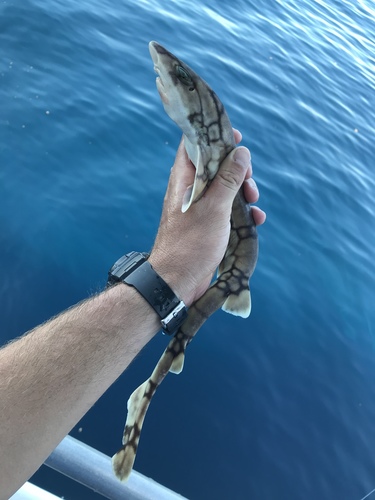
The chain catshark or chain dogfish is a small, reticulated catshark that is biofluorescent. The species is common in the Northwest Atlantic, Gulf of Mexico, and Caribbean. It is harmless and rarely encountered by humans. It has very similar reproductive traits to the small-spotted catshark.
📌 Distribution
The chain catshark is found in the Northwest Atlantic, Gulf of Mexico and Caribbean, ranging from George's Bank in Massachusetts, to Nicaragua and Barbados. Due to the shark's depth distribution, it has been suggested that the shark does not perform large-scale migrations.
Scyliorhinus retifer jaws.jpg|Jaws
Scyliorhinus retifer upper teeth.jpg|Upper teeth
Scyliorhinus retifer lower teeth.jpg|Lower teeth
📌 Habitat and behavior
]]
The catshark spends the daytime resting at the bottom, usually in contact with certain structures. It has been observed with large burrowing cerianthid anemone tubes and boulders.
📌 Reproduction
===Size and sexual maturity===
The maximum length of this shark is . Males reach maturity at a length between .
📌 Mating
Observed mating between the species suggests biting plays an element and that mating occurs repeatedly. Behavioral observations include the male biting the female until it can get a firm grasp and subsequently wraps its body around the female for copulation. After copulation, the male releases his bite and both separate.
📌 Egg-laying
The chain catshark prefers vertical structures for egg deposition and always deposits eggs in pairs. The interval between pairs of eggs ranges from a few minutes to 8 days. Development rates average 1 mm diameter per 7.7 days although temperature has also been seen to affect follicle development.
📌 Sperm storage and egg cases
The female chain catshark is able to store sperm and lay eggs several days after initial copulation. The shark has been known to store sperm up to 843 days although, there are some circumstances of poor egg development in eggs laid later. It is suggested that this could be due to a number of factors including, senescence, low sperm viability, or water quality factors.
📌 Embryos
Embryos take 8–12 months to develop due to temperature variations in the environment. The catshark lays eggs in their blastodisc form. The following exhibits a typical developmental timeline (measurements are embryo length):
* – it has well-defined gill arches and has a thin ventral finfold
* – dorsal and pelvic fin buds appear
* – embryo has protruding eyes and well-developed gill filaments
* – it has lost its translucency and develops slits in the egg case, allowing fluid exchange from surrounding seawater and the interior
* – the finfold starts to decay
* – the finfold and gill filaments are reduced or absent
* – external appearance is complete but yolk sac is still being absorbed
* – hatching
📌 Fluorescence
The chain catshark is one of four elasmobranch species shown to possesses biofluorescent properties. The researchers of the study examined the vision of Scyliorhinus retifer using microspectrophotometry and designed a "shark-eye" camera that yielded contrast information on areas where fluorescence is anatomically distributed on the shark. The repeated evolution of biofluorescence in elasmobranchs, coupled with a visual adaptation to detect it; and evidence that biofluorescence creates greater luminosity contrast with the surrounding background, highlights the potential importance of biofluorescence in elasmobranch behavior and biology. The key fluorescent pigments in the chain catshark and the swell shark are a set of brominated kynurenine compounds that appear to be synthesized by the kynurenine pathway starting from 6-bromo-tryptophan. The biochemical origin of 6-bromo-tryptophan in these species is not known.
📌 Relationship with humans
The chain catshark is not currently fished for human consumption.
The chain catshark has been described as "gorgeous", and this, combined with its small size, makes it a popular cold-water aquarium fish. It is frequently displayed and bred at public aquariums. Research in shark behavior, including reproduction, has been done in chain catsharks kept in public aquariums or laboratories.