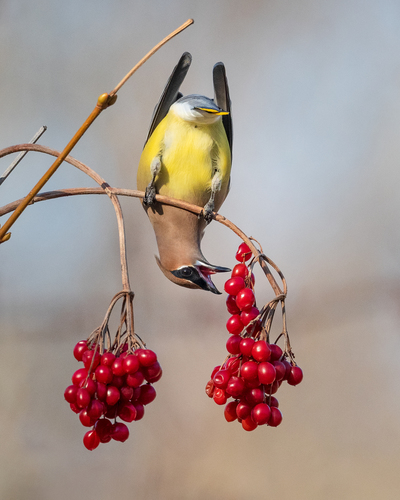
The cedar waxwing is a member of the family Bombycillidae or waxwing family of passerine birds. It is a medium-sized bird that is mainly brown, gray, and yellow. Some of the wing feathers have red tips which resemble sealing wax, giving these birds their common name. It is a native of North and Central America, breeding in open wooded areas in southern Canada and wintering in the southern half of the United States, Central America, and the far northwest of South America. Its diet includes cedar cones, fruit, holly berries, and insects. The cedar waxwing is listed as least concern on the IUCN Red List.
π Taxonomy
The three species of waxwings were moved to their own genus, Bombycilla, by Louis Pierre Vieillot in 1808.
Bombycilla is Vieillot's attempt at Latin for "silktail", translating the German name SeidenschwΓ€nze. Vieillot thought that motacilla, Latin for wagtails, was derived from mota for "move" and cilla, which he thought meant "tail"; however, Motacilla actually combines motacis, a mover, with the diminutive suffix -illa. He then combined this "cilla" with the Latin bombyx, meaning silk.
π Vocalizations
The two common calls of these birds include very high-pitched whistles and buzzy trills about a half second long often, represented as see or sree. Its call can also be described as "high, thin, whistles." They call often, especially in flight.
π Distribution and habitat
tree]]
Their preferred habitat consists of trees at the edge of wooded areas or forests, especially those that provide access to berry sources as well as water. They are frequently seen in fruiting trees. with erratic winter movements, though most of the population migrates farther south into the United States and beyond, sometimes reaching as far as northern South America. They will move in huge numbers if berry supplies are low. Rare vagrants have reached western Europe, and there are two recorded occurrences of cedar waxwing sightings in Great Britain. Individual Bohemian waxwings will occasionally join large winter flocks of cedar waxwings.
π Behavior and ecology
Cedar waxwings are sociable, seen in flocks year round. They are non-territorial birds and "will often groom each other." They move from place to place depending on where they can find good sources of berries.
π Breeding
]]
The mating season for this bird begins around the end of spring and runs through to late summer. The male will do a "hopping dance" for the female. If she is interested, she'll hop back. During courtship, the male and female will sit together and pass small objects back and forth, such as flower petals or an insect. Mating pairs will sometimes rub their beaks together. The nest is a loose, open cup built with grass and twigs, lined with softer materials, and supported by a tree branch averaging above ground but, at times, considerably higher. It takes around five or six days for the female waxwing to build the nest, and it can take up to 2,500 trips back and forth. Sometimes, the female will steal nest material from other species' nests. The outer diameter of the nest is approximately . Usually, 5 or 6 eggs are laid, and the female incubates them for 11 to 13 days. The eggs are oval shaped with a smooth surface and very little, if any, gloss. The egg shells are of various shades of light or bluish grey with irregular, dark brown spots or greyish-brown splotches. Both parents build the nest and feed the young. Typically, there are one or two broods during the mating season. Young leave the nest about 14 to 18 days after hatching.
π Digestion
Cedar waxwings are a highly specialized frugivorous species, exhibiting almost full reliance on sugary fruits, unlike other fruit-eating passerines that exhibit only opportunistic frugivory when other food sources are in poor supply. Their efficient digestion of fruits containing simple sugars allows them to live on fruit alone, while other fruit-eating passerines found subsisting on fruit alone to be fatal. Reliance on primarily fruit alone occurs until fruit cessation in the spring when the birds start to feed on insects and flowers. In such cases, intestinal analysis revealed stomach contents of 84% fruit, 12% invertebrates, and 4% flowers, among 212 individuals involved in the study.
Despite the advantage of frugivorous specialization, they did lose body mass when experimentally fed one fruit type alone (Viburnum opulus), but gained body mass when fed pollen-rich catkins as well (Populus deltoides). Many fleshy fruits are energy-rich. However, they are deficient in the nitrogen (protein) levels required by cedar waxwings (1.7%). The nutrient deficit of sugary fruits alone is mitigated through flower and subsequent pollen consumption that is rich in protein. This response to food diversity illustrates the importance of multiple food sources in order to acquire the precise nutrients needed to maintain bodily metabolism.
Even though waxwings displayed efficient rates of digestion, they also exhibited relatively quick passage rates that are indicative of their low utilization efficiency (36.5%), as fruit skins appeared undigested in feces. The low utilization efficiency of fruits digested by cedar waxwings not only indicates the necessity of consuming large quantities of fruits, but viable seeds found in feces also suggest the important role they may play in seed dispersal. A positive correlation between seed defecation and fruit consumption is seen as rates of ingestion increased only when rates of seed processing also increased. This allows them to still exhibit relatively high digestion efficiencies in spite of the gut processing limitations that are associated with eating seeds. The digestive strategies employed by these birds allow them to subsist on a predominately fruit-based diet.
π Conservation status
Waxwings are evaluated as Least Concern on the IUCN Red List of Endangered Species. Populations are increasing in their range partly because fields are being allowed to grow into forests and shrublands, and fruiting trees like mountain ash are being planted as landscaping. On the other hand, cedar waxwings do sometimes crash into windows and get hit by cars while foraging along roadsides.