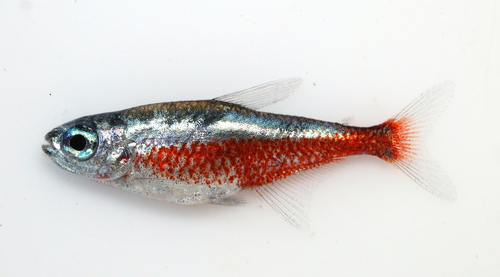
The cardinal tetra is a species of freshwater fish of the family Acestrorhamphidae, the American characins, of order Characiformes. It is native to the upper Orinoco and Negro Rivers in South America. Growing to about 3 cm (1.2 in) in total length, the cardinal tetra has the striking iridescent blue line characteristic of the genus Paracheirodon laterally bisecting the fish, with the body below this line being vivid red in color, hence the name "cardinal tetra". The cardinal tetra's appearance is similar to that of the closely related neon tetra, with which it is often confused; the neon's red coloration extends only about halfway to the nose, and the neon's blue stripe is a less vibrant blue.
📌 Taxonomy
American ichthyologist Leonard Peter Schultz described the cardinal tetra in 1956 as Cheirodon axelrodi. The specific epithet honors ichthyologist Herbert R. Axelrod. Hyphessobrycon cardinalis is an obsolete synonym. The fish's common name, cardinal tetra, refers to the brilliant red coloration, reminiscent of a cardinal's robes. P. axelrodi is also often called the red neon tetra.
The species exists in a number of different color forms or phenotypes. A "gold" and "silver-blonde" form exists in the Rio Negro drainage that has less blue in the longitudinal stripe. The normal form from the Rio Negro drainage has a blue stripe, which extends to the adipose fin, while the Orinoco drainage phenotype has a stripe that stops posterior to the adipose. The Orinoco phenotype may represent a subspecies of P. axelrodi.
📌 Distribution and habitat
Cardinal tetras are found in the upper Orinoco of Colombia and Venezuela, as well as the upper Rio Negro of Brazil.
📌 Ecology and behavior
===Diet===
The cardinal tetra forages in areas of slow-moving, shallow water. It is predominantly predatory, feeding on tiny animals found on underwater plants, roots, and leaf litter. Creatures commonly eaten include the larvae of chironomid midges and microcrustaceans such as water fleas (Cladocera) of the families Moinidae, Macrotrichidae, and Daphniidae, and copepods of the family Harpacticidae. Other organisms eaten include other fly larvae, insect eggs, rotifers, and testate amoebae.
📌 Reproduction
In the wild, the cardinal tetra swims upstream in large numbers to parts of its native river habitat completely enclosed above by rainforest canopy. Such waters are subject to heavy shading by the rainforest trees, and virtually no sunlight reaches them. Here, the fishes spawn in large aggregations. If the fishes are ready to spawn, the male pursues the female into fine-leaved plants; her fuller outline, which usually indicates the presence of ripe eggs within her reproductive tract, should be readily apparent at this point. If the female is ready, she allows the male to swim alongside her, and together, the pair release eggs and sperm.
📌 Lifespan
The fish might also be effectively an annual species with a lifespan of just a single year in nature. It lives for several years in captivity. For those seeking to breed them in the aquarium, the best way to do so is by mimicking the same natural setup. A study conducted in Manaus, Brazil, subjected cardinal tetras to adverse water conditions for 96 hours. The fish perished at a low temperature of and a high of , and pH below 2.9 or above 8.8.
📌 In the aquarium trade
]]
An entire industry is in place in Barcelos on the banks of Brazil's Rio Negro in which the local population catches fish for the aquarium trade. The cardinal fishery here is highly valued by the local people who act as stewards for the environment. The local people may not become involved in potentially environmentally damaging activities, such as deforestation, because they can make a sustainable living from the fishery.