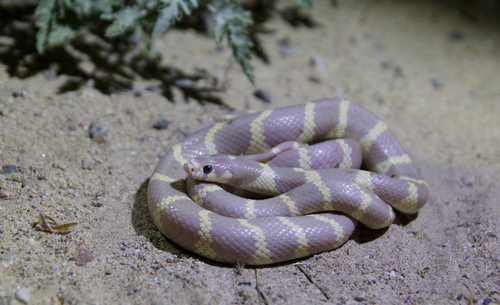
The California kingsnake is a nonvenomous colubrid snake endemic to the western United States and northern Mexico, and is found in a variety of habitats. Due to ease of care and a wide range of color variations, the California kingsnake is one of the most popular snakes in captivity.
๐ Range and habitat
The California kingsnake is widespread along the West Coast of North America to elevations of approximately in the Tehachapi Mountains and to over in the southeastern Sierra Nevada Mountains. This species lives in a wide variety of habitats, including woodland chaparral, grassland, deserts, marshes, and even suburban areas. These snakes live in Oregon, California, Nevada, Utah, Arizona, southwestern Colorado, northwestern New Mexico, and northwestern Mexico. In Arizona, they intergrade with the desert kingsnake (Lampropeltis splendida) and the Mexican black kingsnake (Lampropeltis getula nigrita).
The species has also become invasive on the Spanish island of Gran Canaria. In 2014 the population there had reached an estimated 20,000 individuals.
๐ Behavior
The California kingsnake is cathemeral; it may be active day or night depending on ambient temperatures. When disturbed, California kingsnakes often coil their bodies into a ball to hide their heads, hiss, and rattle their tails, which can produce a sound somewhat resembling that of a rattlesnake. When they are nervous they tend to twitch their tails. They are considered harmless to humans, but if handled it is common for this species to bite, as well as to excrete musk and fecal contents from their cloaca. It is also common for this musky odor to be excreted when the snake feels threatened.
California Kingsnakes, along with other reptiles and amphibians in winter months, brumate as a means of conserving energy and to regulate body temperatures during cold temperatures. During brumation, California king snakes neither eat nor excrete feces, but they occasionally awake to drink water. Also in efforts to regulate body temperatures, California kingsnakes tend to burrow underneath vegetation or other coverings to cool down, and to bask in the sun to increase their internal temperatures.
๐ Reproduction
The California kingsnake is an oviparous internal fertilization animal, meaning it lays eggs, as opposed to giving live birth like some other snakes. Courtship for this kingsnake begins in the spring usually sometime after their hibernation or first shedding in preparation the female will have chosen a suitable location. The typical clutch size is five to 12 eggs with an average of nine,
๐ In captivity
The California kingsnake is one of the most popular pet reptiles due to its ease of care, attractive appearance and docile demeanor. Due to natural color and pattern variability between individual snakes, snake enthusiasts have selectively bred for a variety of color patterns known as "morphs". Wild-type California kingsnakes are technically illegal to sell without special permits in their home state of California. These increased restrictions are due to a law that prohibits sale of native California species within state lines; albino morphs are exempt from this law. The law is loosely enforced.
In the wild, kingsnakes are able to thermoregulate, migrating to warmer areas if needed due to their cold bloodedness. However, in captivity, kingsnakes are not able to freely change locations so most owners use heat lamps, heating pads, and regulate temperatures in their homes to ensure the health of the kingsnake. Temperatures between 70 ยฐF and 85 ยฐF are adequate for kingsnakes in captivity.
๐ Two-headed Snake
A two-headed California kingsnake raised to the age of seventeen at the Arizona State University reptile collection has gained some notoriety as a rare example of serpentine polycephaly. It was born in the wild within the vicinity of the South Mountain Park and Reserve in Arizona, until it was discovered beneath the toilet seat of a public restroom in the foothills of the park and relocated to ASU. This mutation was most likely the case of failed cell division during the process of producing twins.