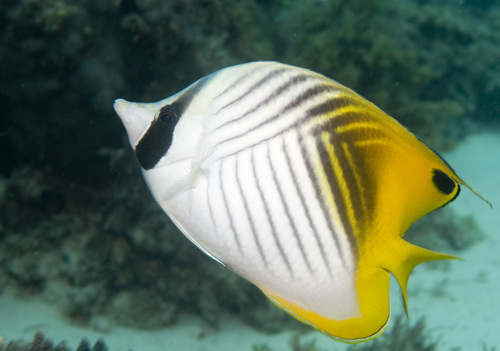
The butterflyfish are a group of conspicuous tropical marine fish of the family Chaetodontidae; the bannerfish and coralfish are also included in this group. The approximately 129 species in 12 genera are found mostly on the reefs of the Atlantic, Indian, and Pacific Oceans. A number of species pairs occur in the Indian and Pacific Oceans, members of the huge genus Chaetodon.
Butterflyfish look like smaller versions of angelfish (Pomacanthidae), but unlike these, lack preopercle spines at the gill covers. Some members of the genus Heniochus resemble the Moorish idol (Zanclus cornutus) of the monotypic Zanclidae. All three families belong to the order Acanthuriformes and share a similar habitat.
== Description and ecology ==
Butterflyfish mostly range from 12 to 22 cm (4.7 to 8.7 in) in length. The largest species, the lined butterflyfish and the saddle butterflyfish, C. ephippium, grow to 30 cm (12 in). The common name references the brightly coloured and strikingly patterned bodies of many species, bearing shades of black, white, blue, red, orange, and yellow. Other species are dull in colour. Butterflyfish are a boundless, different group of marine percoids with delegates on practically all coral reef frameworks and in every single tropical ocean. Their bright and color patterns have drawn in much consideration, creating an abundance of data about their conduct and environment. Many have eyespots on their flanks and dark bands across their eyes, not unlike the patterns seen on butterfly wings. Their deep, laterally narrow bodies are easily noticed through the profusion of reef life. The conspicuous coloration of butterflyfish may be intended for interspecies communication. Butterflyfish have uninterrupted dorsal fins with tail fins that may be rounded or truncated, but are never forked.
Generally diurnal and frequenting waters less than 18 m (59 ft) deep (though some species descend to 180 m (590 ft), butterflyfish stick to particular home ranges. These corallivores are especially territorial, forming pairs and staking claim to a specific coral head. Contrastingly, the zooplankton feeders form large conspecific groups. By night, butterflyfish hide in reef crevices and exhibit markedly different coloration.
Their coloration also makes them popular aquarium fish. However, most species feed on coral polyps and sea anemones. Balancing the relative populations of prey and predator is complex, leading hobby aquarists to focus on the few generalists and specialist zooplankton feeders.
Butterflyfish are pelagic spawners; that is, they release many buoyant eggs into the water, which become part of the plankton, floating with the currents until hatching. The fry go through a tholichthys stage, wherein the body of the postlarval fish is covered in large, bony plates extending from the head. They lose their bony plates as they mature. Only one other family of fish, the scats (Scatophagidae) express such an armored stage.
== Taxonomy, systematics and evolution ==
The Chaetodontidae can be, but are not usually, divided into two lineages that arguably are subfamilies. The subfamily name Chaetodontinae is a little-used leftover from the period when the Pomacanthidae and Chaetodontidae were united under the latter name as a single family. Hence, Chaetodontinae is today considered a junior synonym of Chaetodontidae. In any case, one lineage of Chaetodontidae (in the modern sense) contains the "typical" butterflyfish around Chaetodon, while the other unites the bannerfish and coralfish genera. As the Perciformes are highly paraphyletic, the precise relationships of the Chaetodontidae as a whole are badly resolved.
Chaetodontidae is classified within the suborder Percoidei by the 5th edition of Fishes of the World, but they are placed in an unnamed clade which sits outside the superfamily Percoidea. This clade contains 7 families which appear to have some relationship to Acanthuroidei, Monodactylidae, and Priacanthidae. Other authorities have paced the family in the order Chaetodontiformes alongside the family Leiognathidae. Presently, based on the most recent phylogenetic analyses, Eschmeyer's Catalog of Fishes places it in the large, diverse order Acanthuriformes. Molecular analyses suggest that the Chaetodontidae shared a common ancestor with the Scatophagidae and Pomacanthidae that lived during the Early Eocene (54 Ma).
Before DNA sequencing, the taxonomy was confused about whether to treat these as species or subspecies. Also, numerous subgenera have been proposed for splitting out of Chaetodon, and it is becoming clear how to subdivide the genus if that is desired.
=== Fossil record ===
The fossil record of this group is disputed and marginal. Their restriction to coral reefs means their carcasses are liable to be dispersed by scavengers, overgrown by corals, and any that do fossilize will not long survive erosion. Many Eocene-aged fish such as Pygaeus have been variously referred to Chaetodontidae in the past; if used for calibration, it can be deduced that most living genera were probably distinct by the end of the Paleogene 23 Mya. However, these Eocene genera cannot be reliably referred to Chaetodontidae.
The earliest confirmed fossil specimens of Chaetodontidae are an indeterminate larval specimen from Frauenweiler, Germany, two tholichthys specimens from the Menilite Formation of Poland, as well as the extinct species Chaetodon (Blumchaetodon) wattsi from Italy; all date to the Early Oligocene. The occurrence of the first confirmed butterflyfish in the Early Oligocene is supported by molecular phylogenies indicating that the family may have arose during the Late Eocene.
=== Genera ===
The family can be divided in two groups (the bannerfish-coralfish lineage and the butterflyfish lineage) considered distinct subfamilies by Eschmeyer's Catalog of Fishes:
Family Chaetodontidae Rafinesque, 1815
Subfamily Heniochinae Kaup, 1860 (bannerfishes and coralfishes)
Amphichaetodon Burgess, 1978
Coradion Kaup, 1860
Chelmon Cloquet, 1817
Chelmonops Bleeker, 1876
Forcipiger Jordan & McGregor, 1898
Hemitaurichthys Bleeker, 1876
Heniochus Cuvier, 1816
Johnrandallia Nalbant, 1974
Subfamily Chaetodontinae Rafinesque, 1815
Chaetodon Linnaeus, 1758
Prognathodes Gill, 1862
Subfamily incertae sedis
Parachaetodon Bleeker, 1874
Roa Jordan, 1923
=== Timeline ===
== Gallery ==
== Further reading ==
Pratchett, Morgan S. & Berumen, Michael L. & Kapoor, B.G. [Editors] : Biology of Butterflyfishes. CRC Press, 2014. ISBN 978-1-4665-8290-3
== References ==
General
Fessler, Jennifer L. & Westneat, Mark W. (2007): Molecular phylogenetics of the butterflyfishes (Chaetodontidae): Taxonomy and biogeography of a global coral reef fish family. Mol. Phylogenet. Evol. 45(1): 50β68. doi:10.1016/j.ympev.2007.05.018 (HTML abstract)
FishBase [2008]: Family Chaetodontidae β Butterflyfishes. Retrieved 2008-SEP-02.
Hsu, Kui-Ching; Chen, Jeng-Ping & Shao, Kwang-Tsao (2007): Molecular phylogeny of Chaetodon (Teleostei: Chaetodontidae) in the Indo-West Pacific: evolution in geminate species pairs and species groups. Raffles Bulletin of Zoology Supplement 14: 77β86. PDF fulltext Archived 2007-08-11 at the Wayback Machine
Sepkoski, Jack (2002): [Chaetodon]. In: A compendium of fossil marine animal genera. Bulletins of American Paleontology 364: 560. HTML database excerpt
Specific
π Habitat & Distribution
Description and ecology
A school of false Moorish idols, Heniochus diphreutes
Butterflyfish mostly range from 12 to 22 cm (4.7 to 8.7 in) in length. The largest species, the lined butterflyfish and the saddle butterflyfish, C. ephippium, grow to 30 cm (12 in). The common name references the brightly coloured and strikingly patterned bodies of many species, bearing shades of black, white, blue, red, orange, and yellow. Other species are dull in colour. Butterflyfish are a boundless, different group of marine percoids with delegates on practically all coral reef frameworks and in every single tropical ocean. Their bright and color patterns have drawn in much consideration, creating an abundance of data about their conduct and environment.[1] Many have eyespots on their flanks and dark bands across their eyes, not unlike the patterns seen on butterfly wings.[2] Their deep, laterally narrow bodies are easily noticed through the profusion of reef life. The conspicuous coloration of butterflyfish may be intended for interspecies communication. Butterflyfish have uninterrupted dorsal fins with tail fins that may be rounded or truncated, but are never forked.
Generally diurnal and frequenting waters less than 18 m (59 ft) deep (though some species descend to 180 m (590 ft), butterflyfish stick to particular home ranges. These corallivores are especially territorial, forming pairs and staking claim to a specific coral head. Contrastingly, the zooplankton feeders form large conspecific groups. By night, butterflyfish hide in reef crevices and exhibit markedly different coloration.
Their coloration also makes them popular aquarium fish. However, most species feed on coral polyps and sea anemones. Balancing the relative populations of prey and predator is complex, leading hobby aquarists to focus on the few generalists and specialist zooplankton feeders.
Butterflyfish are pelagic spawners; that is, they release many buoyant eggs into the water, which become part of the plankton, floating with the currents until hatching. The fry go through a tholichthys stage, wherein the body of the postlarval fish is covered in large, bony plates extending from the head. They lose their bony plates as they mature.[2] Only one other family of fish, the scats (Scatophagidae) express such an armored stage.
^ Smith, W. (2003). The evolution of the laterophysic connection with a revised phylogeny and taxonomy of butterflyfishes (Teleostei: Chaetodontidae). Cladistics the International Journal of the Willi Hennig Society., 19(4), 287β306. https://doi.org/10.1016/S0748-3007(03)00070-7
^ a b
.mw-parser-output cite.citation{font-style:inherit;word-wrap:break-word}.mw-parser-output .citation q{quotes:"\"""\"""'""'"}.mw-parser-output .citation:target{background-color:rgba(0,127,255,0.133)}.mw-parser-output .id-lock-free.id-lock-free a{background:url("//upload.wikimedia.org/wikipedia/commons/6/65/Lock-green.svg")right 0.1em center/9px no-repeat}.mw-parser-output .id-lock-limited.id-lock-limited a,.mw-parser-output .id-lock-registration.id-lock-registration a{background:url("//upload.wikimedia.org/wikipedia/commons/d/d6/Lock-gray-alt-2.svg")right 0.1em center/9px no-repeat}.mw-parser-output .id-lock-subscription.id-lock-subscription a{background:url("//upload.wikimedia.org/wikipedia/commons/a/aa/Lock-red-alt-2.svg")right 0.1em center/9px no-repeat}.mw-parser-output .cs1-ws-icon a{background:url("//upload.wikimedia.org/wikipedia/commons/4/4c/Wikisource-logo.svg")right 0.1em center/12px no-repeat}body:not(.skin-timeless):not(.skin-minerva) .mw-parser-output .id-lock-free a,body:not(.skin-timeless):not(.skin-minerva) .mw-parser-output .id-lock-limited a,body:not(.skin-timeless):not(.skin-minerva) .mw-parser-output .id-lock-registration a,body:not(.skin-timeless):not(.skin-minerva) .mw-parser-output .id-lock-subscription a,body:not(.skin-timeless):not(.skin-minerva) .mw-parser-output .cs1-ws-icon a{background-size:contain;padding:0 1em 0 0}.mw-parser-output .cs1-code{color:inherit;background:inherit;border:none;padding:inherit}.mw-parser-output .cs1-hidden-error{display:none;color:var(--color-error,#d33)}.mw-parser-output .cs1-visible-error{color:var(--color-error,#d33)}.mw-parser-output .cs1-maint{display:none;color:#085;margin-left:0.3em}.mw-parser-output .cs1-kern-left{padding-left:0.2em}.mw-parser-output .cs1-kern-right{padding-right:0.2em}.mw-parser-output .citation .mw-selflink{font-weight:inherit}@media screen{.mw-parser-output .cs1-format{font-size:95%}html.skin-theme-clientpref-night .mw-parser-output .cs1-maint{color:#18911f}}@media screen and (prefers-color-scheme:dark){html.skin-theme-clientpref-os .mw-parser-output .cs1-maint{color:#18911f}}Johnson, G.D.; Gill, A.C. (1998). Paxton, J.R.; Eschmeyer, W.N. (eds.). Encyclopedia of Fishes. San Diego: Academic Press. p. 184. ISBN 978-0-12-547665-2.
π Description and ecology
of false Moorish idols, Heniochus diphreutes|alt=Fish bearing two strong black stripes separated by one strong white stripe with long white tendril as dorsal fin]]
Butterflyfish mostly range from in length. The largest species, the lined butterflyfish and the saddle butterflyfish, C. ephippium, grow to . The common name references the brightly coloured and strikingly patterned bodies of many species, bearing shades of black, white, blue, red, orange, and yellow. Other species are dull in colour. Butterflyfish are a boundless, different group of marine percoids with delegates on practically all coral reef frameworks and in every single tropical ocean. Their bright and color patterns have drawn in much consideration, creating an abundance of data about their conduct and environment. Many have eyespots on their flanks and dark bands across their eyes, not unlike the patterns seen on butterfly wings. Their deep, laterally narrow bodies are easily noticed through the profusion of reef life. The conspicuous coloration of butterflyfish may be intended for interspecies communication. Butterflyfish have uninterrupted dorsal fins with tail fins that may be rounded or truncated, but are never forked.
Generally diurnal and frequenting waters less than deep (though some species descend to , butterflyfish stick to particular home ranges. These corallivores are especially territorial, forming pairs and staking claim to a specific coral head. Contrastingly, the zooplankton feeders form large conspecific groups. By night, butterflyfish hide in reef crevices and exhibit markedly different coloration.
Their coloration also makes them popular aquarium fish. However, most species feed on coral polyps and sea anemones. Balancing the relative populations of prey and predator is complex, leading hobby aquarists to focus on the few generalists and specialist zooplankton feeders.
Butterflyfish are pelagic spawners; that is, they release many buoyant eggs into the water, which become part of the plankton, floating with the currents until hatching. The fry go through a tholichthys stage, wherein the body of the postlarval fish is covered in large, bony plates extending from the head. They lose their bony plates as they mature. Only one other family of fish, the scats (Scatophagidae) express such an armored stage.
π Taxonomy, systematics and evolution
The Chaetodontidae can be, but are not usually, divided into two lineages that arguably are subfamilies. The subfamily name Chaetodontinae is a little-used leftover from the period when the Pomacanthidae and Chaetodontidae were united under the latter name as a single family. Hence, Chaetodontinae is today considered a junior synonym of Chaetodontidae. In any case, one lineage of Chaetodontidae (in the modern sense) contains the "typical" butterflyfish around Chaetodon, while the other unites the bannerfish and coralfish genera. As the Perciformes are highly paraphyletic, the precise relationships of the Chaetodontidae as a whole are badly resolved.
Chaetodontidae is classified within the suborder Percoidei by the 5th edition of Fishes of the World, but they are placed in an unnamed clade which sits outside the superfamily Percoidea. This clade contains 7 families which appear to have some relationship to Acanthuroidei, Monodactylidae, and Priacanthidae. Other authorities have paced the family in the order Chaetodontiformes alongside the family Leiognathidae. Presently, based on the most recent phylogenetic analyses, Eschmeyer's Catalog of Fishes places it in the large, diverse order Acanthuriformes. Molecular analyses suggest that the Chaetodontidae shared a common ancestor with the Scatophagidae and Pomacanthidae that lived during the Early Eocene (54 Ma).
Before DNA sequencing, the taxonomy was confused about whether to treat these as species or subspecies. Also, numerous subgenera have been proposed for splitting out of Chaetodon, and it is becoming clear how to subdivide the genus if that is desired.
π Fossil record
The fossil record of this group is disputed and marginal. Their restriction to coral reefs means their carcasses are liable to be dispersed by scavengers, overgrown by corals, and any that do fossilize will not long survive erosion. Many Eocene-aged fish such as Pygaeus have been variously referred to Chaetodontidae in the past; if used for calibration, it can be deduced that most living genera were probably distinct by the end of the Paleogene 23 Mya. However, these Eocene genera cannot be reliably referred to Chaetodontidae.
The earliest confirmed fossil specimens of Chaetodontidae are an indeterminate larval specimen from Frauenweiler, Germany, two tholichthys specimens from the Menilite Formation of Poland, as well as the extinct species Chaetodon (Blumchaetodon) wattsi from Italy; all date to the Early Oligocene. The occurrence of the first confirmed butterflyfish in the Early Oligocene is supported by molecular phylogenies indicating that the family may have arose during the Late Eocene.
π Genera
The family can be divided in two groups (the bannerfish-coralfish lineage and the butterflyfish lineage) considered distinct subfamilies by Eschmeyer's Catalog of Fishes:
* Family Chaetodontidae Rafinesque, 1815
** Subfamily Heniochinae Kaup, 1860 (bannerfishes and coralfishes)
*** Amphichaetodon Burgess, 1978
*** Coradion Kaup, 1860
*** Chelmon Cloquet, 1817
*** Chelmonops Bleeker, 1876
*** Forcipiger Jordan & McGregor, 1898
*** Hemitaurichthys Bleeker, 1876
*** Heniochus Cuvier, 1816
*** Johnrandallia Nalbant, 1974
** Subfamily Chaetodontinae Rafinesque, 1815
*** Chaetodon Linnaeus, 1758
*** Prognathodes Gill, 1862
** Subfamily incertae sedis
*** Parachaetodon Bleeker, 1874
*** Roa Jordan, 1923
π Timeline
ImageSize = width:1000px height:auto barincrement:15px
PlotArea = left:10px bottom:50px top:10px right:10px
Period = from:-66 till:10
TimeAxis = orientation:horizontal
ScaleMajor = unit:year increment:5 start:-66
ScaleMinor = unit:year increment:1 start:-66
TimeAxis = orientation:hor
AlignBars = justify
Colors =
#legends
id:CAR value:claret
id:ANK value:rgb(0.4,0.3,0.196)
id:HER value:teal
id:HAD value:green
id:OMN value:blue
id:black value:black
id:white value:white
id:cenozoic value:rgb(0.54,0.54,0.258)
id:paleogene value:rgb(0.99,0.6,0.32)
id:paleocene value:rgb(0.99,0.65,0.37)
id:eocene value:rgb(0.99,0.71,0.42)
id:oligocene value:rgb(0.99,0.75,0.48)
id:neogene value:rgb(0.999999,0.9,0.1)
id:miocene value:rgb(0.999999,0.999999,0)
id:pliocene value:rgb(0.97,0.98,0.68)
id:quaternary value:rgb(0.98,0.98,0.5)
id:pleistocene value:rgb(0.999999,0.95,0.68)
id:holocene value:rgb(0.999,0.95,0.88)
BarData=
bar:eratop
bar:space
bar:periodtop
bar:space
bar:NAM1
bar:NAM2
bar:space
bar:period
bar:space
bar:era
PlotData=
align:center textcolor:black fontsize:M mark:(line,black) width:25
shift:(7,-4)
bar:periodtop
from: -66 till: -55.8 color:paleocene text:Paleocene
from: -55.8 till: -33.9 color:eocene text:Eocene
from: -33.9 till: -23.03 color:oligocene text:Oligocene
from: -23.03 till: -5.332 color:miocene text:Miocene
from: -5.332 till: -2.588 color:pliocene text:Plio.
from: -2.588 till: -0.0117 color:pleistocene text:Pleist.
from: -0.0117 till: 0 color:holocene text:H.
bar:eratop
from: -66 till: -23.03 color:paleogene text:Paleogene
from: -23.03 till: -2.588 color:neogene text:Neogene
from: -2.588 till: 0 color:quaternary text:Q.
PlotData=
align:left fontsize:M mark:(line,white) width:5 anchor:till align:left
color:oligocene bar:NAM1 from: -28.4 till: 0 text: Chaetodon
color:miocene bar:NAM2 from: -23.03 till: 0 text: Chelmon
PlotData=
align:center textcolor:black fontsize:M mark:(line,black) width:25
bar:period
from: -66 till: -55.8 color:paleocene text:Paleocene
from: -55.8 till: -33.9 color:eocene text:Eocene
from: -33.9 till: -23.03 color:oligocene text:Oligocene
from: -23.03 till: -5.332 color:miocene text:Miocene
from: -5.332 till: -2.588 color:pliocene text:Plio.
from: -2.588 till: -0.0117 color:pleistocene text:Pleist.
from: -0.0117 till: 0 color:holocene text:H.
bar:era
from: -66 till: -23.03 color:paleogene text:Paleogene
from: -23.03 till: -2.588 color:neogene text:Neogene
from: -2.588 till: 0 color:quaternary text:Q.