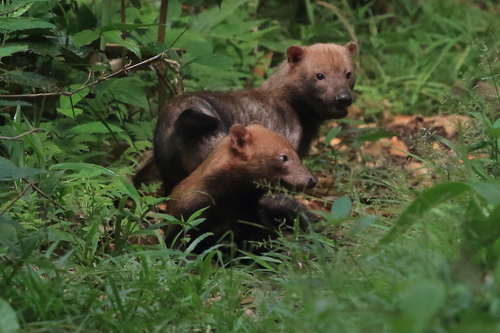
The bush dog is a canine found in Central and South America. In spite of its extensive range, it is very rare in most areas except in Suriname, Guyana and Peru; it was first described by Peter Wilhelm Lund from fossils in Brazilian caves and was believed to be extinct.
🛡️ Conservation Status
near threatened
nt
📌 Genetics
Speothos has a diploid chromosome number of 74. This makes it unable to produce fertile hybrids with other canid species.
📌 Distribution and habitat
Bush dogs are found from Costa Rica in Central America and through much of South America east of the Andes, as far south as central Bolivia, Paraguay, and southern Brazil. They primarily inhabit lowland forests up to elevation, New, repeated observations of bush dog groups have been recorded in east-central (Barbilla National Park) and south-eastern (La Amistad International Park) Costa Rica, and a substantial portion of the Talamanca Mountains up to to the north-northwest and at elevations up to . Very recent fossils dating from 300 AD to 900 AD (the Late Ceramic Age) have been found in the Manzanilla site on the eastern coast of Trinidad.
There are three recognised subspecies:
📌 Behavior
Bush dogs are carnivores and hunt during the day. Their typical prey are pacas, agoutis, acouchis and capybaras, all large rodents. Although they can hunt alone, bush dogs are usually found in small packs. When hunting paca, part of the pack chases it on land and part wait for it in the water, where it often retreats. Although they can hunt such large prey in groups, bush dogs generally prefer smaller prey that does not pose a high risk of injury; a lone bush dog may suffer broken canine teeth attempting subdue a paca. Packmates keep in contact with frequent whines, perhaps because visibility is poor in the undergrowth where they typically hunt. While eating large prey, parents position themselves at either ends of the animal, making it easier for the pups to disembowel it.
📌 Reproduction
Bush dogs mate throughout the year; oestrus lasts up to twelve days and occurs every 15 to 44 days. Like many other canids, bush dog mating includes a copulatory tie, during which the animals are locked together.
Gestation lasts from 65 to 83 days and normally results in the birth of a litter of three to six pups, although larger litters of up to 10 have been reported. They can live for up to 10 years in captivity.
📌 Conservation
Bush dogs are among the least-studied canines, and their conservation efforts are still in early stages. Due to their rarity, when bush dog bones were discovered in a cave in 1839, paleontologist Peter Wilhelm Lund mistakenly believed they were extinct. Living individuals were later found.
Research shows they are generalists capable of thriving in diverse habitats. However, conservation is challenging due to their dense habitats and sparse, scattered populations, making them difficult to locate. Bush dogs require large, undisturbed territories to support their pack-based lifestyle, and they are notably shy.
The International Union for Conservation of Nature (IUCN) lists bush dogs as Near Threatened due to a population decline of approximately 20–25% over the past 12 years. The main threats include habitat loss (particularly from deforestation for wood, cattle farming, and palm oil production), loss of prey due to human hunting, and diseases contracted from domestic dogs. Habitat loss, especially through Amazonian clear-cutting, is the most significant threat, while disease transmission from unvaccinated domestic dogs has also become a growing concern due to human encroachment.
Hunting bush dogs is illegal in most of their range, including countries like Colombia, Ecuador, Brazil, French Guiana, Paraguay, Peru, Bolivia, Panama, and Argentina. However, Guyana and Suriname lack explicit hunting bans for bush dogs, and many countries in the bush dog's range have limited resources to enforce existing wildlife laws.
To better understand and protect bush dogs, scientists are experimenting with various monitoring methods. Traditional camera traps have proven ineffective due to bush dogs' elusive nature, so researchers are now using scent-detection dogs to locate bush dog burrows. This approach aims to provide valuable insights into their habitat use, prey preferences, and pack dynamics, including when cubs leave the pack. Protected areas such as the Yasuni Biosphere Reserve may support stable populations.
In a positive development, bush dogs were recently captured on camera traps in Costa Rica's Talamanca Mountains in 2020, suggesting they may be expanding their range northward and into higher elevations. This could indicate that with dedicated conservation efforts, bush dogs may stabilize or even increase in numbers.