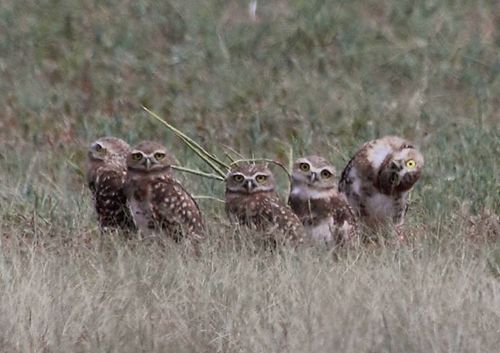
The burrowing owl, also called the shoco, is a small, long-legged, primarily terrestrial—though not flightless—species of owl native to the open landscapes of North and South America. They are typically found in grasslands, rangelands, agricultural areas, deserts, or any other open, dry area with low vegetation. They nest and roost in burrows, and, despite their common name, do not often construct these dwellings themselves, rather repurposing disused burrows or tunnels previously excavated and inhabited by other species, such as American badgers, foxes, ground squirrels or prairie dogs, among others.
📌 Taxonomy
The burrowing owl was formally described by Spanish naturalist Juan Ignacio Molina in 1782 under the binomial name Strix cunicularia from a specimen collected in Chile. The specific epithet is from the Latin cunicularius, meaning "burrower" or "miner". The burrowing owl is now placed in the genus Athene which was introduced by German zoologist Friedrich Boie in 1822.
The burrowing owl is sometimes classified in the monotypic genus Speotyto (based on an overall unique morphology and karyotype). Osteology and DNA sequence data, though, suggests that the burrowing owl is a terrestrial member of the little owls genus (Athene), thus it is placed in that group today by most authorities.
A considerable number of subspecies have been described, though they differ little in appearance; the taxonomic validity of several is still up for debate.
* A. c. grallaria (Temminck, 1822): Brazilian burrowing owl – Central and eastern Brazil
*†A. c. guadeloupensis (Ridgway, 1874): Guadeloupe burrowing owl – formerly Guadeloupe and Marie-Galante islands; extinct (circa 1890)
* A. c. guantanamensis (Garrido, 2001): Cuban burrowing owl – Cuba and Isla de la Juventud
* A. c. hypugaea (Bonaparte, 1825): western burrowing owl – Southern Canada through the Great Plains, south to Central America; listed as Apparently Secure
* A. c. juninensis (Berlepsch & Stolzmann, 1902): south Andean burrowing owl – Andes Mountains and foothills from central Perú to northwestern Argentina (may include A. c. punensis)
* A. c. minor (Cory, 1918): Guyanese burrowing owl – southern Guyana and Roraima state (Brazil)
* A. c. nanodes (Berlepsch & Stolzmann, 1892): Southwest Peruvian burrowing owl – southwestern Perú (may include A. c. intermedia)
* A. c. pichinchae (Boetticher, 1929): West Ecuadorean burrowing owl – western Ecuador
* A. c. rostrata (C. H. Townsend, 1890): Revillagigedo burrowing owl – Clarion and Revillagigedo Islands
* A. c. tolimae (Stone, 1899): West Colombian burrowing owl – Western Colombia (may include A. c. carrikeri)
* A. c. troglodytes (Wetmore & Swales, 1931): Hispaniolan burrowing owl – Hispaniola (Haiti and the Dominican Republic) and surrounding islands (Gonâve, Beata Island)
includes A. c. partridgei (Olrog, 1976): Corrientes burrowing owl – Corrientes Province, Argentina (probably not distinct from A. c. cunicularia)
A paleosubspecies, A. c. providentiae, has been described from fossil remains from the Pleistocene of the Bahamas. How these birds relate to the extant A. c. floridana – that is, whether they were among the ancestors of that subspecies, or whether they represented a more distant lineage that completely disappeared later – is unknown.
In addition, prehistoric fossils of similar owls have been recovered from many islands in the Caribbean (Barbuda, the Cayman Islands, Jamaica, Mona Island and Puerto Rico). These birds became extinct towards the end of the Pleistocene, probably because of ecological and sea-level changes at the end of the last ice age rather than human activity. These fossil owls differed in size from present-day burrowing owls, and their relationship to the modern taxa has not been resolved.
File:Western burrowing owl, Glenn County-0550.jpg|Western burrowing owl (A. c. hypugaea),California.
File:Burrowing Owl Florida.jpg|Florida burrowing owl (A. c. floridana),Florida.
Brazilian burrowing owl (Athene cunicularia grallaria) Rio Negro.jpg|Brazilian burrowing owl A. c. grallariaPantanal, Brazil
Southern burrowing owl (Athene cunicularia cunicularia) Colonia 2.jpg|Southern burrowing owl (A. c. cunicularia),Uruguay
📌 Distribution and habitat
Before European colonization, burrowing owls probably inhabited every suitable area of the New World, but in North America, they have experienced some restrictions in distribution since then. In parts of South America, they are expanding their range due to deforestation.
Burrowing owls range from the southern portions of the western Canadian provinces (British Columbia, Alberta, Saskatchewan, Manitoba) and all the way through Mexico to western Panamá. They are also found across the state of Florida, as well as some Caribbean islands. In South America, they are fairly common, and are known to inhabit every country on the continent, with the exception of the dense Amazon rainforest interior and the highest ranges of the Andes Mountains. Their preference is for the cooler, possibly sub-tropical coastal and temperate regions. South of the Amazon, their population seems to again rebound, as they are widely distributed from southern Brazil and the Pantanal down to Patagonia and Tierra del Fuego.
Burrowing owls are year-round residents in most of their range. Birds that breed in Canada and the northern U.S. usually migrate south to Mexico and the southern U.S. during winter months.
📌 Behaviour and ecology
This species can live for at least 9 years in the wild and over 10 years in captivity. They are also killed by both feral and domestic cats and dogs. Two birds studied in the Parque Nacional de La Macarena of Colombia were free of blood parasites.
Burrowing owls often nest and roost in the burrows made by ground squirrels, a strategy also used by rattlesnakes. When threatened, the owl retreats to the burrow and produces rattling and hissing sounds similar to those of a rattlesnake. The behavior is suggested to be an example of acoustic Batesian mimicry and has been observed to be an effective strategy against animals that are familiar with the dangers posed by rattlesnakes.
📌 Breeding
The nesting season begins in late March or April in North America. Burrowing owls usually only have one mate but occasionally a male will have two mates. Pairs of owls will sometimes nest in loose colonies. Their typical breeding habitat is open grassland or prairie, but they can occasionally adapt to other open areas like airports, golf courses, and agricultural fields. Burrowing owls are slightly tolerant of human presence, often nesting near roads, farms, homes, and regularly maintained irrigation canals.
The owls nest in a burrow, hence the name burrowing owl. If burrows are unavailable and the soil is not hard or rocky, the owls may excavate their own. Burrowing owls will also nest in shallow, underground, man-made structures that have easy access to the surface.
During the nesting season, burrowing owls will collect a wide variety of materials to line their nest, some of which are left around the entrance to the burrow. The most common material is mammal dung, usually from cattle. At one time it was thought that the dung helped to mask the scent of the juvenile owls, but researchers now believe the dung helps to control the microclimate inside the burrow and to attract insects, which the owls may eat.
The female lays an egg every one or two days until she has completed a clutch, which can consist of four to 12 eggs (usually 9). She then incubates the eggs for 3–4 weeks while the male brings her food. After the eggs hatch, both parents feed the chicks. Four weeks after hatching, the chicks can make short flights and begin leaving the nest burrow. The parents still help feed the chicks for 1–3 months.
Site fidelity rates appear to vary among populations. In some locations, owls will frequently reuse a nest several years in a row. Owls in migratory northern populations are less likely to return to the same burrow every year. Also, as with many other birds, the female owls are more likely to disperse to a different site than are male owls.
📌 Food and feeding
When hunting, they wait on a perch until they spot prey. Then, they swoop down on prey or fly up to catch insects in flight. Sometimes, they chase prey on foot across the ground. The highly variable diet includes invertebrates and small vertebrates, which make up roughly one third and two thirds of the diet, respectively. Burrowing owls mainly eat large insects and small rodents. Although burrowing owls often live close to ground squirrels (Marmotini), they rarely prey upon them. They also hunt bats. An analysis of burrowing owl diets in the Dominican Republic found the owls consumed ~53% invertebrates, ~28% other birds, ~15% reptiles, ~3% amphibians, and 1% mammals. Burrowing owls can also predate on invertebrates attracted to artificial night lighting.
Unlike other owls, they also eat fruits and seeds, especially the fruit of tasajillo (Cylindropuntia leptocaulis) and other prickly pear and cholla cacti. On Clarion Island, where mammalian prey is lacking, they feed essentially on crickets and prickly pear fruit, adding Clarión wrens (Troglodytes tanneri) and young Clarion mourning doves (Zenaida macroura clarionensis) on occasion.
📌 Status and conservation
The burrowing owl is endangered in Canada and a California species of special concern. It is common and widespread in open regions of many Neotropical countries, where they sometimes even inhabit fields and parks in cities. In regions bordering the Amazon rainforest they are spreading with deforestation.
📌 California Endangered Species Act Listing Petition
In March 2024, Center for Biological Diversity, Urban Bird Foundation, Defenders of Wildlife, Burrowing Owl Preservation Society, Santa Clara Valley Audubon Society, Central Valley Bird Club and San Bernardino Valley Audubon Society submitted a California Endangered Species Act listing petition to the Fish and Game Commission to get protections for five populations of the western burrowing owl.
The petition requests endangered status for burrowing owls in southwestern California, central-western California and the San Francisco Bay Area, and threatened status for burrowing owls in the Central Valley and southern desert range.
📌 Dependency on burrowing animals
The major reasons for declining populations in North America are loss of habitat, and control programs for prairie dogs. While some species of burrowing owl can dig their own burrows, most species rely on burrowing animals to burrow holes that the owls can use as shelter and nesting space. There is a high correlation between the location of burrowing animal colonies, like those of ground squirrels, with the presence of burrowing owls. Rates of burrowing owl decline have also been shown to correlate with prairie dog decline. Western burrowing owls, for example, nest in burrows made by black-tailed prairie dogs since they are unable to dig their own. This is most common in agricultural areas, where burrows cause damage to existing crops, creating a problem for local farmers. In California, California ground squirrels have been known to feed on crop seedlings as well as grasses meant for cattle, which prevents crop growth and decreases food supply for cattle. With fewer burrows available, burrowing owl populations will be more concentrated, with more owls occupying fewer burrows . However, creating artificial burrows is not sustainable and is not effective as a long term solution.
📌 Anthropogenic impacts
]]
, Argentina]]
Burrowing owls readily inhabit some anthropogenic landscapes, such as airport grasslands or golf courses, and are known to take advantage of artificial nest sites (plastic burrows with tubing for the entrance) and perches. The urban-residing burrowing owls have also developed the behavior of digging their own burrows and exhibit different fear responses to human and domestic dogs compared to their rural counterparts. Research has suggested that this species has made adaptations to the rapid urbanization of their usual habitat, and conservation efforts should be considered accordingly. Genetic analysis of the two North American subspecies indicates that inbreeding is not a problem within those populations. Studies have recently shown that in areas that have a lower adult survival rate, juvenile survival rates increase. This is due to increased nesting opportunities and is called compensatory demographic response. However groups like FAU and Project Perch have helped preserve the habitats in place and relocating the burrowing owls nearby if necessary.
📌 Relocation
Where the presence of burrowing owls conflicts with development interests, a passive relocation technique has been applied successfully: rather than capturing the birds and transporting them to a new site (which may be stressful and prone to failure), the owls are half-coerced, half-enticed to move on their own accord. The preparations need to start several months prior to the anticipated disturbance with observing the owl colony and noting especially their local movements and site preferences. After choosing a location nearby that has suitable ground and provides good burrowing owl breeding habitat, this new site is enhanced by adding burrows, perches, etc. Once the owls have accustomed to the changes and are found to be interested in the location – if possible, this should be at the onset of spring, before the breeding season starts – they are prevented from entering the old burrows. A simple one-way trapdoor design has been described that is placed over the burrow for this purpose. because of the species high site fidelity.
📌 Predation
In Florida, burrowing owls may be eaten by some growth stage of invasive snakes such as Burmese pythons, reticulated pythons, Southern African rock pythons, Central African rock pythons, boa constrictors, yellow anacondas, Bolivian anacondas, dark-spotted anacondas, and green anacondas.