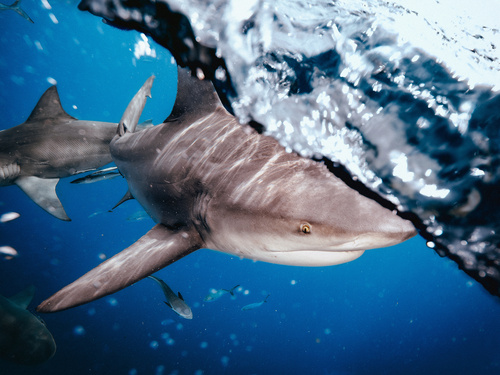
The bull shark, also known as the Zambezi shark in Africa and Lake Nicaragua shark in Nicaragua, is a species of requiem shark commonly found worldwide in warm, shallow waters along coasts and in rivers. It is known for its aggressive nature, and presence mainly in warm, shallow brackish and freshwater systems including estuaries and (usually) lower reaches of rivers. Their aggressive nature has led to ongoing shark-culling efforts near beaches to protect beachgoers, which is one of the causes of bull shark populations continuing to decrease. Bull sharks are listed as vulnerable on the IUCN Red List.
π‘οΈ Conservation Status
vulnerable
vu
π Etymology
The name "bull shark" comes from the shark's stocky shape, broad, flat snout, and aggressive, unpredictable behavior. river shark, freshwater whaler, estuary whaler, Swan River whaler, cub shark, and shovelnose shark.
π Evolution
Some of the bull shark's closest living relatives do not have the capabilities of osmoregulation. Its genus, Carcharhinus, also includes the sandbar shark, which is not capable of osmoregulation. However, the two genera have distinct taxonomic placements within the Carcharhinidae, with the bull shark being nested within the genus Carcharhinus, while the river sharks are sister to the genus Lamiopsis. This suggests that their similar physiologies convergently evolved.
The earliest fossil teeth of the bull shark are known from the Early Miocene of Egypt and Peru. They start to become much more widespread in geologic formations worldwide from the Middle Miocene onwards.
π Anatomy and appearance
Bull sharks are large and stout, with females being larger than males. The bull shark can be up to in length at birth. Adult female bull sharks average long and typically weigh , whereas the slightly smaller adult male averages and . While a maximum size of is commonly reported, a single record exists of a female specimen of exactly . A long pregnant individual reached . The maximum weight of the long pregnant female can be over , ranking it among the largest of the requiem sharks. Bull sharks are wider and heavier than other requiem sharks of comparable length, and are grey on top and white below. The second dorsal fin is smaller than the first. The bull shark's caudal fin is longer and lower than that of the larger sharks, and it has a small snout, and lacks an interdorsal ridge.
A female Carcharhinus leucas at the Shark Reef Marine Reserve, Fiji - pone.0016597.s006.ogv|A female Bull Shark in Fiji
Carcharhinus leucas upper teeth.jpg|Upper teeth
Carcharhinus leucas lower teeth.jpg|Lower teeth
SEM Carcharhinus leucas, 9x (3261812961).jpg|Electron micrograph of an upper tooth
π Exceptional specimens
In early June 2012, off the coast of the Florida Keys near the western part of the Atlantic Ocean, a female believed to measure at least and was caught by members of the R.J. Dunlap Marine Conservation Program. followed by another specimen weighing about and measuring about the same in length, in January 2020. Unconfirmed reports suggest that the very largest, exceptional specimens can possibly weigh up to .
π Distribution and habitat
The bull shark is commonly found worldwide in coastal areas of warm oceans, in rivers and lakes, and occasionally salt and freshwater streams if they are deep enough. It is found to a depth of , but does not usually swim deeper than . In the Atlantic, it is found from Massachusetts to southern Brazil, and from Morocco to Angola.
Populations of bull sharks are also found in several major rivers, with more than 500 bull sharks thought to be living in the Brisbane River. One was reportedly seen swimming the flooded streets of Brisbane, Queensland, Australia, during the 2010β11 Queensland floods. Several were sighted in one of the main streets of Goodna, Queensland, shortly after the peak of the January 2011, floods. A large bull shark was caught in the canals of Scarborough, just north of Brisbane within Moreton Bay. Still greater numbers are in the canals of the Gold Coast, Queensland. In the warmer months of the year, bull sharks frequent Sydney Harbour. In the Pacific Ocean, it can be found from Baja California to Ecuador.
The bull shark has traveled up the Amazon River to Iquitos in Peru and north Bolivia. and has been rumored to also inhabit the Cahora Bassa lake upstream of the Zambezi. The species has a distinct preference for warm currents.
After Hurricane Katrina, many bull sharks were sighted in Lake Pontchartrain. In July 2023 some local fishermen in the Atchafalaya River have reported increasing numbers. Bull sharks have occasionally gone as far upstream in the Mississippi River as Alton, Illinois. Bull sharks have also been found in the Potomac River in St. Mary's County, Maryland. From 1996 to 2013, a golf course lake at Carbrook, Logan City, Queensland, Australia was the home to several bull sharks. They were trapped following a flood of the Logan and Albert Rivers in 1996, and resided in the lake until 2013, when they disappeared after another series of floods. The golf course capitalized on the novelty, changing their logo to feature the sharks and hosting a monthly tournament called the "Shark Lake Challenge".
π Behavior
===Freshwater tolerance===
The bull shark is the best known of 43 species of elasmobranch, across 10 genera and four families, to have been reported in fresh and/or brackish water. Other species that enter rivers include the stingrays (Dasyatidae, Potamotrygonidae and others) and sawfish (Pristidae). Some skates (Rajidae), smooth dogfishes (Triakidae), and sandbar sharks (Carcharhinus plumbeus) regularly enter estuaries.
The bull shark is diadromous, meaning they can swim between salt and fresh water with ease, This bottleneck may have separated the bull shark from the rest of the Elasmobranchii subclass and favored the genes for an osmoregulatory system.
Elasmobranchs' ability to enter fresh water is limited because their blood is normally at least as salty (in terms of osmotic strength) as seawater through the accumulation of urea and trimethylamine oxide, but bull sharks living in fresh water show a significantly reduced concentration of urea within their blood. Despite this, the solute composition (i.e. osmolarity) of a bull shark in fresh water is still much higher than that of the external environment. This results in a large influx of water across the gills due to osmosis and loss of sodium and chloride from the shark's body. However, bull sharks in fresh water possess several organs with which to maintain appropriate salt and water balance; these are the rectal gland, kidneys, liver, and gills. All elasmobranchs have a rectal gland which functions in the excretion of excess salts accumulated as a consequence of living in seawater. Bull sharks in freshwater environments decrease the salt-excretory activity of the rectal gland, thereby conserving sodium and chloride. The kidneys produce large amounts of dilute urine, but also play an important role in the active reabsorption of solutes into the blood. whereas urea is produced in the liver as required with changes in environmental salinity. Recent work also shows that the differences in density of fresh water to that of marine waters result in significantly greater negative buoyancies in sharks occupying fresh water, resulting in increasing costs of living in fresh water. Bull sharks caught in freshwater have subsequently been shown to have lower liver densities than sharks living in marine waters. This may reduce the added cost of greater negative buoyancy.
Bull sharks are able to regulate themselves to live in either fresh or salt water. It can live in fresh water for its entire life, but this does not happen, mostly due to the reproductive needs of the shark. Young bull sharks leave the brackish water in which they are born and move out into the sea to breed. While is theoretically possible for bull sharks to live purely in fresh water, experiments conducted on bull sharks found that they died within four years. The stomach was opened and all that was found were two small, unidentifiable fishes. The cause of death could have been starvation since the primary food source for bull sharks resides in salt water.
In a research experiment, the bull sharks were found to be at the mouth of an estuary for the majority of the time. They stayed at the mouth of the river independent of the salinity of the water. The driving factor for a bull shark to be in fresh or salt water, however, is its age; as the bull shark ages, its tolerance for very low or high salinity increases. Bull sharks tagged inside the lake have later been caught in the open ocean (and vice versa), with some taking as few as seven to 11 days to complete the journey.
π Reproduction
Bull sharks mate during late summer and early autumn, often in bays and estuaries. After gestating for 12 months, a bull shark may give birth to 1 to 13 live young.
They are viviparous, born live and free-swimming. The young are about at birth. The bull shark does not rear its young; the young bull sharks are born into flat, protected areas.
π Interactions with humans
Since bull sharks often dwell in very shallow waters, are found in many types of habitats, are territorial by nature, and have no tolerance for provocation, they may be more dangerous to humans than any other species of shark.
One or more bull sharks may have been involved in the Jersey Shore shark attacks of 1916. While it is a common misconception that these attacks were the inspiration for the novel Jaws, its author Peter Benchley has stated this is not the case.
π Visual cues
Behavioral studies have confirmed that sharks can take visual cues to discriminate between different objects. The bull shark is able to discriminate between colors of mesh netting that is present underwater. It was found that bull sharks tended to avoid mesh netting of bright colors rather than colors that blended in with the water. Bright yellow mesh netting was found to be easily avoided when it was placed in the path of the bull shark. This was found to be the reason that sharks are attracted to bright yellow survival gear rather than ones that were painted black.
π Energy conservation
In 2008, researchers tagged and recorded the movements of young bull sharks in the Caloosahatchee River estuary. They were testing to find out what determined the movement of the young bull sharks. It was found that the young bull sharks synchronously moved downriver when the environmental conditions changed. This large movement of young bull sharks were found to be moving as a response rather than other external factors such as predators. The movement was found to be directly related to the bull shark conserving energy for itself. One way the bull shark is able to conserve energy is that when the tidal flow changes, the bull shark uses the tidal flow in order to conserve energy as it moves downriver. Another way for the bull shark to conserve energy is to decrease the amount of energy needed to osmoregulate the surrounding environment.
π Ecology
Humans are the biggest threat to bull sharks. Larger sharks, such as the tiger shark and great white shark, may attack them, but typically only target juveniles. and a Nile crocodile was reportedly sighted consuming a bull shark in South Africa.
π Conservation
's Shark Lagoon exhibit]]
The bull shark is listed as a vulnerable species on the IUCN Red List and its population is decreasing. Despite its status, the species isn't named as a protected species. Threats to the bull shark are numerous, such as getting caught in fishing nets, overfishing for their oil, skin, and meat, pollution to their habitat, and more. In many areas of the world, including Australia and South Africa, there are shark-culling measures around beaches to prevent attacks on beach-goers. Researchers tried to fix the problem of sharks getting too close to land by testing out a device called the SharkSafe Barrierβ’. This barrier used magnetic and visual stimuli, which utilized rows of piping to create a continuous magnetic field to deter the sharks. However, researchers concluded that the technology needs to be improved and tested further before it can be implemented as a reliable safety measure. Other research is being conducted to come up with conservation solutions for the bull sharks. One example is The Nature Conservancy satellite tagging sharks to track their migration and find their habitats in order to guide what areas require further protection projects.