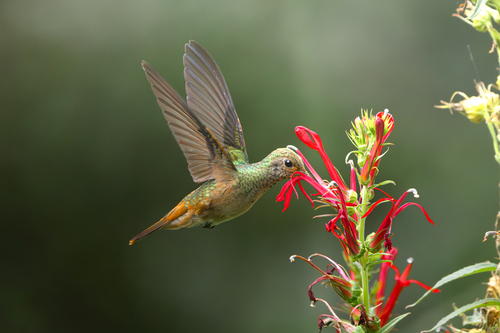
The buff-bellied hummingbird is a species of hummingbird in the "emeralds", tribe Trochilini of subfamily Trochilinae. It is found in Belize, Guatemala, Mexico, and the United States.
📌 Taxonomy and systematics
The buff-bellied hummingbird has three subspecies, the nominate A. y. yucatanensis, A. y. chalconota, and A. y. cerviniventris.
📌 Distribution and habitat
The nominate subspecies of buff-bellied hummingbird is found year-round from northern Belize and northwestern Guatemala north to Tabasco, Campeche, and Yucatán in southeastern Mexico. A. y. chalconota is found year-round from extreme southern Texas south in Mexico as far as north-central Veracruz and also in winter further north and east in the U.S. Subspecies A. y. cerviniventris is found year-round from central Veracruz south through Puebla and Oaxaca to northern Chiapas.
The buff-bellied hummingbird inhabits a variety of landscapes in its year-round range, most of which are semi-open to open and rather dry. They include scrubby woodlands, the edges of denser forest, thorn forest, oak woodlands and "islands" in grasslands, and urban and suburban parks and gardens. Details are lacking about its habitat preferences in the U.S. during winter dispersal.
📌 Behavior
===Movement===
The buff-bellied hummingbird's migration pattern has not been exactly determined. Except in northern Mexico and Texas it appears to be sedentary. Some members of subspecies A. y. chalconota disperse north and east along the Gulf Coast, regularly as far as the Florida panhandle and irregularly to elsewhere in Florida and as far north as North Carolina.
📌 Feeding
The buff-bellied hummingbird feeds on nectar from a very wide variety of flowering plants, shrubs, and trees including those with non-tubular blossoms. It nectars by hovering rather than perching. It is very territorial, vigorously defending feeding sites including sugar water feeders from other hummingbirds and some insects. In addition to nectar it feeds on small arthropods captured on the wing or by gleaning from vegetation.
📌 Breeding
The buff-bellied hummingbird's breeding season in south Texas is mostly between late March and early August but nesting has occurred both earlier and later. On the Yucatán Peninsula nesting may start as early as January and continue to at least mid-April. In "eastern Mexico" the nesting season has been reported as being from April to July. The nest is a cup of plant and other fibers such as thistledown, grass, hair, and nylon bound with spiderweb and covered with lichens and bark shreds. It is typically placed in a branch fork of a small tree or shrub between above the ground, though sometimes higher. The incubation period and time to fledging are not known.
📌 Vocalization
The buff-bellied hummingbird's vocalizations have been well studied only in Texas. Displaying individuals make a two-syllable "tsi-we" call. During feeding it makes "tik" or "tik-k" notes. When chasing other hummingbirds it gives a "long, low call with notes repeated rapidly (see-see-see-see-su-su)"; this vocalization has also been described as the species' song.
📌 Status
The IUCN has assessed the buff-bellied hummingbird as being of Least Concern. It has a very large range, and though its population size is not known it been increasing since at least the 1980s. No immediate threats have been identified. In much of its range a significant amount of its natural habitat has been converted for agriculture, grazing, and human residence. The "effect of land-clearing on this hummingbird, however, has not been documented."