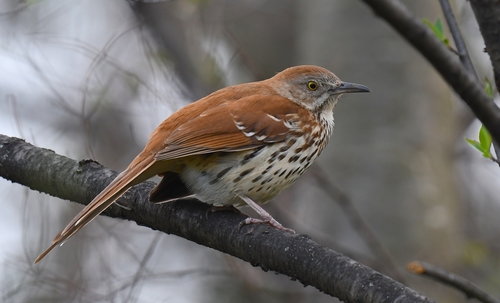
The brown thrasher, sometimes erroneously called the brown thrush or fox-coloured thrush, is a bird in the family Mimidae, which also includes the New World catbirds and mockingbirds. The brown thrasher is abundant throughout the eastern and central United States and southern and central Canada, and it is the only thrasher to live primarily east of the Rockies and central Texas. It is the state bird of Georgia.
π Taxonomy and naming
The brown thrasher was originally described by Carl Linnaeus in his landmark 1758 10th edition of Systema Naturae as Turdus rufus. The genus name Toxostoma comes from the Ancient Greek , "bow" or "arch" and ', "mouth". The specific ' is Latin for "red", but covers a wider range of hues than the English term.
Although not in the thrush family, this bird is sometimes erroneously called the brown thrush. The name misconception could be because the word thrasher is believed to derive from the word thrush. The naturalist Mark Catesby called it the fox-coloured thrush.
π Similar species
The similar-looking long-billed thrasher has a significantly smaller range. It has a gray head and neck, and has a longer bill than the brown thrasher.
π Distribution and habitat
The brown thrasher resides in various habitats. It prefers to live in woodland edges, thickets and dense brush, It can also inhabit areas that are agricultural and near suburban areas, but is less likely to live near housing than other bird species. The increase in trees throughout the Great Plains during the past century due to fire suppression and tree planting facilitated a westward range expansion of the brown thrasher as well as range expansions of many other species of birds. Studies indicate that thrashers that reside in the New England region of the United States during the breeding season fly toward the Carolinas and Georgia, birds located in the east of the Mississippi winter from Arkansas to Georgia, and birds located in the Dakotas and the central Canadian provinces head towards eastern Texas and Louisiana. as well as a British record of a transatlantic vagrant.
π Behavior
's picture depicting ferruginous thrush]]
The brown thrasher has been observed either solo or in pairs. The brown thrasher is usually an elusive bird, and maintains its evasiveness with low-level flying. When it feels bothered, it usually hides into thickets and gives cackling calls. The brown thrasher has been noted for having an aggressive behavior, and is a staunch defender of its nest. It is also thought that the name comes from the thrashing sound that is made while it is smashing large insects to kill and eventually eat.
π Feeding
This bird is omnivorous, which has a diet that includes insects, berries, nuts and seeds, as well as earthworms, snails, and sometimes lizards and frogs. During the breeding season, the diet consists primarily of beetles, grasshoppers, and other arthropods, and fruits, nuts and seeds. More than 80% of the diet of brown thrasher from Illinois is made of animal matter, about 50% being beetles. In Iowa, about 20% of the summer diet was found to consist of grasshoppers. By the late summer, it begins to shift towards more of a herbivore diet, focusing on fruits, nuts, seeds, and grains, 60% of the food in Illinois being fruits and seeds. By winter, the customary diet of the brown thrasher is fruit and acorns. Wintering birds in Texas were found to eat 58% plant material (mainly sugar berry and poison ivy) and 42% animal material in October; by March, in the dry period when food supply is generally lower, 80% of the food became animal and only 20% plants. Vertebrates are only eaten occasionally and are often comprised by small reptiles and amphibians, such as lizards, small or young snakes, tree frogs and salamanders.
The brown thrasher utilizes its vision while scouring for food. It usually forages for food under leaves, brushes, and soil debris on the ground using its bill. It then swipes the floor in side-to-side motions, and investigates the area it recently foraged in. Foraging success is 25% greater in dry leaf litter as compared to damp leaf letter. The brown thrasher can also hammer nuts such as acorns in order to remove the shell. In one case, a brown thrasher was observed to dig a hole about deep, place an acorn in it and hit the acorn until it cracked, considered to be a form of tool usage. In a laboratory experiment, a brown thrasher was found to be able to discern and reject the toxic eastern newt (Notophthalmus viridescens) and a palatable mimic of that species, the red salamander (Pseudotriton ruber), but continued to eat palatable dusky salamanders (Desmognathus spp.).
π Breeding
Brown thrashers are typically monogamous birds, but mate-switching does occur, at times during the same season. Their breeding season varies by region. In the southeastern United States, the breeding months begin in February and March, while May and June see the commencement of breeding in the northern portion of their breeding range. When males enter the breeding grounds, their territory can range from . Around this time of the year the males are usually at their most active, singing loudly to attract potential mates, and are found on top of perches. The courting ritual involves the exchanging of probable nesting material. Males will sing gentler as they sight a female, and this enacts the female to grab a twig or leaf and present it to the male, with flapping wings and chirping sounds. The males might also present a gift in response and approach the female. Both sexes will take part in nest building once mates find each other, and will mate after the nest is completed. There are rare occurrences of no spots on the eggs. The male sings a series of short repeated melodious phrases from an open perch to declare his territory, and is also very aggressive in defending the nest, known to strike people and animals.
π Vocal development
]]
The male brown thrasher may have the largest song repertoire of any North American bird, which has been documented as at least over 1,100 songs. while others put the number beyond 3,000. The males' singing voice usually contains more of a melodic tone than that of the related grey catbird. Its song are coherent phrases that are iterated no more than three times, but has been done for minutes at a time. By the fall, the male sings with smoother sub-songs. Others calls may consist of an acute, sudden chakk, Brown thrashers are noted for their mimicry (as a member of the family Mimidae), but they are not as diverse in this category as their relative the northern mockingbird. However, during the breeding season, the mimicking ability of the male is at its best display, impersonating sounds from tufted titmice (Baeolophus bicolor), northern cardinals (Cardinalis cardinalis), wood thrushes, northern flickers (Colaptes auratus), among other species.
π Predation and threats
Although this bird is widespread and still common, it has declined in numbers in some areas due to loss of suitable habitat. Despite the decrease, the rate does not warrant a status towards vulnerable. One of the natural nuisances is the parasitic brown-headed cowbird (Molothrus ater), but these incidents are rare. Whenever these situations occur, the brown thrashers usually discard the cowbirds' eggs. Occasionally, the thrasher has thrown out their own eggs instead of the cowbird eggs due to similar egg size, Because of the apparent lack of opportunistic behavior around species like these, thrashers are prone to be driven out of zones for territory competition. Brown thrashers have tendencies to double-brood or have failures on their first nesting attempts due to predation. Grey catbirds have been seen invading brown thrashers' nests and breaking their eggs. In Kansas, at least eight species of snake were identified as potentially serious sources of nest failure. Among the identified avian predators of adults are Cooper's hawks (Accipiter cooperii), northern goshawk (Accipiter gentilis), broad-winged hawks (Buteo platypterus), merlins (Falco columbarius), peregrine falcons (Falco peregrinus), eastern screech-owls (Megascops asio), great horned owls (Bubo virginianus) barred owls (Strix varia) and long-eared owls (Asio otus).
The brown thrasher methods of defending itself include using its bill, which can inflict significant damage to species smaller than it, along with wing-flapping and vocal expressions.
π State bird
The brown thrasher is the state bird of Georgia. The brown thrasher also was the inspiration for the name of Atlanta's former National Hockey League team, the Atlanta Thrashers, who relocated in 2011 to become the current Winnipeg Jets (the original Jets relocated to Phoenix in 1996 to become the Coyotes). The Coyotes have since relocated again and are now known as the Utah Mammoth.
π Book
* Cavitt, J. F., and C. A. Haas. 2000. Brown Thrasher (Toxostoma rufum). In The Birds of North America, No. 557 (A. Poole and F. Gill, eds.). The Birds of North America, Inc., Philadelphia, PA.
π Theses
* Boughey MJ. Ph.D. (1978). The function of song variety in the brown thrasher (Toxostoma rufum). Clark University, United States β Massachusetts.
* Bromer WR. Ph.D. (1988). Dispersal of dogwood seeds by avian frugivores: Ecological and evolutionary consequences. Purdue University, United States β Indiana.
* Cavitt JF II. Ph.D. (1998). The role of food supply and nest predation in limiting reproductive success of brown thrashers (Toxostoma rufum): Effects of predator removal, food supplements and predation risk. Kansas State University, United States β Kansas.
* Gubanyi JA. Ph.D. (2001). Effects of high deer abundance on forests in eastern Nebraska. The University of Nebraska β Lincoln, United States β Nebraska.
* Haas CA. Ph.D. (1990). Breeding ecology and site fidelity of American robins, brown thrashers, and loggerhead shrikes in shelterbelts in North Dakota. Cornell University, United States β New York.
* Quinn J. MS (2006). Mechanism of Parasite Egg Rejection by the Northern Mocking Bird and Brown Thrasher in Northeast Louisiana. University of Louisiana at Monroe, Monroe LA
π Articles
*
*
*
*
*
*
*
*
*
*
*
*
*
*
*
*
*
*
*
*
*
*
-->
brown thrasher
brown thrasher
Category:Birds of Canada
Category:Native birds of the Canadian Prairies
Category:Native birds of the Eastern United States
Category:Native birds of the Plains-Midwest (United States)
Category:Symbols of Georgia (U.S. state)
brown thrasher
brown thrasher
Category:Birds of the United States
Category:Least concern biota of the United States