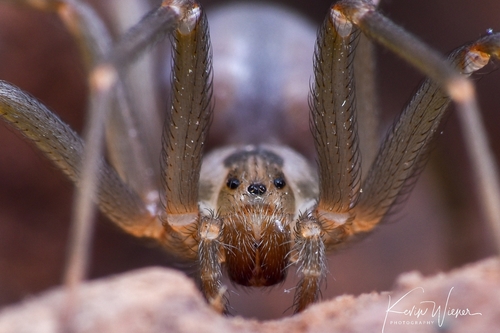
The brown recluse is a recluse spider with necrotic venom. Similar to those of other recluse spiders, their bites sometimes require medical attention. The brown recluse is one of two spiders in North America with dangerous venom, the other being the black widow.
📌 Distribution
(diameter )]]
The documented range of this species lies roughly south of a line from southeastern Nebraska through southern Iowa, Illinois, and Indiana to southwestern Ohio. In the southern states, it is native from central Texas to western Georgia and north to Kentucky.
Despite rumors to the contrary, the brown recluse spider has not established itself in California or anywhere outside its native range. There are other species of the genus Loxosceles native to the southwestern part of the United States, including California, which may resemble the brown recluse, but interactions between humans and the recluse species in California and the region are rare because those species' native ranges lie outside of dense human populations.
From this study, the most common spider submitted from California as a brown recluse was in the genus Titiotus, whose bite is deemed harmless. A similar study documented that various arachnids were routinely misidentified by physicians, pest control operators, and other non-expert authorities, who told their patients or clients that the spider they had was a brown recluse when in fact it was not.
Despite the absence of brown recluses from the Western U.S., physicians in the region commonly diagnose "brown recluse bites", leading to the popular misconception that the spiders inhabit those areas.
Over the last century, spiders have occasionally been intercepted in locations where they have no known established populations; these spiders may be transported fairly easily, though the lack of established populations well outside the natural range also indicates that such movement has not led to the colonization of new areas, after decades of opportunities. Note that the occurrence of brown recluses in a single building (such as a warehouse) outside of the native range is not considered as successful colonization; such single-building populations can occur (e.g., in several such cases in Florida),
but do not spread, and can be easily eradicated.
The spider has also received numerous sensationalized media reports of bites occurring where these spiders are absent (and no specimens were found), such as a 2014 report from Thailand, where a man was claimed to have died from a brown recluse bite.
Many misidentifications and erroneous geographic records stem from the similarity between L. reclusa and a related introduced species, the Mediterranean recluse (Loxosceles rufescens), which is found worldwide, including numerous sightings throughout the United States; the two species are superficially almost indistinguishable, and misidentifications are common, making it difficult to distinguish which reports of recluses refer to which species.
📌 Life cycle
Adult brown recluse spiders often live about one to two years. Each female produces several egg sacs over a period of two to three months, from May to July, with approximately 50 eggs in each sac. The eggs hatch in about one month. The spiderlings take about one year to grow to adulthood. The brown recluse spider is resilient and can tolerate up to six months of extreme drought and scarcity or absence of food. On one occasion, a brown recluse survived in controlled captivity for over five seasons without any food at all.
As part of the haplogynae, brown recluses do not balloon, which limits their ability to widely disperse geographically.
The brown recluse will, though not habitually, cannibalize another if food becomes scarce; especially during its typical mating season from June to September or when an unreceptive female encounters an aggressive male.
📌 Behavior
A brown recluse's stance on a flat surface is usually with all legs radially extended. When alarmed it may lower its body, withdraw the forward two legs straight rearward into a defensive position, withdraw the rearmost pair of legs into a position for lunging forward, and stand motionless with pedipalps raised. The pedipalps in mature specimens are dark and quite prominent and are normally held horizontally forward. When threatened it usually flees, seemingly to avoid a conflict, and if detained may further avoid contact with quick horizontal rotating movements or even resort to assuming a lifeless pose (playing dead). The spider does not usually jump unless touched brusquely, and even then its avoidance movement is more of a horizontal lunge rather than a vaulting of itself entirely off the surface. When running, the brown recluse does not leave a silk line behind, which would make it more easily tracked when it is being pursued. Movement at virtually any speed is an evenly paced gait with legs extended.
The brown recluse spider displays autotomy as a defense mechanism against physical, predatory attack to a leg as well as to prevent predatory, venom injections from spreading to the rest of the body. "Once a leg is lost, a recluse spider does not regenerate a new one with subsequent molts", unlike the huntsman spider, which does regenerate autotomized legs. With each time that a leg is autotomized, the recluse "changes its gait to compensate for the loss."
📌 Bite
Like all members of the Loxosceles genus, the brown recluse has potent tissue-destroying venoms containing the dermonecrotic agent sphingomyelinase D.
Most bites are minor with no dermonecrosis, but a small number of brown recluse bites produce loxoscelism, a condition where the skin around the bite dies. While loxoscelism usually manifests as a skin condition (cutaneous loxoscelism), it can also include systemic symptoms like fever, nausea, and vomiting (viscerocutaneous loxoscelism). In very rare cases, bites can even cause hemolysis – the bursting of red blood cells.
In one study of clinically diagnosed brown recluse bites, skin necrosis occurred 37% of the time, while systemic illness occurred 14% of the time.
As suggested by its specific name reclusa (recluse), the brown recluse spider is rarely aggressive, and bites from the species are uncommon. In 2001, more than 2,000 brown recluse spiders were removed from a heavily infested home in Kansas, yet the four residents who had lived there for years were never harmed by the spiders, despite many encounters with them.
The spider usually bites only when pressed against the skin, such as when tangled within clothes, shoes, towels, bedding, or inside work gloves. Many human victims report having been bitten after putting on clothes or shoes that had not been worn recently or had been left for many days undisturbed on the floor. The fangs of the brown recluse are not large enough to penetrate most fabric.
When both types of loxoscelism do result, systemic effects may occur before necrosis, as the venom spreads throughout the body in minutes. Children, the elderly, and the debilitatingly ill may be more susceptible to systemic loxoscelism. The systemic symptoms most commonly experienced include nausea, vomiting, fever, rashes, and muscle and joint pain. Rarely, such bites can result in hemolysis, low platelet levels, blood clots throughout the body, organ damage, and even death.
Most fatalities are in children under the age of seven
or those with a weak immune system.
While the majority of brown recluse spider bites do not result in any symptoms, cutaneous symptoms occur more frequently than systemic symptoms. In such instances, the bite forms a necrotizing ulcer as the result of soft tissue destruction and may take months to heal, leaving deep scars. These bites usually become painful and itchy within 2–8 hours. Pain and other local effects worsen 12–36 hours after the bite, and the necrosis develops over the next few days.
Over time, the wound may grow to as large as 25 cm (10 inches). The damaged tissue becomes gangrenous and eventually sloughs away. L. reclusa can produce slightly more than 0.1 μL of venom, though the average yield is less.
📌 Misdiagnosis
There is an ELISA-based test for brown recluse venom that can determine whether a wound is a brown recluse bite, although it is not commercially available and not in routine clinical use. Clinical diagnoses often use Occam's razor principle in diagnosing bites based on what spiders the patient likely encountered and previous similar diagnoses.
suggested the mnemonic "NOT RECLUSE", shown below, as a memory device to help laymen and medical professionals more objectively screen and diagnose potential cases of loxoscelism.
:{| style="text-align:left;vertical-align:top;"
|+ NOT RECLUSE mnemonic
Many of these conditions are far more common and more likely to be the source of necrotic wounds, even in areas where brown recluse spiders actually occur. Misdiagnosis of MRSA as spider bites is extremely common (nearly 30% of patients with MRSA reported that they initially suspected a spider bite), and can have fatal consequences.
Reported cases of brown recluse bites occur primarily in Arkansas, Colorado, Kansas, Missouri, Nebraska, Oklahoma, and Texas.
There have been many reports of brown recluse bites in California – though a few related species of spiders may be found there, none of the related spiders in California is known to bite humans.
To date, the reports of bites from areas outside of the spider's native range have been either unverified or, if verified, the spiders have been moved to those locations by travelers or commerce.
📌 Other spiders
: For a comparison of the toxicity of several kinds of spider
: bites, see the list of medically significant spider bites
Many arachnologists believe that a large number of bites attributed to the brown recluse in the U.S. West Coast are either from other spider species or not spider bites at all. Other spiders in western states that might possibly cause necrotic injuries are the hobo spider, desert recluse spider, and the yellow sac spider.
For example, the venom of the hobo spider, a common European species now established in the northwestern United States and southern British Columbia, has been reported to produce similar symptoms as the brown recluse bite when injected into laboratory rabbits. However, the toxicity of hobo spider venom has been called into question: Actual bites (rather than syringe injections) have not been shown to cause necrosis, and no necrotic hobo spider bites have ever been reported where it is native.
Numerous other spiders have been associated with necrotic bites in the medical literature. Other recluse species, such as the desert recluse (found in the deserts of southwestern United States), are reported to have caused necrotic bite wounds, though only rarely.
The hobo spider and the yellow sac spider have also been reported to cause necrotic bites. However, the bites from these spiders are not known to produce the severe symptoms that can follow from a recluse spider bite, and the level of danger posed by these has been called into question.
So far, no known necrotoxins have been isolated from the venom of any of these spiders, and some arachnologists have disputed the accuracy of spider identifications carried out by bite victims, family members, medical responders, and other non-experts in arachnology.
There have been several studies questioning the danger posed by some of the other spiders mentioned: In these studies, scientists examined case studies of bites in which the spider in question was identified by an expert, and found that the incidence of necrotic injury diminished significantly when "questionable" identifications were excluded from the sample set.
📌 Bite treatment
First aid involves the application of an ice pack to control inflammation and prompt medical care. If it can be easily captured, the spider should be brought with the patient in a clear, tightly closed container so it may be identified by an arachnologist; if there is no specimen at all, then confirmation by an expert is impossible.
In almost all cases, bites are self-limited and typically heal without any medical intervention.
Outpatient palliative care following discharge often consists of a weak or moderate strength opioid (e.g. codeine or tramadol, respectively) depending on pain scores, an anti-inflammatory agent (e.g. naproxen, cortisone), and an antispasmodic (e.g. cyclobenzaprine, diazepam), for a few days to a week. If the pain or spasms have not resolved by this time, a second medical evaluation is generally advised, and differential diagnoses may be considered.
📌 Specific treatments
In presumed cases of recluse bites, dapsone is often used for the treatment of necrosis, but controlled clinical trials have yet to demonstrate efficacy.
However, dapsone may be effective in treating many "spider bites" because many such cases are actually misdiagnosed microbial infections.
There have been conflicting reports about its efficacy in treating brown recluse bites, and some have suggested it should no longer be used routinely, if at all.
Wound infection is rare. Antibiotics are not recommended unless there is a credible diagnosis of infection.
Studies have shown that surgical intervention is ineffective and may worsen outcomes. Excision may delay wound healing, cause abscesses, and lead to scarring.
Purportedly application of nitroglycerin stopped necrosis. However, one scientific animal study found no benefit in preventing necrosis, with the study's results showing it increased inflammation and caused symptoms of systemic envenoming. The authors concluded the results of the study did not support the use of topical nitroglycerin in brown recluse envenoming.
Antivenom is available in South America for the venom of related species of recluse spiders. However, the bites, often being painless, usually do not present symptoms until 24 or more hours after the event, possibly limiting the effect of this intervention.
📌 Spider population control
Due to increased fear of these spiders prompted by greater public awareness of their presence in recent years, the extermination of domestic brown recluses is performed frequently in the lower midwestern United States. Brown recluse spiders possess a variety of adaptive abilities, including the ability to survive up to 10 months with no food or water. Additionally, these spiders survive significantly longer in a relatively cool, thermally stable environment.