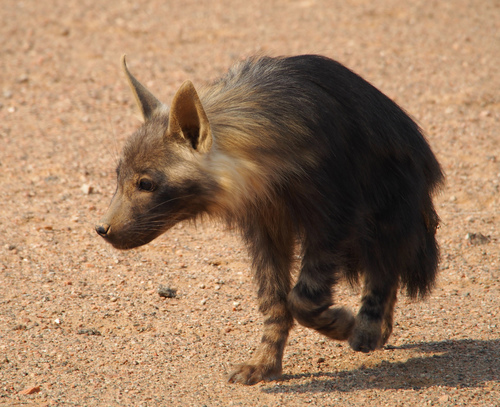
The brown hyena, also called the strandwolf, is a species of hyena found in Namibia, Botswana, western and southern Zimbabwe, southern Mozambique, western Eswatini, and South Africa. It is the only extant species in the genus Parahyaena. It is currently the rarest species of hyena. The largest remaining brown hyena population is located in the southern Kalahari Desert and coastal areas in Southwest Africa. The global population of brown hyena is estimated by IUCN at a number between 4,000 and 10,000 and its conservation status is marked as near threatened in the IUCN Red List.
π‘οΈ Conservation Status
near threatened
nt
π Distribution and habitat
The brown hyena inhabits desert areas, semi-desert, and open woodland savannah in Southern Africa. It can survive close to urban areas by scavenging, and they have been documented using the deteriorating infrastructure of abandoned mining towns in Namibia for shade and as den sites for mothers with pups. The brown hyena is not dependent on the ready availability of water sources for frequent drinking and favors rocky, mountainous areas, as these provide shade. It has home ranges of in size.
π Fossil record
Today, the brown hyena only inhabits Southern Africa, with the earliest known occurrence in the region during the Late Pliocene based on fossils from the Makapansgat-Member 3, dated to approximately . It may have lived also in the Iberian Peninsula and perhaps in other parts of Europe, indicated by fossils found in the area of Granada (Fonelas 1) dated to the Late Pliocene, but it is uncertain whether the Fonelas hyena specimens are truly brown hyena. Early Pleistocene brown hyenas are known to have fed on hominins, though whether this constituted scavenging or active predation is unclear. During the Middle Pleistocene, it inhabited what is now Kenya. Latrines made by brown hyenas have been discovered in South Africa dating back to the Middle Pleistocene. There is the possibility that Parahyaena may be synonymous with the extinct Pachycrocuta, making the brown hyena the only extant member of this genus.
π Ecology and behavior
In the Kalahari, 80% of a brown hyena's activity time is spent at night, searching for food in an area on spanning on average, with territories of having been recorded. They may cache excess food in shrubs or holes and recover it within 24 hours.
π Social behavior
Brown hyenas have a social hierarchy comparable to that of wolves, with a mated pair and their offspring. They live in clans composed of extended families of four to six individuals. during which the hyena deposits secretions from its large anal gland, which is located below the base of the tail and produces a black and white paste, on vegetation and boulders. Brown hyenas maintain a stable clan hierarchy through ritualized aggressive displays and mock fights. A brown hyena male can move up in rank by killing a higher ranking male in confrontation, while the alpha female is usually just the oldest female in the clan. Emigration is common in brown hyena clans, particularly among young males, which will join other groups upon reaching adulthood.
π Reproduction and life cycle
The brown hyena does not have a mating season. Female brown hyenas are polyestrous and typically produce their first litter when they are two years old. They mate primarily from May to August. Males and females in the same clan usually do not mate with each other; rather, females will mate with nomadic males. Clan males display no resistance to this behavior, and will assist the females in raising their cubs. Females give birth in dens, which are hidden in remote sand dunes far from the territories of spotted hyenas and lions. The gestation period is around 3 months. Mothers generally produce one litter every 20 months. Usually, only the dominant female breeds; however, if two litters are born in the same clan, the mothers will nurse each other's cubs, though favoring their own. Litters usually consist of 1β5 cubs, which weigh at birth. Unlike spotted hyenas, brown hyenas are born with their eyes closed, and open them after eight days. Cubs are weaned at 12 months and leave their dens after 18 months. Also unlike spotted hyenas, all adult members of the clan will carry food back to the cubs. They are not fully weaned and do not leave the vicinity of their den until they reach 14 months of age. Brown hyenas reach full size at an age of around 30 months and have a life span of about 12 to 15 years.
π Threats and conservation status
The global brown hyena population is estimated to comprise 4,000 to 10,000 individuals. It is listed as Near Threatened in the IUCN Red List. The major threat to the brown hyena is human persecution, based on the mistaken belief that it is harmful to livestock. Farmers find brown hyenas scavenging on livestock carcasses and wrongly assume that the hyenas have killed their animals. Brown hyena body parts are also occasionally used for traditional medicines and rituals. The brown hyena is not in high demand for trophy hunting.
There are several conservation areas that are home to the brown hyena, including the Etosha National Park in Namibia, the Central Kalahari Game Reserve in Botswana and the Kgalagadi Transfrontier Park. The maintenance of these protected areas aids in the conservation of these animals. Educational campaigns are being utilized to promote awareness about hyenas and dispel prevailing myths, while problem individuals are removed from farmlands and urbanized areas.