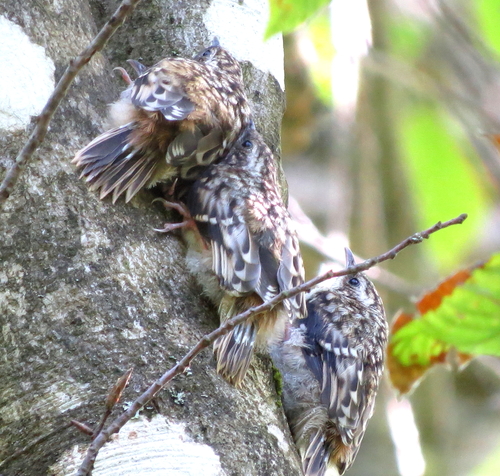
The brown creeper, also known as the American treecreeper, is a small songbird, the only North American member of the treecreeper family Certhiidae.
📌 Distribution, habitat and range
Brown creepers are both migratory and year-round residents in North America. Their breeding habitat is mature forests, especially conifers, in Canada, Alaska and the northeastern and western United States, and they are non-breeding in the southern part of the United States. They are permanent residents through much of their range; many northern birds migrate to the southern half of the United States. Brown creepers have occurred as vagrants to Bermuda and Central America's mountains in Guatemala, Honduras and the northern cordillera of El Salvador. Since 1966 the brown creeper has experienced a yearly 1.5% population increase throughout the northeastern and northwestern (Pacific coast) regions of its range. The first breeding brown creepers in the Northwest Territories were detected in 2008, in the Liard Valley, which may be a result of northern range expansion.
Brown creepers have been recorded breeding in the dry season (January–February) in Chalatenango Department, El Salvador, a behaviour unusual to insectivorous birds and shared in the region only by the golden-fronted woodpecker.
📌 Subspecies
Thirteen subspecies are recognised:
* C. a. alascensis Webster, JD, 1986 – central south Alaska
* C. a. occidentalis Ridgway, 1882 – southeast Alaska, west Canada and west US
* C. a. stewarti Webster, JD, 1986 – islands off British Columbia (southwest Canada)
* C. a. zelotes Osgood, 1901 – mountains of south Oregon to north, east, south California (west US)
* C. a. phillipsi Unitt & Rea, 1997 – central California (west US)
* C. a. montana Ridgway, 1882 – interior southwest Canada to central north and central US
* C. a. leucosticta Van Rossem, 1931 – south Nevada and Utah (central west US)
* C. a. americana Bonaparte, 1838 – south, east Canada and central north, northeast US
* C. a. nigrescens Burleigh, 1935 – central east US
* C. a. albescens Berlepsch, 1888 – southwest US and northwest Mexico
* C. a. alticola Miller, GS, 1895 – west, southwest, central Mexico
* C. a. pernigra Griscom, 1935 – south Mexico and Guatemala
* C. a. extima Miller, W & Griscom, 1925 – east Guatemala to Nicaragua
📌 Conservation status
station in the United States]]
The species has declined in much of North America but appears to be doing well in Washington, with a small (though not statistically significant) increase on the state's breeding bird survey since 1966. As with many of Washington's birds, the Cascade mountain range divides this species into two subspecies.
In Wyoming, brown creepers have been recognized as preferring habitat within large, intact and mature stands of spruces, firs, or lodgepole pine. It is therefore potentially vulnerable to logging, climate change, or replacement of those tree species by Ponderosa pine. However, it is not considered a species of serious concern in that state.
In New Brunswick, brown creepers have been shown to respond negatively to even moderate forestry. Conservation efforts in the province have focused on maintaining unmanaged patches with high densities of trees and snags in mature forest.
Ivory-billed woodcreepers (Xiphorhynchus flavigaster) have been observed extracting brown creeper nestlings and dropping them away from the nest.
📌 Behavior
Brown creepers forage on tree trunks and branches, typically zig-zagging upwards from the bottom of a tree trunk, and then flying down to the bottom of another tree. They creep slowly with their body flattened against the bark, probing with their beak for insects. They will rarely feed on the ground. They mainly eat small arthropods found in the bark, but sometimes they will eat seeds in winter.
📌 Breeding
Breeding season typically begins in April. The female will make a partial cup nest either under a piece of bark partially detached from the tree, or in a tree cavity. It will lay 3–7 eggs, and incubation lasts approximately two weeks. Both of the parents help feed the chicks. Parents both take turns feeding nestlings and removing fecal sacs from the nest.