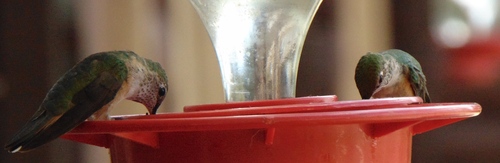
The broad-tailed hummingbird is a medium-sized hummingbird species found in highland regions from western United States and Western Canada to Mexico and Guatemala.
π Vocalizations
The broad-tailed hummingbird produces several different sound patterns. This bird's call sounds like a sharp "cheet", which is repeated "cheet cheet cheet cheet...". The wing trill produces a buzzing sound and can be heard 50 m away by other males and 75 m away by other females. This sound is produced when air passes rapidly through the 9th and 10th primary feathers. In one experiment, birds without this wing trill lost their territory more easily to more aggressive birds.
π Taxonomy
The broad-tailed hummingbird, Selasphorus platycercus, is a member of the order Apodiformes, in the family Trochilidae. Hummingbird taxonomy has not been extensively studied, but its phylogenic division can be divided as a family into nine clades in which the broad-tailed hummingbird is a member of the "Bee group" and included in the Selasphorus genus. This genus is composed of 6 members taxonomically distinguished based on color characteristics. This genus is characterized by hummingbirds with a plumage containing rufous coloration and a neck gorget of orange to purple in males.
Selasphorus sasin : Allen's hummingbird
Selasphorus rufus : Rufous hummingbird
Selasphorus scintilla : Scintillant hummingbird
Selasphorus ardens : Glow-throated hummingbird
Selasphorus flammula :Volcano hummingbird
On a geographic scale, the genus Selasphorus can be subdivided into 2 groups of species, one living in North America, and a second in the region of Costa Rica and Panama.
π Distribution
The broad-tailed hummingbird is found from Guatemala to Mexico, and western United States and Western Canada during summer, while wintering regions are mainly in southern Mexico and Guatemala.
π Migration
This species exhibits partial migration, depending on the northern range during winter. Some populations of the broad-tailed hummingbird in southern Mexico and Guatemala do not migrate, a variation in behavior called "sedentary".
π Reproduction
The range of breeding locations appear to be from central Montana in the north to Guatemala in the south. Although broad-tailed hummingbirds have been seen in British Columbia, these birds appear to be accidental migrants, with no evidence for breeding at such northern latitudes.
π Breeding site
The broad-tailed hummingbird has a promiscuous mating system and does not form a pair bond. The reproduction time for broad-tailed hummingbirds correlated with the time flower production is at its peak.
π Courtship
Male perform an aerial display to attract females during the breeding season. Males will fly high and dive while producing a trill sound with their wing feathers.
π Nest construction
In 70% of cases, females return to their nest site from one year to the next. Nest material can be stolen by other females for the construction of a nest.
π Brooding
The female will lay two white eggs of around in length and incubate them alone for around 16 to 19 days. Nest cup diameter increases as the chicks age. Chicks are altricial at their hatch, and will take around 10 to 12 days for feathering. The female will stay with the fledged young up to several weeks.
π Conservation status
This species conservation status is "Least Concern", indicating it is not an endangered species, having a wide range and moderate population size, although one survey indicated a 52% decline in population between 1966 and 2015. It appears to be adapted to human-modified habitats.