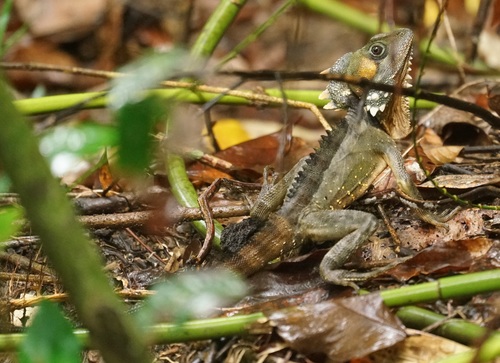
Boyd's forest dragon is a species of arboreal lizard in the family Agamidae. The species is native to rainforests and their margins in the Wet Tropics region of northern Queensland, Australia. It is the larger of the two species of Lophosaurus found in Australia. Another species, the southern angle-headed dragon, L. spinipes, is found in southern Queensland and northern New South Wales.
π Etymology
The generic name Lophosaurus stands for "crested lizard", from the Greek lophos for "crest", and saurus for "lizard". The specific name, boydii, is a reference to English-born John Archibald Boyd (1846β1926), who lived in Fiji from 1865 to 1882 and then on a sugar plantation at Ingham, Queensland, and collected specimens for the Australian Museum. The binomial authority is William John Macleay, who provided the original description of the species in 1884. Additionally, the Kuku Yalanji people of North Queensland named this lizard "Jalbil" which refers not only to this species, but also to the mythological creature who split Snapper Island away from the mainland.
π Geographic range and habitat
The species Lophosaurus boydii is restricted to rainforests and their margins in northern Queensland, Australia, from just north of Townsville to near Cooktown. It is found in both upland and lowland rainforest, and is often seen around Lake Eacham (Yidyam) and Lake Barrine, and in parts of Malanda Falls Conservation Park and at Mossman Gorge.
It is recorded using tree-hollows.
π Behavior
Boyd's forest dragon spends the majority of its time perched on the trunks of trees, usually at around head height, although daily movements can exceed on the ground. When approached, it will usually move around to the opposite side of the tree, keeping the trunk between it and its harasser.
Unlike most other lizards, Boyd's forest dragon does not bask in the sun, instead letting its body temperature fluctuate with air temperature (thermoconforming rather than thermoregulating). The one possible exception to this general rule is gravid (pregnant) females, which are often observed sitting on or beside forest roads and exhibit elevated body temperatures.
Boyd's forest dragon typically commences activity at dawn and ceases activity at dusk, remaining active even when it rains. Activity is highly seasonal, all but ceasing during the cooler months, when lizards typically move into the rainforest canopy.
Both males and females appear to be territorial, with males defending an area of around 1,000 square metres (0.247 acres). Female territories are smaller, with male territories often containing the territories of more than one female.
Hatchlings, juveniles and smaller adults can often be found "sleeping" at night at the ends of tree branches with the head pointing back towards the trunk.
π Reproduction
Reproduction in Lophosaurus boydii is via eggs, with clutch sizes varying from one to six eggs. Eggs are about long and wide, and weigh about . Egg size and weight are both higher in upland populations. Females in lowland populations may lay more than one clutch in a season, but clutch sizes are typically smaller than those laid by upland females. The eggs are laid in shallow nests, often in rainforest clearingsβboth natural and man-made (the verges of roads are particularly popular). The eggs take about 100 days to incubate.
Sexual maturity is achieved in around one to two years in lowland populations but probably takes at least a year longer in upland populations.
π Predators
Known predators of juvenile and adult Boyd's forest dragon include grey goshawks and feral pigs. Slaty-grey snakes (Stegonotus cucullatus) have also been known to eat forest dragon eggs.
π Parasites
Small orange mites are commonly found on the dewlap and in the groin areas of the legs of Boyd's forest dragon.