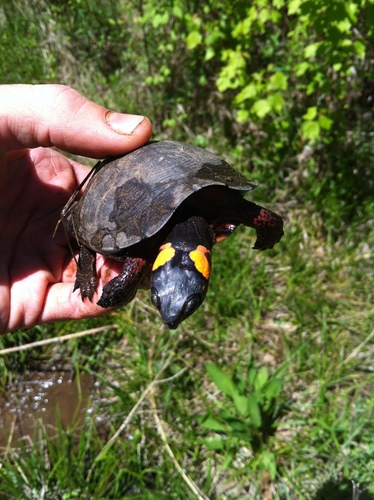
The bog turtle, also known commonly as Muhlenberg's turtle, is a critically endangered species of semiaquatic turtle in the family Emydidae. The species is native to the eastern United States. It was first scientifically described in 1801 after an 18th-century survey of Pennsylvania. The smallest North American turtle, it measures about 10 centimeters (4 in) in straight carapace length when fully grown. Although the bog turtle is similar in appearance to the painted turtle and the spotted turtle, its closest relative is actually the somewhat larger wood turtle. The bog turtle can be found from Vermont in the north, south to Georgia, and west to Pennsylvania. Diurnal and secretive, it spends most of its time buried in mud and – during the winter months – in hibernation. The bog turtle is omnivorous, feeding mainly on small invertebrates. The bog turtle is the state reptile of New Jersey.
🛡️ Conservation Status
critically endangered
cr
📌 Taxonomy
that show both the top (carapace) and bottom (plastron). It is brown and black except for a bright yellow or orange spot on the side of its neck.]]
The bog turtle was noted in the 18th century by Gotthilf Heinrich Ernst Muhlenberg, a self-taught botanist and clergyman. Muhlenberg, who named more than 150 North American plant species, was conducting a survey of the flora of Lancaster County, Pennsylvania, when he discovered the small turtle. In 1801, Johann David Schoepff named Muhlenberg's discovery Testudo muhlenbergii in Muhlenberg's honor.
In 1829, Richard Harlan renamed the turtle Emys muhlenbergii. The species was subsequently renamed Calemys muhlenbergii by Louis Agassiz in 1857, and Clemmys muhlenbergii by Henry Watson Fowler in 1906. Synonyms include Emys biguttata, named in 1824 by Thomas Say on the basis of a turtle from the vicinity of Philadelphia, and Clemmys nuchalis, described by Dunn in 1917 from near Linville, North Carolina. Today, there are various names for the bog turtle, including mud turtle, marsh turtle, yellowhead, and snapper (not to be confused with the snapping turtle, which often goes by the same name). Nucleotide sequencing and ribosomal DNA analyses suggested that the bog turtle and the wood turtle are closely related, but neither is directly related to the spotted turtle, hence the separation of the genus Glyptemys.
📌 Geographic distribution and habitat
The bog turtle is native only to the eastern United States, congregating in colonies that often consist of fewer than 20 individuals. It prefers calcareous wetlands (areas containing lime), including meadows, bogs, marshes, and spring seeps, that have both wet and dry regions. Its habitat is often on the edge of woods. With habitats often time containing both overlapping wet and dry pockets
The bog turtle's preferred habitat, sometimes called a fen, is slightly acidic with a high water table year-round. The constant saturation leads to the depletion of oxygen, subsequently resulting in anaerobic conditions. Soft mud, sand, or stone characterize the bottom substrate. The bog turtle uses soft, deep mud to shelter from predators and the weather. Spring seeps and groundwater springs provide optimum locations for hibernation during winter. Home range size is sex dependent, averaging about for males and for females. The range of the bog turtle extensively overlaps that of its relative, the wood turtle.
Rushes, tussock sedge, cattails, jewelweed, sphagnum, and various native true grasses are found in the bog turtle's habitat, as well as some shrubs and trees such as willows, red maples, and alders. It is important for its habitat to have an open canopy, because the bog turtle spends a considerable amount of time basking in the sunlight. An open canopy allows sufficient sunlight to reach the ground so that the bog turtle can manage its metabolic processes through thermoregulation. The incubation of eggs also requires levels of sunlight and humidity that shaded areas typically lack. The ideal bog turtle habitat is early successional. Late successional habitats contain taller trees that block the necessary sunlight. Erosion and runoff of nutrients into the wetlands accelerate succession. Changes caused by humans have begun to eliminate bog turtles from areas where they would normally survive.
📌 Northern and southern populations
The northern and southern bog turtle populations are separated by a gap over much of Virginia, which lacks bog turtle colonies. In both areas, the bog turtle colonies tend to occupy widely scattered ranges.
The southern population is much smaller in number (only about 96 colonies have been located), The turtles in this population are even more scattered than in the northern population and live at higher elevations, up to .
📌 Evolutionary history
There have been only three recorded discoveries of bog turtle fossils. The late J. Alan Holman, a paleontologist and herpetologist, first identified bog turtle plastral remains in Cumberland Cave, Maryland (near Corriganville), which are of Irvingtonian age (from to 300,000 years ago). The second discovery was of Rancholabrean (between 300,000 and 11,000 years ago) shell pieces in the Giant Cement Quarry in South Carolina (near Harleyville), by Bentely and Knight in 1998. The third discovery was found in Livingston County, New York, at the Cole Gravel Pit archaeological site (around 3900 years ago).
The bog turtle's karyotype is composed of 50 chromosomes. The northern and southern populations are at present genetically isolated, likely as a consequence of farming and habitat destruction in Virginia's Shenandoah Valley during the American Civil War.
📌 Behavior
The bog turtle is primarily diurnal, active during the day and sleeping at night. It wakes in the early morning, basks until fully warm, then begins its search for food. During colder days, the bog turtle will spend much of its time in dense underbrush, underwater, or buried in mud. or become subterranean, sometimes occupying networks of tunnels filled with water.
Late September to March or April with the larger and older male usually winning. The female is also aggressive when threatened. She will defend the area around her nest, usually up to a radius of , from encroaching females, but when a juvenile approaches, she ignores it, and when a male appears she surrenders her area (except during mating season).
s prey on the bog turtle.|alt=Two skunks displaying their tails and backsides. The skunk on the right is larger than the one on the left, and both are facing towards the middle of the image.]]
📌 Predators, parasites, and diseases
A host of different animals, including common snapping turtles, herons and egrets, common water snakes, common garter snakes, Virginia opossums, American mink, muskrats, striped skunks, spotted skunks, gray foxes, red foxes, dogs, coyotes, and raccoons prey upon adults and juveniles of bog turtles. In addition, leeches (Placobdella multilineata and P. parasitica) and parasitic flies (Cistudinomyia cistudinis) plague some individuals, causing blood loss and weakness. Its shell offers little protection from predators. The bog turtle's main defense when threatened by an animal is to bury itself in soft mud. It rarely defends its territory or bites when approached. Bacterial aggregates (sometimes known as biofilms) have also been found in the lungs of two deceased specimens discovered in 1982 and 1995 from colonies in the southern population.
📌 Movement
Day-to-day, the bog turtle moves very little, typically basking in the sun and waiting for prey. Though it is not especially lively on sunny days, the bog turtle is usually active after rainfall. Both sexes are capable of homing when released at distances up to from their site of capture. Home-range sizes in Maryland vary from to with considerable amounts of variation between sites and years.
Average distances traveled:
* Males: 15 meters per day
* Females: 12 meters per day
The bog turtle is semiaquatic and can move both on land and in the water. The distance and frequency of movements on land help herpetologists understand the behavior, ecology, gene flow, and the level of success of different bog turtle colonies. The vast majority of bog turtle movements are less than , and only 2 percent are of distances over ; large, expansive trips (i.e., between neighboring wetlands), are rare.
The movement of bog turtles between colonies facilitates genetic diversity. If this movement were to be prevented, or limited in any significant way, the species would have a higher likelihood of becoming extinct because genetic diversity would fall. Some aspects of a bog turtle's movement that remain unresolved include: phenomena that motivate bog turtles to move outside their natural habitat; the distances an individual can be expected to travel each day, week, and year; and how separation of small groups affects the genetics of the species.
📌 Life cycle
Bog turtles are sexually mature when they reach between 8 and 11 years of age (both sexes). They mate in the spring after emerging from hibernation, in a copulation session that usually lasts for 5–20 minutes, typically during the afternoon, and may occur on land or in the water. It begins with the male recognizing the female's sex. During the courtship ritual, the male gently bites and nudges the female's head. Younger males tend to be more aggressive during copulation, and females sometimes try to avoid an over-aggressive male. However, as the female ages, she is more likely to accept the aggressiveness of a male, and may even take the role of initiator. If the female yields, she may withdraw her front limbs and head. After the entire process is over, which usually takes about 35 minutes, The nest is typically deep and around. The eggs are white, elliptical, and on average long and wide. Both genders grow rapidly until they reach maturity. Juveniles almost double in size in their first four years, but do not become fully grown until five or six years old. and the average lifespan is 20–30 years. The age of a bog turtle is determined by counting the number of rings in a scute, minus the first one (which develops before birth).
📌 Conservation
Protected under the United States Federal Endangered Species Act, Despite regulations prohibiting their collection, barter, or export, bog turtles are commonly taken by poachers. The bog turtle was listed as critically endangered in the 2011 IUCN Red List.
The development of new neighborhoods and roadways obstructs the bog turtle's movement between wetlands, thus inhibiting the establishment of new bog turtle colonies. Pesticides, runoff, and industrial discharge are all harmful to the bog turtles' habitat and food supply.
Today, the rebounding of bog turtle colonies depends on private intervention. Population monitoring involves meticulous land surveys over vast countrysides. In addition to surveying land visually, remote sensing has been used to biologically classify a wetland as either suitable or unsuitable for a bog turtle colony. This allows for comparisons to be made between known areas of bog turtle success and potential areas of future habitation.
To help the existing colonies rebound, several private projects have been initiated in an attempt to limit the encroachment of overshadowing trees and bushes, the construction of new highways and neighborhoods, and other natural and man-made threats. and promoting beaver activity, including dam construction in and around wetlands.
The study of bog turtles in the wild is a significant aid to the development of a conservation strategy. Radio telemetry has been used to track the turtles' movements in their natural habitat.