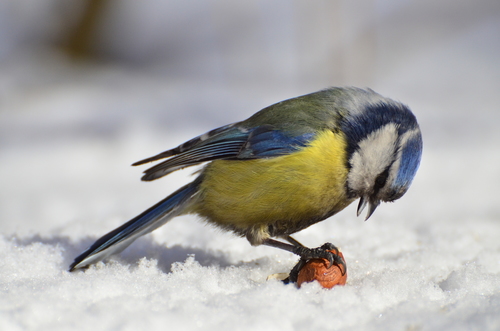
The Eurasian blue tit is a small passerine bird in the tit family, Paridae. It is easily recognised by its blue and yellow plumage and small size.
📌 Taxonomy
The Eurasian blue tit was first described by Carl Linnaeus in 1758 in the 10th edition of his Systema Naturae under the binomial name Parus caeruleus. Two centuries earlier, before the introduction of the binomial nomenclature, the same Latin name had been used by the Swiss naturalist Conrad Gesner when he described and illustrated the blue tit in his Historiae animalium of 1555. The genus Cyanistes now contains three species, the Eurasian blue tit, the African blue tit, and the azure tit.
📌 Subspecies
Nine subspecies are recognised.
* C. c. obscurus – (Pražák, 1894): found in Ireland, Britain and Channel Islands
* C. c. caeruleus – (Linnaeus, 1758): the nominate subspecies, occurring in Continental Europe to northern Spain, Sicily, northern Turkey and northern Urals
* C. c. balearicus – (von Jordans, 1913): native to Majorca Island (Balearic Islands)
* C. c. ogliastrae – (Hartert, 1905): found in Portugal, southern Spain, Corsica and Sardinia
* C. c. calamensis – (Parrot, 1908): found in southern Greece, Pelopónnisos, Cyclades, Crete and Rhodes
* C. c. orientalis – Zarudny & Loudon, 1905: found in southern European Russia (Volga River to central and southern Urals)
* C. c. satunini – Zarudny, 1908: found in the Crimean Peninsula, Caucasus, Transcaucasia and northwestern Iran to eastern Turkey
* C. c. raddei – Zarudny, 1908: found in northern Iran
* C. c. persicus – (Blanford, 1873): found in the Zagros Mountains
📌 Hybrids
Pleske's tit (Cyanistes × pleskei) is a common interspecific hybrid between this species and the azure tit (Cyanistes cyanus), in western Russia. Such birds can resemble azure tits, but have less white on their tails and a hint of yellow on their chests, or resemble blue tits, but have whitish underparts.
📌 Distribution and habitat
]]
There are currently around 20 to 44 million pairs in Europe.
📌 Behaviour and ecology
Eurasian blue tits and great tits form mixed winter flocks, and the former are perhaps better at balancing on slender twigs. A Eurasian blue tit often ascends a tree trunk in short, jerky hops, reminiscent of a treecreeper. The bird usually roosts in ivy or evergreens, but in harsh winters it will roost wherever it can find a suitable small hole, whether in a tree or a nesting box. They are very agile and can hang from almost anywhere.
It is a common and popular European garden bird, due to its perky acrobatic performances when visiting bird feeders. It swings beneath the feeder, calling "tee, tee, tee" or a scolding "churr".
📌 Breeding
File:Cyanistes caeruleus -Norfolk, England -adult feeding chick-8.jpg|Feeding the young at a nest box in England
File:Blue Tit Nest 06-05-12 (7003304998).jpg|Eggs in a nest in England
File:20120606 182000 Side w.jpg|Young inside a nestbox in Nittedal, Norway
File:PimpelMezen Voeren Jongen.webm|Feeding young
The Eurasian blue tit will nest in any suitable hole, whether in a tree, wall, or stump, or in an artificial nest box. They often compete with house sparrows or great tits for these sites. Few birds are more likely to accept the shelter of a nesting box, and the same hole is often used year after year. When one pair dies, another takes its place.
During the incubation period, the female blue tit does all of the incubating, while the male feeds her. During the nestling period, both female nest attendance and male feeding rates are higher in the morning, declining throughout the day. Although blue tits are socially monogamous, they regularly engage in extra-pair copulations with other individuals.
, London]]
Eggs are long and wide. Egg size appears to depend mostly on the size of individual females and secondarily on habitat, with smaller eggs found at higher altitudes. The clutch's total weight can be 1.5 times as heavy as the female bird.
Eurasian blue tits sit closely on their nests, hissing and biting at any intruding fingers. In the southwest of England, this behaviour has earned the species the colloquial nickname "Little Billy Biter" or "Billy Biter". When protecting its eggs, it raises its crest, but this is a sign of excitement rather than anger, as it is also elevated during the nuptial display.
The nesting material is usually moss, wool, hair, and feathers, and the eggs are laid in April or May. The number in the clutch is often very large, but seven or eight eggs are normal. Clutch size varies with latitude and other geographic parameters. In some locations, larger clutches may be laid by two or even more hens, but single-hen clutches of 14 have been verified in the UK. During the height of the breeding season, it is not unusual for a single bird to feed the chicks in the nest at a rate of one feeding every 90 seconds. In winter, they form flocks with other tit species.
An analysis of ring-recovery data in Britain revealed that the survival rate for juveniles in their first year was 38%, compared to an annual survival of 53% for adults. This suggests that the typical life expectancy of a bird upon reaching breeding age is three years. The oldest recorded blue tit in Britain was ringed in Bedfordshire and lived for 10 years and 3 months, while the oldest bird overall was ringed in the Czech Republic and lived for 11 years and 7 months.
📌 Food and feeding
in England]]
The Eurasian blue tit's diet consists mainly of insects, spiders and other small invertebrates, but it will also eat fruits and seeds outside of the breeding season. Animal items taken include springtails (Collembola), grasshoppers (Orthoptera), damselflies (Odonata), earwigs (Dermaptera), moths (Lepidoptera) and lacewings (Neuroptera). It often takes items while hanging upside-down. While foraging, it probes into opening buds and peels bark from hazel trees (Corylus). It rarely hovers and only very occasionally forages on the ground. It visits bird tables and takes bread, cheese, fat and a variety of seeds, especially sunflower seeds (Helianthus. Large seeds are carried to a nearby branch, where they are opened by holding the seed with one foot while hammering it with the bill.
📌 Voice
Eurasian blue tits use songs and calls throughout the year. Songs are mostly performed in late winter and spring to defend the territory or to attract mates. Calls are used for multiple reasons, The information conveyed by begging calls can be masked by anthropogenic noise, and the age-related variation in calls may mean some phases of nestling development are more vulnerable to this disruption than others.
📌 Learned behaviour
An interesting example of culturally transmitted learning in birds is the phenomenon, dating from the 1920s, of blue tits teaching one another to open traditional British milk bottles with foil tops to access the cream underneath. Such behaviour has since been gradually suppressed due to the declining popularity of both full-fat milk and milk delivery. In addition, the instinct to strip bark from trees in search of insects has developed into a tendency to peel building materials such as thatch, wallpaper, stucco and window putty.
📌 Predators and natural threats
The small size of the Eurasian blue tit makes it vulnerable to predation by larger birds such as jays, which catch the vulnerable fledglings when they leave the nest. The most important predators are probably the Eurasian sparrowhawk, closely and the domestic cat. Nests may also be robbed by mammals such as weasels and red squirrels, as well as introduced grey squirrels in the UK.
Successful chick breeding depends on a sufficient supply of green caterpillars, as well as favourable weather. Breeding seasons may be badly affected if the weather is unseasonably cold and wet between May and July, particularly if this coincides with the emergence of caterpillars on which the nestlings are fed.
📌 Parasites
Eurasian blue tits are known to be host to feather mites, and occasionally lice and flat flies. In Europe, the only feather mite species known to live on blue tits is Proctophyllodes stylifer. However, this mite does not appear to cause any harm to the bird, as it is only known to feed on dead feather tissue. P. stylifer lives through all its developmental stages, i.e. egg, larva, protonymph, tritonymph and adult, within the plumage of the same host. The usual sites where P. stylifer is encountered are in the remiges and the rectrices of the bird where they can be found randomly positioned between the barbs of the rachis.
📌 Status and conservation
The long-term population trend of the Eurasian blue tit in Europe is positive, with numbers increasing by 30 per cent between 1980 and 2016. During this period, the range limit shifted northwards by in Fennoscandia. Laying dates have advanced, and the warmer springs increase the likelihood of second broods. The species is classified as a of least concern in the Red list of the International Union for Conservation of Nature, and as a Green Status species, since 1996, by the Royal Society for the Protection of Birds in the United Kingdom.
📌 Cultural significance
The Eurasian blue tit has appeared on many stamps and ornaments. Its most recent appearance on a British stamp was in the 2025 "Garden Wildlife" series.