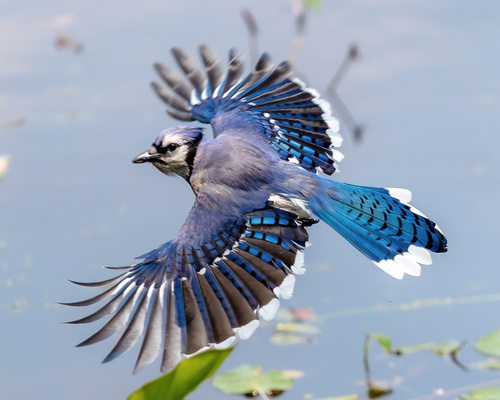
The blue jay is a passerine bird in the family Corvidae, native to eastern North America. It lives in most of the eastern and central United States; some eastern populations may be migratory. Resident populations are also in Newfoundland, Canada; breeding populations are found across southern Canada. It breeds in both deciduous and coniferous forests, and is common in residential areas. Its coloration is predominantly blue, with a white chest and underparts, and a blue crest; it has a black, U-shaped collar around its neck and a black border behind the crest. Males and females are similar in size and plumage, which does not vary throughout the year. Four subspecies have been recognized.
📌 Taxonomy
The blue jay was first described as Pica glandaria cærulea cristata in English naturalist Mark Catesby's 1731 publication of Natural History of Carolina, Florida, and the Bahamas. It was later described as Corvus cristatus in Carl Linnaeus' 1758 edition of Systema Naturae. In the 19th century, the jay was described by French ornithologist Charles Lucien Bonaparte in 1838 as Cyanocorax cristatus in A geographical and comparative list of the birds of Europe and North America, and given its modern scientific name Cyanocitta cristata by Hugh Edwin Strickland in 1845. The genus name Cyanocitta derives from the Greek words kyaneos (blue) and the kitta and kissa (chattering bird, jay), and the term "blue chatterer" refers to the bright blue plumage of the head, nape, back, and tail of the bird. The specific name cristata (crested, tufted) derives from Latin referring to the prominent blue crest of the jay.
📌 Distribution and habitat
The blue jay occurs from southern Canada and throughout the eastern and central United States south to Florida and northeastern Texas. The western edge of the range stops where the arid pine forest and scrub habitat of the closely related Steller's jay (C. stelleri) begins, generally in the eastern foothills of the Rocky Mountains. Recently, the range of the blue jay has extended northwestwards so that it is now a rare but regularly seen winter visitor along the northern US and southern Canadian Pacific Coast.
The increase in trees throughout the Great Plains during the past century due to fire suppression and tree planting facilitated the western range expansion of the blue jay as well as range expansions of many other species of birds. From 1966 to 2015, the Blue Jay experienced a population decline along the Atlantic coast, but a greater than 1.5% annual population increase throughout the northern part of its range, including Labrador, Nova Scotia, southern Quebec, and southern Manitoba.
The northernmost subspecies C. c. bromia is, subject to necessity, migratory. It may withdraw several hundred kilometers south in the northernmost parts of its range. Thousands of blue jays have been observed to migrate in flocks along the Great Lakes and Atlantic coasts. It migrates during the daytime, in loose flocks of 5 to 250 birds. Much about their migratory behavior remains a mystery. Some are present throughout winter in all parts of their range. Young jays may be more likely to migrate than adults, but many adults also migrate. Some individual jays migrate south one year, stay north the next winter, and then migrate south again the next year. To date, no one has concretely worked out why they migrate when they do. Likely, it is related to weather conditions and how abundant the winter food sources are, which can determine whether other northern birds will move south.
The blue jay occupies a variety of habitats within its large range, from the pine woods of Florida to the spruce-fir forests of northern Ontario. It is less abundant in denser forests, preferring mixed woodlands with oaks and beeches. It has adapted to human activity very well, occurring in parks and residential areas, and can adapt to wholesale deforestation with relative ease if human activity creates other means for the jays to get by.
📌 Subspecies
Four subspecies are generally accepted, though the variation within this species is rather subtle and essentially clinal. No firm boundaries can be drawn between the inland subspecies. The ranges of the coastal races are better delimited.
|-
| || Cyanocitta cristata cristata|| Coastal blue jay || The nominate subspecies, mid-sized and vivid blue. || Coastal USA from North Carolina to Texas, except southern Florida. Type locality: southeastern South Carolina.
|-
| || Cyanocitta cristata semplei
| Florida blue jay || The smallest subspecies, much like C. c. bromia in color. || Southern Florida. Type locality: Coconut Grove, Miami-Dade County, Florida.
|-
|}
📌 Behavior
chasing a blue jay]]
The blue jay is a noisy, bold, and aggressive passerine. It is a moderately slow flier (roughly ) when unprovoked. It flies with body and tail held level, with slow wing beats.
Its slow flying speeds make this species easy prey for hawks and owls when it flies in open areas. Virtually all the raptorial birds sympatric in distribution with the blue jay may prey upon it, especially swift bird-hunting specialists such as the Accipiter hawks. Diverse predators may prey on jay eggs and young up to their fledgling stage, including tree squirrels, snakes, cats, crows, raccoons, opossums, other jays and possibly many of the same birds of prey who attack adults.
The blue jay can be beneficial to other bird species, as it may chase predatory birds, such as hawks and owls, and will scream if it sees a predator within its territory. It has also been known to sound an alarm call when hawks or other dangers are near, and smaller birds often recognize this call and hide themselves away accordingly. It may occasionally impersonate the calls of raptors, especially those of the red-tailed and red-shouldered hawks, possibly to test whether a hawk is in the vicinity, though also possibly to scare off other birds that may compete for food sources. It may also be aggressive towards humans who come close to its nest, and if an owl roosts near the nest during the daytime the blue jay mobs it until it takes a new roost. Jays are very territorial birds, and they will chase others from a feeder for an easier meal. Additionally, the blue jay may raid other birds' nests, stealing eggs, chicks, and nests. However, this may not be as common as is typically thought, as only 1% of food matter in one study was bird material.
Blue jays, like other corvids, are highly curious and are considered intelligent birds. Young individuals playfully snatch brightly colored or reflective objects, such as bottle caps or pieces of aluminum foil, and carry them around until they lose interest. A wild blue jay was observed using a piece of bark to aid in catching a spider.
📌 Reproduction
The mating season begins in mid-March, peaks in mid-April to May, and extends into July. Any suitable tree or large bush may be used for nesting, though an evergreen is preferred. The nest is preferentially built at a height in the trees of . It is cup-shaped and composed of twigs, small roots, bark strips, moss, other plant material, cloth, paper, and feathers, with occasional mud added to the cup.
Blue jays are not very picky about nesting locations. If no better place is available – such as in a heavily deforested area – they will even use places like the large mailboxes typical of the rural United States. Another wild jay was found to have been around years old. A more common lifespan for wild birds that survive to adulthood is around 7 years. Beyond predation and the occasional collision with man-made objects, a common cause of mortality in recent decades has been the West Nile virus, to which corvids as a whole seem especially susceptible. However, despite several major local declines, overall blue jays have not seemed to have been depleted by the disease.
📌 Vocalizations
Blue jays can make a large variety of sounds, and individuals may vary perceptibly in their calling style. Like other corvids, they may learn to mimic human speech. Blue jays can also copy the cries of local hawks so well that it is sometimes difficult to tell which it is. Their voice is typical of most jays in being varied, but the most commonly recognized sound is the alarm call, which is a loud, almost gull-like scream. There is also a high-pitched jayer-jayer call that increases in speed as the bird becomes more agitated. This particular call can be easily confused with the chickadee's song because of the slow-starting chick-ah-dee-ee. Blue jays will use these calls to band together to mob potential predators such as hawks and drive them away from the jays' nests.
Blue jays also have quiet, less noticeable calls which they use among themselves in proximity. One of the most distinctive calls of this type is often referred to as the "rusty pump" owing to its squeaky resemblance to the sound of an old hand-operated water pump. The blue jay (and other corvids) are distinct from most other songbirds for using their call as a song.
📌 In human culture
===Fiction and folklore===
In old African-American folktales of the southern United States, the blue jay was a significant metaphysical creature. In some tales, the blue jay was credited with making the earth "when all de worl' was water" by bringing the first "grit" or "dirt". In other tales the blue jay was temporarily conscripted as a servant of the Devil, and would not be seen on Friday as it was gathering twigs to furnish hell's kindling and give fire to wicked men on Earth. Relieved from duty on Saturday, its song for the day was abundant and joyous.
An anthropomorphic blue jay named Mordecai is one of the main characters of the Cartoon Network animated television series Regular Show.
📌 Mascots and symbols
The blue jay is the provincial bird of the province of Prince Edward Island in Canada.
The blue jay is also the official mascot for Johns Hopkins University, Elmhurst University, and Creighton University.
The blue jay was adopted as the team symbol of the Toronto Blue Jays Major League Baseball team, as well as some of their minor league affiliates. Their mascot, Ace, is an anthropomorphic blue jay.