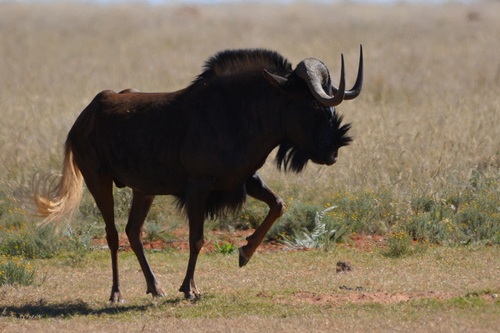
The black wildebeest or white-tailed gnu is one of the two closely related wildebeest species. It is a member of the genus Connochaetes and family Bovidae. It was first described in 1780 by Eberhard August Wilhelm von Zimmermann. The black wildebeest is typically 1.7–2.2 m in head-and-body length, and the typical weight is 110–180 kg (240–400 lb). Males stand about 1.11–1.21 m at the shoulder, while the height of the females is 1.06–1.16 m. The black wildebeest is characterised by its white, long, horse-like tail. It also has a dark brown to black coat and long, dark-coloured hair between its forelegs and under its belly.
📌 Taxonomy and evolution
The scientific name of the black wildebeest is Connochaetes gnou. The animal is placed in the genus Connochaetes and family Bovidae and was first described by German zoologist Eberhard August Wilhelm von Zimmermann in 1780. He based his description on an article written by natural philosopher Jean-Nicolas-Sébastien Allamand in 1776. The specific name gnou originates from the Khoikhoi name for these animals, gnou. The common name "gnu" is also said to have originated from the Hottentot name t'gnu, which refers to the repeated calls of "ge-nu" by the bull in the mating season. The black wildebeest lineage seems to have diverged from the blue wildebeest in the mid- to late Pleistocene, and became a distinct species around a million years ago.
Features necessary for defending a territory, such as the horns and broad-based skull of the modern black wildebeest, have been found in their fossil ancestors. The earliest known fossil remains are in sedimentary rock in Cornelia in the Free State and date back about 800,000 years. Fossils have also been reported from the Vaal River deposits, though whether or not they are as ancient as those found in Cornelia is unclear. Horns of the black wildebeest have been found in sand dunes near Hermanus in South Africa. This is far beyond the recorded range of the species and these animals may have migrated to that region from the karoo.
📌 Hybrids
The black wildebeest is known to hybridise with its taxonomically close relative, the blue wildebeest. Male black wildebeest have been reported to mate with female blue wildebeest and vice versa. Another study reported an increase in the size of the hybrid as compared to either of its parents. In some animals, the auditory bullae are highly deformed, and in others, the radius and ulna are fused.
📌 Diseases and parasites
The black wildebeest is particularly susceptible to anthrax, and rare and widely scattered outbreaks have been recorded and have proved deadly. Ataxia related to myelopathy and low copper concentrations in the liver have also been seen in the black wildebeest. Heartwater (Ehrlichia ruminantium) is a tick-borne rickettsial disease that affects the black wildebeest, and as the blue wildebeest is fatally affected by rinderpest and foot-and-mouth disease, it is also likely to be susceptible to these. Malignant catarrhal fever is a fatal disease of domestic cattle caused by a gammaherpesvirus. Like the blue wildebeest, the black wildebeest seems to act as a reservoir for the virus and all animals are carriers, being persistently infected, but showing no symptoms. The virus is transmitted from mother to calf during the gestation period or soon after birth.
Black wildebeest act as hosts to a number of external and internal parasites. A study of the animal in Karroid Mountainveld (Eastern Cape Province, South Africa) revealed the presence of all the larval stages of the nasal bot flies Oestrus variolosus and Gedoelstia hässleri. The first-instar larvae of G. hässleri were found in large numbers on the dura mater of wildebeest calves, specially between June and August, and these later migrated to the nasal passages. Repeated outbreaks of mange (scab) have led to large-scale extinctions.
📌 Ecology and behavior
in Gauteng, South Africa]]
Black wildebeest are mainly active during the early morning and late afternoon, preferring to rest during the hottest part of the day. The animals can run at speeds of . They are preyed on by the lion, spotted hyena, Cape hunting dog, leopard, cheetah, and Nile crocodile. Of these, the calves are targeted mainly by the hyenas, while lions attack the adults. Young males are generally repelled by their mothers before the calving season starts. Separation of a young calf from its mother can be a major cause of calf mortality. While some male yearlings stay within the female herd, the others join a bachelor herd. These are usually loose associations, and unlike the female herds, the individuals are not much attached to each other. Another difference between the female and bachelor herds is the lesser aggression on the part of the males. These bachelor herds move widely in the available habitat and act as a refuge for males that have been unsuccessful as territorial bulls, and also as a reserve for future breeding males.
Mature bulls, generally more than 4 years old, set up their own territories through which female herds often pass. These territories are maintained throughout the year, with animals usually separated by a distance around , but this can vary according to the quality of the habitat. In favourable conditions, this distance is as little as , but can be as large as in poor habitat. Each bull has a patch of ground in the centre of his territory in which he regularly drops dung, and in which he performs acts of display. These include urinating, scraping, pawing, and rolling on the ground and thumping it with his horns - all of which demonstrate his prowess to other bulls. An encounter between two bulls involves elaborate rituals. Estes coined the term "challenge ritual" to describe this behaviour for the blue wildebeest, but this is also applicable to the black wildebeest, owing to their close similarity in behavior. The bulls approach each other with their heads lowered, resembling a grazing position (sometimes actually grazing). This is usually followed by movements such as standing in a reverse-parallel position, in which one male urinates and the opponent smells and performs flehmen, after which they may reverse the procedure. During this ritual or afterwards, the two can toss their horns at each other, circle one another, or even look away. Then begins the fight, which may be of low intensity (consisting of interlocking the horns and pushing each other in a standing position) or high intensity (consisting of their dropping to their knees and straining against each other powerfully, trying to remain in contact while their foreheads are nearly touching the ground). Threat displays such as shaking the head may also take place.
📌 Reproduction
Male black wildebeest reach sexual maturity at the age of 3 years, but may mature at a younger age in captivity. Females first come into estrus and breed as yearlings or as 2-year-olds.
in Gauteng, South Africa]]
The gestation period lasts for about 8.5 months, after which a single calf is born. Females in labour do not move away from the female herd and repeatedly lie down and get up again. Births normally take place in areas with short grass when the cow is in the lying position. She stands up immediately afterwards, which causes the umbilical cord to break, and vigorously licks the calf and chews on the afterbirth. In spite of regional variations, around 80% of the females give birth to their calves within a period of 2–3 weeks after the onset of the rainy season - from mid-November to the end of December. Seasonal breeding has also been reported among wildebeest in captivity in European zoos. Twin births have not been reported.
The calf has a tawny, shaggy coat and weighs about . By the end of the fourth week, the four incisors have fully emerged and about the same time, two knob-like structures, the horn buds, appear on the head. These later develop into horns, which reach a length of by the fifth month and are well developed by the eighth month. The calf is able to stand and run shortly after birth, a period of great danger for animals in the wild. It is fed by its lactating mother for 6–8 months, begins nibbling on grass blades at one month, and remains with the mother until her next calf is born a year later.
📌 Distribution and habitat
(1753 – 1790)]]
The black wildebeest is native to southern Africa. Its historical range included South Africa, Eswatini, and Lesotho, but in the latter two countries, it was hunted to extinction in the 19th century. It has now been reintroduced there and also introduced to Namibia, where it has become well established. In most reserves, the black wildebeest shares its habitat with the blesbok and the springbok.
📌 Threats and conservation
]]
Where it lives alongside the blue wildebeest, the two species can hybridise, and this is regarded as a potential threat to the maintenance of the species. The black wildebeest was once very numerous and was present in Southern Africa in vast herds, but by the end of the 19th century, it had nearly been hunted to extinction and fewer than 600 animals remained. A small number of individuals was still present in game reserves and at zoos, and from these, the population was rescued.
More than 18,000 individuals are now believed to remain, 7,000 of which are in Namibia, outside their natural range, and where they are farmed. Around 80% of the wildebeest occurs in private areas, while the other 20% is confined in protected areas. The population is now trending upward (particularly on private land) and for this reason the International Union for Conservation of Nature, in its Red List of Threatened Species, rates the black wildebeest as being of least concern Its introduction into Namibia has been a success and numbers have increased substantially there from 150 in 1982 to 7,000 in 1992.
📌 Uses and interaction with humans
The black wildebeest is depicted on the coat of arms of the Province of Natal in South Africa. Over the years, the South African authorities have issued stamps displaying the animal and the South African Mint has struck a 5-rand coin with a prancing black wildebeest.
Though they are not present in their natural habitat in such large numbers today, black wildebeest were at one time the main herbivores in the ecosystem and the main prey item for large predators such as the lion. Now, they are economically important for human beings, as they are a major tourist attraction, and provide animal products such as leather and meat. The hide makes good-quality leather, and the flesh is coarse, dry, and rather tough. The wildebeest can provide 10 times as much meat as a Thomson's gazelle. The silky, flowing tail is used to make fly-whisks or chowries.