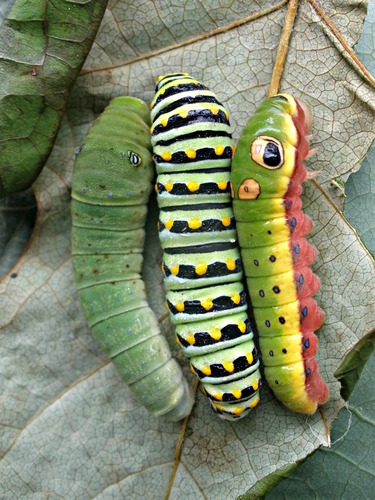
Papilio polyxenes, the (eastern) black swallowtail, American swallowtail or parsnip swallowtail, is a butterfly found throughout much of North America. An extremely similar-appearing species, Papilio joanae, occurs in the Ozark Mountains region, but it appears to be closely related to Papilio machaon, rather than P. polyxenes. The species is named after the figure in Greek mythology, Polyxena, who was the youngest daughter of King Priam of Troy. Its caterpillar is often called the "parsley worm" because the caterpillar feeds on parsley.
π Taxonomy
Papilio polyxenes is part of the tribe Papilionini of the swallowtail butterfly family, Papilionidae. The members of this tribe all have tails on the hindwings, and therefore include species named swallowtail. P. polyxenes is part of the genus Papilio, which is the biggest group of the family Papilionidae. Subspecies polyxenes, once found in Cuba, is now considered likely extinct. Members of this genus typically feed on plants of the family Lauraceae, Rutaceae and Umbelliferae.
π Distribution
Papilio polyxenes are found from southern Canada through to South America. In North America they are more common east of the Rocky Mountains. They are usually found in open areas like fields, parks, marshes or deserts, and they prefer tropical or temperate habitats.
π Eggs and larvae
Eggs are pale yellow. Young larvae are mostly black and white with a saddle, and older larvae are green with black transverse bands containing yellow spots.
π Caterpillar and chrysalis
This caterpillar absorbs toxins from the host plants, and therefore tastes poor to bird predators. A section of the green pupae will turn a much darker green at the very end of the pupae stage. This color change occurs a few hours to a full day before hatching.
π Sexual dimorphism
, New Jersey, United States]]
The black swallowtail has a wingspan of 6.9β8.4 cm, and females are typically larger than males.
Both sexes show a red spot with a black bullseye on the inner hind margin of the hindwings and an isolated yellow spot on the front edge of the wings. The ventral side of wings of males and females are essentially identical: forewings have two rows of pale yellow spots, and hindwings have rows of bright orange spots separated by areas of powdery blue. The ventral side also acts as an effective mimic for both males and females for protection against predators.
π Mimicry
Female markings are similar to those of B. philenor, allowing females to engage in dorsal mimicry to reduce risk of predation by birds that preferentially prey on the black swallowtail. Females have evolved dorsal mimicry because they spend more time revealing their dorsal wing side during oviposition. The ventral wing surface of the black swallowtail also mimics that of B. philenor, so both males and females are protected when their ventral wing surface is displayed.
π Intrasexual selection
Male black swallowtails can sometimes mimic the female wing-back pattern, and therefore succeed in reduced predation as well.
π Life cycle
Females lay single eggs on host plants, usually on the new foliage and occasionally on flowers. The eggs stage lasts 4β9 days, the larval stage 10β30 days, and the pupal stage 18 days.
Feeny et al., 1985 finds that survival of eggs and larvae of P. polyxenes varies depending on the location (near Ithaca, New York) where the eggs were laid. Eggs laid on wild carrot or parsnip plants were more likely to survive to the fifth instar than were eggs laid on poison hemlock. Eggs laid on plants at elevations of above sea-level were more likely to survive than eggs laid at 120 meters above sea-level. There were also significant differences in survival rates between early and late broods in a year, and between years. In all cases, the primary cause of mortality was predation.
π Emergence
Winter is spent in the chrysalis stage, and adults will emerge in the spring to seek out host plants. Adults will emerge in the mornings on a daily basis. First brood adults will fly from mid-May until late June, second brood adults will fly from early July until late August, and occasionally a partial third brood will occur that will emerge later in the season.
]]
π Life expectancy
Members of the black swallowtail are long lived compared to other butterflies that inhabit temperate zones.
π Food plants
Papilio polyxenes use a variety of herbs in the carrot family (Apiaceae), but will choose the food plants for their larvae based on visual and chemical variations. Host plant odor is one of the cues involved in the selection of landing sites for oviposition. The responses to these cues are innate, and feeding on a host plant as a larva does not increase the preference for that plant as an adult.
* American angelica, Angelica atropurpurea
* Hairy angelica, Angelica venenosa
* Cutleaf waterparsnip, Berula erecta
* Water cowbane, Oxypolis filiformis
* Parsnip, Pastinaca sativa
* Parsley, Petroselinum crispum
* Mock bishopweed, Ptilimnium capillaceum
* Rue, Ruta graveolens
* Water parsnip, Sium suave
* Roughfruit scaleseed, Spermolepis divaricata
* Yellow pimpernel, Taenidia integerrima
* Northern prickly ash, Zanthoxylum americanum
* Golden alexanders, Zizia
π Behavior
===Thermoregulation===
Core body, or thoracic temperatures of around 24 degrees Celsius are necessary for flight.
π Territorial defense
Male butterflies secure territories to use in mate location and courtship.
Male territories are generally of high relative elevation and topographic distinctness. This feature serves as an advantage to the lek mating system described later, as males will be concentrated in predictable locations and will be easy to encounter by females.
π Aggression
In previous studies, nearly 80% of successful courtship flights were confined to a male's territory. Because a preferred territory site is crucial in mating success, males are extremely aggressive in maintaining their territory. Black swallowtails have a 4:1 male biased sex ratio, and a low female mating frequency which leads to intense male-male competition.
π Mating systems
===Protandry===
The black swallowtail is protandrous, meaning males emerge before females.
π Lek mating
This type of territorial organization leads the black swallowtail to engage in a lek mating system.
The territory that has the most male-male encounters can be seen as being the most desirable to both males and females, and is also the territory that has the highest female visitation rate. Hilltop leks give the advantage to females because they make it easy to locate mates, and competition for superiority creates an array of males who have already demonstrated their quality as a mate.
π Copulation
Males can only mate twice a day, but females will mate more than once to replace a sperm supply that has deteriorated with time.
π Similar species
* Old World swallowtail (Papilio machaon)
* Indra swallowtail (Papilio indra)
* Short-tailed swallowtail (Papilio brevicauda)
* Anise swallowtail (Papilio zelicaon)
π In popular culture
The Papilio polyxenes was named the official state butterfly of New Jersey on January 11, 2016.