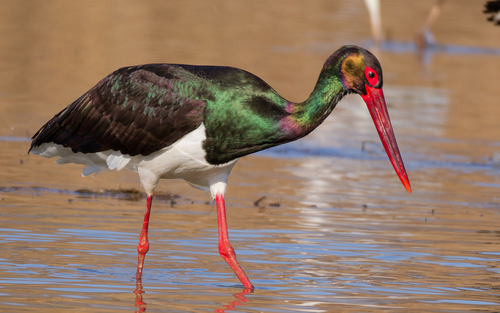
The black stork is a large bird in the stork family Ciconiidae. It was first described by Carl Linnaeus in the 10th edition of his Systema Naturae. Measuring on average 95 to 100 cm from beak tip to end of tail with a 145-to-155 cm (57-to-61 in) wingspan, the adult black stork has mainly black plumage, with white underparts, long red legs and a long pointed red beak. A widespread but uncommon species, it breeds in scattered locations across Europe, and east across the Palearctic to the Pacific Ocean. It is a long-distance migrant, with European populations wintering in tropical Sub-Saharan Africa, and Asian populations in the Indian subcontinent. When migrating between Europe and Africa, it avoids crossing broad expanses of the Mediterranean Sea and detours via the Levant in the east, the Strait of Sicily in the center, or the Strait of Gibraltar in the west. An isolated non-migratory population lives in Southern Africa.
🛡️ Conservation Status
1-И-II
1-и-ii
📌 Taxonomy and etymology
English naturalist Francis Willughby wrote about the black stork in the 17th century, having seen one in Frankfurt. He named it Ciconia nigra, from the Latin words for "stork" and "black" respectively. Fossil remains have been recovered from Miocene beds on Rusinga and Maboko Islands in Kenya, which are indistinguishable from the white and black storks.
📌 Distribution and habitat
During the summer, the black stork is found from Eastern Asia (Siberia and northern China) west to Central Europe, reaching Estonia in the north, Poland, Lower Saxony and Bavaria in Germany, the Czech Republic, Hungary, Italy and Greece in the south, with an outlying population in the central-southwest region of the Iberian Peninsula (Extremadura and surrounding provinces of Spain, plus Portugal). It is migratory, wintering in tropical Africa and Asia, although certain populations of black storks are sedentary or dispersive.
Most of the black storks that summer in Europe migrate to Africa, and Africa. Those summering further east in eastern Russia and China winter mainly in southern China, and occasionally in Hong Kong, Myanmar, northern Thailand, and Laos.
The black stork prefers more wooded areas than the better-known white stork, and breeds in large marshy wetlands with interspersed coniferous or broadleaved woodlands, but also inhabits hills and mountains with sufficient networks of creeks. It usually inhabits ponds, rivers, edges of lakes, estuaries and other freshwater wetlands. It appears to be increasing in numbers in Spain and Portugal, where the population was estimated at 405 to 483 pairs in 2006. It has been recorded in Scotland six times between 1946 and 1983, including from Shetland, Orkney and the Highlands, as well as the Scottish Borders (Peebles). It is not abundant in the western parts of its distribution, but more densely inhabits eastern Transcaucasia. Further east, it has been recorded from locations across Iran, though little is known about its habits there; breeding has been recorded from near Aliabad in Fars province, Khabr National Park in Kerman province, Karun river in Khuzestan province, Qaranqu River in East Azarbaijan province, and Aliabad river in Razavi Khorasan province. The population has declined in Iran due to draining of wetlands. East of the Ural Mountains, the black stork is patchily found in forested and mountainous areas up to 60°‒63° N across Siberia to the Pacific Ocean. South of Siberia, it breeds in Xinjiang, northwestern China, northern Mongolia south to the Altai Mountains, and northeastern China south to the vicinity of Beijing. In the Korean peninsula, the black stork is an uncommon summer visitor, no longer breeding in the south since 1966. Birds have been seen in the northeast but it is not known whether they breed there. Similarly it has been seen in the summer in Afghanistan, but its breeding status is uncertain.
📌 Migration
Migration takes place from early August to October, with a major exodus in September. Some of the Iberian populations, and also those in southern Africa, are essentially non-migratory, though they may wander freely in the non-breeding areas. Since thermals only form over land, the black stork, together with large raptors, must cross the Mediterranean at the narrowest points, and many black storks travel south through the Bosphorus and on through the Sinai, The western route goes over the Rock of Gibraltar or over the Bay of Gibraltar, generally on a southwesterly track that takes them to the central part of the strait, from where they reach Morocco. Many birds then fly around the Sahara next to the coast.
Spain contains several important areas—Monfragüe National Park, Sierra de Gredos Regional Park, National Hunting Reserve in Cíjara, Natural Park of the Sierra Hornachuelos and Doñana National Park—where black storks stop over on the western migration route. Pesticide use has threatened birdlife in nearby Doñana. Further south, Lake Faguibine in Mali is another stopover point but it has been affected by drought in recent years.
📌 Behaviour
A wary species, the black stork avoids contact with people. It rarely indulges in mutual bill-clattering when adults meet at the nest. Adults will do so as part of their mating ritual or when angered. The young clatter their bills when aroused.
The up-down display is used for a number of interactions with other members of the species. Here a stork positions its body horizontally and quickly bobs its head up from down-facing to around 30 degrees above horizontal and back again, while displaying the white segments of its plumage prominently, and this is repeated several times. The display is used as a greeting between birds, and—more vigorously—as a threat display. The species' solitary nature means that this threat display is rarely witnessed.
📌 Breeding
black stork foraging in a ditch in the Netherlands]]
The black stork breeds between April and May in the Northern Hemisphere, The nest is large, constructed from sticks and twigs, and sometimes also large branches, at an elevation of . A 2004 field study of nesting sites in Dadia-Lefkimi-Soufli National Park in north-eastern Greece found that it preferred the Calabrian pine (Pinus brutia), which had large side branches that allowed it to build the nest away from the trunk, as well as black pine (Pinus nigra) and to a lesser extent Turkey oak (Quercus cerris). It chose the largest trees in an area, generally on steeper ground and near streams. Trees chosen were on average over 90 years old. In the Iberian peninsula it nests in pine and cork oak (Quercus suber). The eggs are laid with an interval of two days.
📌 Feeding
The black stork mainly eats fish, It may feed on amphibians, small reptiles, crabs, mammals and birds, and invertebrates such as snails,
Foraging for food takes place mostly in fresh water, though the black stork may look for food on dry land at times. The black stork wades patiently and slowly in shallow water, often alone or in a small group if food is plentiful. It has been observed shading the water with its wings while hunting. In India, it often forages in mixed species flocks with the white stork, woolly-necked stork (Ciconia episcopus), demoiselle crane (Grus virgo) and bar-headed goose (Anser indicus). The black stork also follows large mammals such as deer and livestock, presumably to eat the invertebrates and small animals flushed by their presence.
📌 Parasites and symbionts
More than 12 species of parasitic helminth have been recorded from black storks with Cathaemasia hians and Dicheilonema ciconiae reported to be the most dominant. The juvenile black stork, although having a less diverse helminth population, is parasitized more frequently than the adult. A herpes virus is known from black storks. Birdlice that have been recorded on the species include Neophilopterus tricolor, Colpocephalum nigrae, and Ardeicola maculatus. A diverse array of predatory mesostigmatid mites—particularly the genera Dendrolaelaps and Macrocheles—have been recovered from black stork nests. Their role is unknown, though they could prey on parasitic arthropods.
📌 Status and conservation
Since 1998, the black stork has been rated as a species of least concern on the IUCN Red List of Endangered Species. This is because it has a large range—more than 20,000 km2 (7,700 mi2)—and because its population is thought not to have declined by 30% over ten years or three generations and thus is not a rapid enough decline to warrant a vulnerable rating. Even so, the state of the population overall is unclear, The population in India—a major wintering ground—is declining. Previously a regular winter visitor to the Mai Po Marshes, it is now seldom seen there, and appears to be in decline in China overall. Its habitat is changing rapidly in much of eastern Europe and Asia. Various conservation measures have been taken, including Wetlands International's Conservation Action Plan for African black storks, which focuses on improving the wintering conditions of the birds which breed in Europe. It is protected by the Agreement on the Conservation of African-Eurasian Migratory Waterbirds (AEWA) and the Convention on International Trade in Endangered Species of Wild Fauna and Flora (CITES).
Hunters threaten the black stork in some countries of southern Europe and Asia, such as Pakistan, and breeding populations may have been eliminated there. The black stork vanished from the Ticino River valley in northern Italy, with hunting a likely contributor. In 2005, black storks were released into the Parco Lombardo del Ticino in an attempt to re-establish the species there.
Since October 2021, the black stork has been classified as Moderately Depleted by the IUCN Green Status of Species.