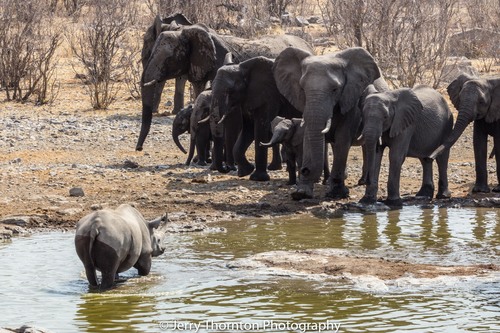
The black rhinoceros, also called the black rhino or the hooked-lip rhinoceros, is a species of rhinoceros native to East and Southern Africa, including Angola, Botswana, Eswatini, Kenya, Lesotho, Malawi, Mozambique, Namibia, South Africa, Tanzania, Zambia, and Zimbabwe. Although the species is referred to as black, its colours vary from brown to grey. It is the only extant species of the genus Diceros.
🛡️ Conservation Status
critically endangered
cr
📌 Taxonomy
The species was first named Rhinoceros bicornis by Carl Linnaeus in the 10th edition of his Systema naturae in 1758. The name means "double-horned rhinoceros". There is some confusion about what exactly Linnaeus conceived under this name as this species was probably based upon the skull of a single-horned Indian rhinoceros (Rhinoceros unicornis), with a second horn artificially added by the collector. Such a skull is known to have existed and Linnaeus even mentioned India as origin of this species. However he also referred to reports from early travellers about a double-horned rhino in Africa and when it emerged that there is only one, single-horned species of rhino in India, Rhinoceros bicornis was used to refer to the African rhinos (the white rhino only became recognised in 1812). In 1911 this was formally fixed and the Cape of Good Hope officially declared the type locality of the species.
📌 Subspecies
The intraspecific variation in the black rhinoceros has been discussed by various authors and is not finally settled. The most accepted scheme considers seven or eight subspecies, of which three became extinct in historical times and one is on the brink of extinction:
* Southern black rhinoceros or Cape black rhinoceros (D. b. bicornis) – Extinct. Once abundant from the Cape of Good Hope to Transvaal, South Africa and probably into the south of Namibia, this was the largest subspecies. It became extinct due to excessive hunting and habitat destruction around 1850.
* North-eastern black rhinoceros (D. b. brucii) – Extinct. Formerly central Sudan, Eritrea, northern and southeastern Ethiopia, Djibouti and northern and southeastern Somalia. Relict populations in northern Somalia vanished during the early 20th century.
* Chobe black rhinoceros (D. b. chobiensis) – A local subspecies restricted to the Chobe Valley in southeastern Angola, Namibia (Zambezi Region) and northern Botswana. Nearly extinct, possibly only one surviving specimen in Botswana. is doubted by a 2004 study. On 10 November 2011 the IUCN declared the western black rhinoceros extinct. This concept is also used by the IUCN, listing three surviving subspecies and recognizing D. b. brucii and D. b. longipes as extinct. The most important difference to the above scheme is the inclusion of the extant southwestern subspecies from Namibia in D. b. bicornis instead of in its own subspecies, whereupon the nominal subspecies is considered extant.
📌 Evolution
The rhinoceros originated in the Eocene about fifty million years ago alongside other members of Perissodactyla. The last common ancestor of living rhinoceroses belonging to the subfamily Rhinocerotinae is suggested to have lived around 16 million years ago. The two species may have descended from the Eurasian species "Ceratotherium" neumayri, but this is disputed. A 2021 genetic analysis estimated the split between the white and black rhinoceros at around 7 million years ago. with the oldest definitive record at the Pliocene–Pleistocene boundary c. 2.5 million years ago at Koobi Fora, Kenya.
A cladogram showing the relationships of recent and Late Pleistocene rhinoceros species (minus Stephanorhinus hemitoechus) based on whole nuclear genomes, after Liu et al., 2021:
Elasmotherium sibiricum
|label2=Rhinocerotinae
|2=
|2= Woolly rhinoceros (Coelodonta antiquitatis)
|2= Merck's rhinoceros (Stephanorhinus kirchbergensis)
}}
|2=Sumatran rhinoceros (Dicerorhinus sumatrensis)
}}
|label2=
|2=
}}
}}
}}|style=font-size:100%;line-height:80%}}
📌 Prehistorical range
As with many other components of the African large mammal fauna, black rhinos probably had a wider range in the northern part of the continent in prehistoric times than today. However this seems to have not been as extensive as that of the white rhino. Unquestionable fossil remains have not yet been found in this area and the abundant petroglyphs found across the Sahara desert are often too schematic to unambiguously decide whether they depict black or white rhinos. Petroglyphs from the Eastern Desert of southeastern Egypt relatively convincingly show the occurrence of black rhinos in these areas in prehistoric times.
📌 Historical and extant range
The natural range of the black rhino included most of southern and eastern Africa, except the Congo Basin, the tropical rainforest areas along the Bight of Benin, the Ethiopian Highlands, and the Horn of Africa. It was abundant in an area stretching from Eritrea and Sudan through South Sudan to southeastern Niger, especially around Lake Chad. Its occurrence further to the west is questionable, although this is often claimed in literature. Similarly it was reintroduced to Zambia (North Luangwa National Park) in 2008, where it had become extinct in 1998, and to Botswana (extinct in 1992, reintroduced in 2003).
In May 2017, 18 eastern black rhinos were translocated from South Africa to the Akagera National Park in Rwanda. The park had around 50 rhinos in the 1970s but the numbers dwindled to zero by 2007. In September 2017, the birth of a calf raised the population to 19. The park has dedicated rhino monitoring teams to protect the animals from poaching.
In October 2017, The governments of Chad and South Africa reached an agreement to transfer six black rhinos from South Africa to Zakouma National Park in Chad. Once established, this will be the northernmost population of the species. The species was wiped out from Chad in the 1970s and is under severe pressure from poaching in South Africa. The agreement calls for South African experts to assess the habitat, local management capabilities, security and the infrastructure before the transfer can take place.
📌 Behavior
]]
Black rhinos are generally thought to be solitary, with the only strong bond between a mother and her calf. In addition, bulls and cows have a consort relationship during mating, also subadults and young adults frequently form loose associations with older individuals of either sex. They are not very territorial and often intersect other rhino territories. Home ranges vary depending on season and the availability of food and water. Generally they have smaller home ranges and larger density in habitats that have plenty of food and water available, and vice versa if resources are not readily available. Sex and age of an individual black rhino influence home range and size, with ranges of cows larger than those of bulls, especially when accompanied by a calf. In the Serengeti home ranges are around , while in the Ngorongoro it is between .
Black rhinos in captivity and reservations sleep patterns have been recently studied to show that males sleep longer on average than females by nearly double the time. Other factors that play a role in their sleeping patterns is the location of where they decide to sleep. Although they do not sleep any longer in captivity, they do sleep at different times due to their location in captivity, or section of the park.
Black rhinos have a reputation for being extremely aggressive, and charge readily at perceived threats. They have even been observed to charge tree trunks and termite mounds. Black rhinos will fight each other, and they have the highest rates of mortal combat recorded for any mammal: about 50 percent of males and 30 percent of females die from combat-related injuries. Adult rhinos normally have no natural predators, due to their imposing size, thick skin, and deadly horns. However, adult black rhinos have fallen prey to crocodiles in exceptional circumstances. Calves and, very seldom, small sub-adults may be preyed upon by lions as well.
While it was assumed all rhinoceros are short-sighted, a study involving black rhinoceros retinas suggests they have better eyesight than previously assumed.
📌 Communication
(D. b. occidentalis) in Etosha National Park, Namibia]]
Black rhinos use several forms of communication. Due to their solitary nature, scent marking is often used to identify themselves to other black rhinos. Urine spraying occurs on trees and bushes, around water holes and feeding areas. Cows urine spray more often when receptive for breeding. Defecation sometimes occurs in the same spot used by different black rhinos, such as around feeding stations and watering tracks. Coming upon these spots, rhinos will smell to see who is in the area and add their own marking. When presented with adult feces, bulls and cows respond differently than when they are presented with subadult feces. The urine and feces of one black rhinoceros helps other black rhinoceroses to determine its age, sex, and identity. Less commonly they will rub their heads or horns against tree trunks to scent-mark.
The black rhino has powerful tube-shaped ears that can freely rotate in all directions. This highly developed sense of hearing allows black rhinos to detect sound over vast distances.
📌 Reproduction
The adults are solitary in nature, coming together only for mating. Mating does not have a seasonal pattern but births tend to be towards the end of the rainy season in more arid environments.
When in season the cows will mark dung piles. Bulls will follow cows when they are in season; when she defecates he will scrape and spread the dung, making it more difficult for rival adult bulls to pick up her scent trail.
Courtship behaviors before mating include snorting and sparring with the horns among males. Another courtship behavior is called bluff and bluster, where the black rhino will snort and swing its head from side to side aggressively before running away repeatedly. Breeding pairs stay together for 2–3 days and sometimes even weeks. They mate several times a day over this time and copulation lasts for a half-hour,
The gestation period for a black rhino is 15 months. The single calf weighs about at birth, and can follow its mother around after just three days. Weaning occurs at around 2 years of age for the offspring. The mother and calf stay together for 2–3 years until the next calf is born; female calves may stay longer, forming small groups. The young are occasionally taken by hyenas and lions. Sexual maturity is reached from 5 to 7 years old for females, and 7 to 8 years for males. The life expectancy in natural conditions (without poaching pressure) is from 35 to 50 years. The oldest living Black rhinoceros was Fausta, who lived to be 57 years old.
📌 Conservation
]]
For most of the 20th century the continental black rhino was the most numerous of all rhino species. Around 1900 there were probably several hundred thousand in the late 1960s to only 10,000 to 15,000 in 1981. In the early 1990s the number dipped below 2,500, and in 2004 it was reported that only 2,410 black rhinos remained. According to the International Rhino Foundation—housed in Yulee, Florida, at White Oak Conservation, which breeds black rhinos—the total African population had recovered to 4,240 by 2008 (which suggests that the 2004 number was low). By 2009 the population of 5,500 was either steady or slowly increasing.
In 1992, nine black rhinos were brought from Chete National Park, Zimbabwe to Australia via Cocos Island. After the natural deaths of the males in the group, four males were brought in from United States and have since adapted well to captivity and new climate. Calves and some subadults are preyed on by lions, but predation is rarely taken into account in managing the black rhinoceros. This is a major flaw because predation should be considered when attributing cause to the poor performance of the black rhinoceros population. In 2002 only ten western black rhinos remained in Cameroon, and in 2006 intensive surveys across its putative range failed to locate any, leading to fears that this subspecies had become extinct. There was a conservation effort in which black rhinos were translocated, but their population did not improve, as they did not like to be in an unfamiliar habitat.
Under CITES Appendix I all international commercial trade of the black rhino horn is prohibited since 1977. However, this is a trade in which not only do the actors benefit, but so do the nation states ignoring them as well. Nevertheless, people continue to remove the rhino from its natural environment and allow for a dependence on human beings to save them from endangerment. This method of extracting the horn, known as dehorning, consists of tranquilizing the rhino then sawing the horn almost completely off to decrease initiative for poaching, although the effectiveness of this in reducing poaching is not known and rhino mothers are known to use their horns to fend off predators.
The only rhino subspecies that has recovered somewhat from the brink of extinction is the southern white rhinoceros, whose numbers now are estimated around 14,500, up from fewer than 50 in the first decade of the 20th century.
But there seems to be hope for the black rhinoceros in recovering their gametes from dead rhinos in captivity. This shows promising results for producing black rhinoceros embryos, which can be used for testing sperm in vitro.
A January 2014 auction for a permit to hunt a black rhinoceros in Namibia sold for $350,000 at a fundraiser hosted by the Dallas Safari Club. The auction drew considerable criticism as well as death threats directed towards members of the club and the man who purchased the permit. This permit was issued for 1 of 18 black rhinoceros specifically identified by Namibia's Ministry of Environment and Tourism as being past breeding age and considered a threat to younger rhinos. The $350,000 that the hunter paid for the permit was used by the Namibian government to fund anti-poaching efforts in the country.
In 2022 South Africa granted permits to hunt 10 black rhinos, stating that the population is growing.
📌 Threats
]]
Today, there are various threats posed to black rhinos including habitat changes, illegal poaching, and competing species. Civil disturbances, such as war, have made mentionably negative effects on the black rhinoceros populations in since the 1960s in countries including, but not limited to, Chad, Cameroon, Rwanda, Mozambique, and Somalia.
Black rhinos face problems associated with the minerals they ingest. They have become adjusted to ingesting less iron in the wild due to their evolutionary progression, which poses a problem when placed in captivity. These rhinoceroses can overload on iron, which leads to build up in the lungs, liver, spleen and small intestine.
Not only do these rhinoceros face threats being in the wild, but in captivity too. Black rhinoceros have become more susceptible to disease in captivity with high rates of mortality. The ancient Chinese often hunted rhino horn for the making of wine cups, as well as the rhino's skin to manufacture imperial crowns, belts and armor for soldiers.