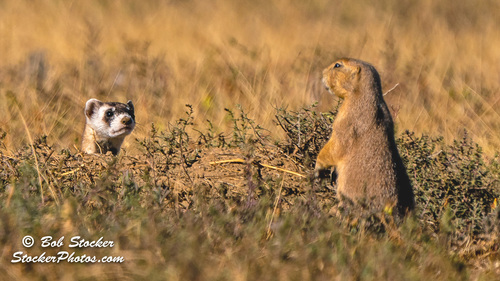
The black-footed ferret, also known as the American polecat or prairie dog hunter, is a species of mustelid native to central North America.
๐ก๏ธ Conservation Status
endangered
en
๐ Evolution
Like its close relative, the Asian steppe polecat (with which it was once thought to be conspecific), the black-footed ferret represents a more progressive form than the European polecat in the direction of carnivory. Molecular evidence indicates that the steppe polecat and black-footed ferret diverged from M. stromeri between 500,000 and 2,000,000 years ago, perhaps in Beringia. The species appeared in the Great Basin and the Rockies by 750,000 years ago. The oldest recorded fossil find originates from Cathedral Cave, White Pine County, Nevada, and dates back 750,000 to 950,000 years ago. The species has likely always been rare, and the modern black-footed ferret represents a relict population. A reported occurrence of the species is from a late Illinoian deposit in Clay County, Nebraska, and it is further recorded from Sangamonian deposits in Nebraska and Medicine Hat, Alberta. Fossils have also been found in Alaska dating from the Pleistocene.
๐ Behavior and ecology
===Territorial behavior===
]]
The black-footed ferret is solitary, except when breeding or raising litters. It is most active above ground from dusk to midnight and 4 am to mid-morning.
Prey density may account for movement distances. Black-footed ferrets may travel up to to seek prey, suggesting that they will interchange freely among white-tailed prairie dog colonies that are less than apart. In areas of high prey density, black-footed ferret movements were nonlinear in character, probably to avoid predators. From December to March over a 4-year study period, black-footed ferrets investigated 68 white-tailed prairie dog holes per of travel/night. Distance traveled between white-tailed prairie dog burrows from December to March averaged over 149 track routes.
๐ Reproduction and development
The reproductive physiology of the black-footed ferret is similar to that of the European polecat and the steppe polecat. It is probably polygynous, based on data collected from home range sizes, skewed sex ratios, and sexual dimorphism. They are then separated into individual prairie dog burrows around their mother's burrow.
๐ Distribution and habitat
The historical range of the black-footed ferret was closely correlated with, but not restricted to, the range of prairie dogs (Cynomys spp.). Its range extended from southern Alberta and southern Saskatchewan south to Texas, New Mexico, and Arizona.
Historical habitats of the black-footed ferret included shortgrass prairie, mixed-grass prairie, desert grassland, shrub steppe, sagebrush steppe, The type of prairie dog burrow may be important for occupancy by black-footed ferrets. Black-footed ferret litters near Meeteetse, Wyoming, were associated with mounded white-tailed prairie dog burrows, which are less common than non-mounded burrows. Mounded burrows contain multiple entrances and probably have a deep and extensive burrow system that protects kits. However, black-footed ferrets used non-mounded prairie dog burrows (64%) more often than mounded burrows (30%) near Meeteetse, Wyoming.
๐ Mortality
Primary causes of mortality include habitat loss, human-introduced diseases, and indirect poisoning from prairie dog control measures. A short-term vaccine for canine distemper is available for captive black-footed ferrets, but no protection is available for young born in the wild. Black-footed ferrets are also susceptible to rabies, tularemia, and human influenza. They can directly contract sylvatic plague (Yersinia pestis), and epidemics in prairie dog towns may completely destroy the ferrets' prey base.
Predators of black-footed ferrets include golden eagles, great horned owls, coyotes, American badgers, bobcats, prairie falcons, ferruginous hawks, and prairie rattlesnakes.
๐ History
Native American tribes, including the Crow, Blackfoot, Sioux, Cheyenne, and Pawnee, used black-footed ferrets for religious rites and for food.}}
๐ Decline
For a time, the black-footed ferret was harvested for the fur trade, with the American Fur Company having received 86 ferret skins from Pratt, Chouteau, and Company of St. Louis in the late 1830s. During the early years of predator control, black-footed ferret carcasses were likely discarded, as their fur was of low value. This likely continued after the passing of the Endangered Species Act of 1973, for fear of reprisals. The large drop in black-footed ferret numbers began during the 1800s through to the 1900s, as prairie dog numbers declined because of control programs and the conversion of prairies to croplands.
Sylvatic plague, a disease caused by Yersinia pestis introduced into North America, also contributed to the prairie dog die-off, though ferret numbers declined proportionately more than their prey, thus indicating other factors may have been responsible. Plague was first detected in South Dakota in a coyote in 2004, and then in about of prairie dogs on Pine Ridge Reservation in 2005. Thereafter of prairie dog colonies were treated with insecticide (DeltaDust) and of black-footed ferret habitat were prophylactically dusted in Conata Basin in 2006โ2007. Nevertheless, plague was proven in ferrets in May 2008. Since then each year of their Conata Basin habitat is dusted and about 50โ150 ferrets are immunized with plague vaccine. Ferrets are unlikely to persist through plague episodes unless there are management efforts that allow access to prey resources at a wider region or actions that could substantially reduce the plague transmission. A 2023 study found that combining insecticide dusting with aerial distribution of oral vaccine baits improved plague resistance in prairie dogs which supports black-footed ferret recovery. The authors emphasized that coordinated, landscape-scale mitigation is essential for maintaining stable prey populations and suitable ferret habitat. Long-term monitoring and integrated management strategies are key to sustaining conservation outcomes in plague-affected regions.
Inbreeding depression may have also contributed to the decline, as studies on black-footed ferrets from Meeteetse, Wyoming, revealed low levels of genetic variation. Canine distemper devastated the Meeteetse ferret population in 1985. A live virus vaccine originally made for domestic ferrets killed large numbers of black-footed ferrets, thus indicating that the species is especially susceptible to distemper.
๐ Reintroduction and conservation
, South Dakota]]
The black-footed ferret experienced a recent population bottleneck in the wild followed by a more than 30-year recovery through ex situ breeding and then reintroduction into its native range. As such, this sole endemic North American ferret allows examining the impact of a severe genetic restriction on subsequent biological form and function, especially on reproductive traits and success. The black-footed ferret was listed as endangered by the United States Fish and Wildlife Service (USFWS) in 1967. Declared extinct in 1979, a residual wild population was discovered in Meeteetse, Wyoming, in 1981. This cohort eventually grew to 130 individuals and was then nearly extirpated by sylvatic plague, Yersinia pestis, and canine distemper virus, Canine morbillivirus, with eventually 18 animals remaining. These survivors were captured from 1985 to 1987 to serve as the foundation for the black-footed ferret ex situ breeding program. Seven of those 18 animals produced offspring that survived and reproduced, and with currently living descendants, are the ancestors of all black-footed ferrets now in the ex situ (about 320) and in situ (about 300) populations.
The black-footed ferret is an example of a species that benefits from strong reproductive science. A captive-breeding program was initiated in 1987, capturing 18 living individuals and using artificial insemination. This is one of the first examples of assisted reproduction contributing to conservation of an endangered species in nature. in Eastern Wyoming, reintroduction expanded to Montana, six sites in South Dakota in 1994, Arizona, Utah, Colorado, Saskatchewan, Canada and Chihuahua, Mexico. The Toronto Zoo has bred hundreds, most of which were released into the wild. Several episodes of Zoo Diaries show aspects of the tightly controlled breeding. In May 2000, the Canadian Species at Risk Act listed the black-footed ferret as being an extirpated species in Canada. A population of 35 animals was released into Grasslands National Park in southern Saskatchewan on October 2, 2009, and a litter of newborn kits was observed in July 2010. Reintroduction sites have experienced multiple years of reproduction from released individuals.
The black-footed ferret was first listed as endangered in 1967 under the Endangered Species Preservation Act, and was re-listed on January 4, 1974, under the Endangered Species Act. In September 2006, South Dakota's ferret population was estimated to be around 420, with 250 (100 breeding adults consisting of 67 females and 33 males) in Eagle Butte, South Dakota, which is , less than 3% of the public grasslands in South Dakota, east of Rapid City, South Dakota, in the Buffalo Gap National Grassland bordering Badlands National Park, 130 ferrets northeast of Eagle Butte, South Dakota, on Cheyenne River Indian Reservation, and about 40 ferrets on the Rosebud Indian Reservation. Arizona's Aubrey Valley ferret population was well over 100 and a second reintroduction site with around 50 animals is used. An August 2007 report in the journal Science counted a population of 223 in one area of Wyoming (the original number of reintroduced ferrets, most of which died, was 228), and an annual growth rate of 35% from 2003 to 2006 was estimated. This rate of recovery is much faster than for many endangered species, and the ferret seems to have prevailed over the previous problems of disease and prey shortage that hampered its improvement.
, about 1,200 ferrets are thought to live in the wild. These wild populations are possible due to the extensive breeding program that releases surplus animals to reintroduction sites, which are then monitored by USFWS biologists for health and growth. However, the species cannot depend just on ex situ breeding for future survival, as reproductive traits such as pregnancy rate and normal sperm motility and morphology have been steadily declining with time in captivity. These declining markers of individual and population health are thought to be due to increased inbreeding, an occurrence often found with small populations or ones that spend a long time in captivity.
Conservation efforts have been opposed by stock growers and ranchers, who have traditionally fought prairie dogs. In 2005, the U.S. Forest Service began poisoning prairie dogs in private land buffer zones of the Conata Basin of Buffalo Gap National Grassland. Because 10โ15 ranchers complained the measure was inadequate, the forest service advised by Mark Rey, then Undersecretary of Agriculture, expanded its "prairie-dog management" in September 2006 to all of South Dakota's Buffalo Gap and the Fort Pierre National Grassland, and also to the Oglala National Grassland in Nebraska, against opinions of biologists in the U.S. Fish and Wildlife Service. Following exposure by conservation groups including the Climate, Community & Biodiversity Alliance and national media public outcry and a lawsuit mobilized federal officials, and the poisoning plan was revoked.
The contradictory mandates of the two federal agencies involved, the USFWS and the U.S. Forest Service, are exemplified in what the Rosebud Sioux tribe experienced: The ferret was reintroduced by the USFWS, which according to the tribe promised to pay more than $1 million a year through 2010. On the other hand, the tribe was also contracted for the U.S. Forest Service prairie dog poisoning program. The increasing numbers of ferrets led to conflicts between the tribe's Cheyenne River Sioux Tribe Game, Fish and Parks Department and the Tribal Land Enterprise Organization. When the federal government started an investigation of the tribe's prairie dog management program, threatening to prosecute tribal employees or agents carrying out the management plan in the ferret reintroduction area, the tribal council passed a resolution in 2008, asking the two federal agencies to remove ferrets, and reimburse the tribe for its expenses for the ferret recovery program.
In 2020, black-footed ferrets were used to test an experimental COVID-19 vaccine in Colorado. COVID testing was performed on black-footed ferrets for crucial conservation reasons, primarily due to concerns that the highly endangered species would be vulnerable to the virus and face extinction from a potential outbreak. Ferrets are known to be susceptible to respiratory diseases, and the coronavirus spreads easily among related species, like mink.
Employees of the San Diego Zoo, the conservation organization Revive & Restore, the ViaGen Pets and Equine Company, and the U.S. Fish and Wildlife Service have teamed up to clone a black-footed ferret. In 2020, a team of scientists cloned a female named Willa, who died in the mid-1980s and left no living descendants. Her clone, a female named Elizabeth Ann, was born on December 10, 2020, making her the first North American endangered species to be cloned. Scientists hoped that the contribution of this individual would alleviate the effects of inbreeding and help black-footed ferrets better cope with plague. Experts estimate that this female's genome contains three times as much genetic diversity as any of the modern black-footed ferrets. In October 2022, Elizabeth Ann received a hysterectomy due to health complications related to hydrometra, a condition causing excessive fluid retention within the uterus, alongside an underdeveloped uterine horn. These conditions are common in black-footed ferrets, and are not believed to be due to the cloning process. Elizabeth Ann otherwise remained healthy and continues to demonstrate normal behavior for an adult ferret.
In April 2024, the U.S. Fish and Wildlife Service announced the birth of two new black-footed ferret clones, Noreen and Antonia, who were cloned from the same genetic material as Elizabeth Ann. Noreen was born at the National Black-footed Ferret Conservation Center in Colorado, while Antonia was born at the Smithsonian National Zoo & Conservation Biology Institute in Virginia.
๐ In popular culture
In 2023, the black-footed ferret was featured on a United States Postal Service Forever stamp as part of the Endangered Species set, based on a photograph from Joel Sartore's Photo Ark. The stamp was dedicated at a ceremony at the National Grasslands Visitor Center in Wall, South Dakota. The U.S. Census Bureau featured a black-footed ferret on its "Data Federated Electronic Research Review Extraction and Tabulation Tool" or "Data FERRETT" web tool. This tool allowed researchers outside the government to extract unique, anonymized data from respondents to Census surveys, including the Current Population Survey.