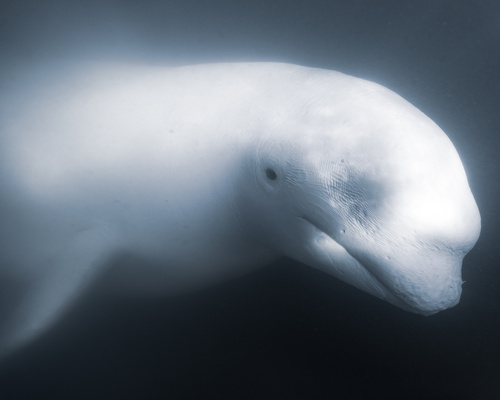
The beluga whale or the white whale is an Arctic and sub-Arctic cetacean. It is one of two living members of the family Monodontidae, along with the narwhal, and the only member of the genus Delphinapterus. It is also known as the sea canary, due to its high-pitched calls; and the melonhead, though that more commonly refers to the melon-headed whale, which is an oceanic dolphin.
📌 Etymology
The Red List of Threatened Species gives both beluga and white whale as common names, though the former is now more popular. The name beluga comes from the Russian , which derives from the word bélyj meaning "white".
📌 Taxonomy
The genus name Delphinapterus means "dolphin without fin" from Greek delphin "dolphin", and apteros "wingless"; the specific epithet leucas comes from the Greek leukas meaning "white". The beluga was first described in 1776 by Peter Simon Pallas. The narwhal is the only other species within the Monodontidae. A skull has been discovered with intermediate characteristics supporting the hypothesis that hybridisation is possible between these two species.
📌 Evolution
Mitochondrial DNA studies have shown modern cetaceans last shared a common ancestor between 25 and 34 million years ago The superfamily Delphinoidea (which contains monodontids, dolphins and porpoises) split from other toothed whales, odontoceti, between 11 and 15 million years ago. Monodontids then split from dolphins (Delphinidae) and later from porpoises (Phocoenidae), their closest relatives in evolutionary terms. In 2017 a study was completed where the genome of a beluga whale was sequenced, comprising 2.327 Gbp of assembled genomic sequence that encoded 29,581 predicted genes. The authors of this study estimated that the genome-wide sequence similarity between beluga whales and killer whales is 97.87%.
The beluga's earliest known distinctive ancestors include the prehistoric Denebola brachycephala from the late Miocene epoch (9–10 million years ago), and Bohaskaia monodontoides, from the early Pliocene (3–5 million years ago). and Virginia indicate the family once inhabited warmer waters. A fossil of the monodontid Casatia thermophila, from five million years ago, provides the strongest evidence that monodontids once inhabited warmer waters, as the fossil was found alongside fossils of tropical species such as bull and tiger sharks.
The fossil record also indicates that, in comparatively recent times, the beluga's range varied with that of the polar ice packs expanding during ice ages and contracting when the ice retreated. Counter-evidence to this theory comes from the finding in 1849 of fossilised beluga bones in Vermont in the United States, from the Atlantic Ocean. The bones were discovered during construction of the first railroad between Rutland and Burlington in Vermont, when workers unearthed the bones of a mysterious animal in Charlotte. Buried nearly below the surface in a thick blue clay, these bones were unlike those of any animal previously discovered in Vermont. Experts identified the bones as those of a beluga. Because Charlotte is over from the nearest ocean, early naturalists were at a loss to explain the presence of the bones of a marine mammal buried beneath the fields of rural Vermont.
The remains were found to be preserved in the sediments of the Champlain Sea, an extension of the Atlantic Ocean within the continent resulting from the rise in sea level at the end of the ice ages some 12,000 years ago. Today, the Charlotte whale is the official Vermont State Fossil (making Vermont the only state whose official fossil is that of a still extant animal).
📌 Longevity
Preliminary investigations suggested a beluga's life expectancy was rarely more than 30 years. The method used to calculate the age of a beluga is based on counting the layers of dentine and dental cement in a specimen's teeth, which were originally thought to be deposited once or twice a year. The layers can be readily identified as one layer consists of opaque dense material and the other is transparent and less dense. It is therefore possible to estimate the age of the individual by extrapolating the number of layers identified and the estimated frequency with which the deposits are laid down. A 2006 study using radiocarbon dating of the dentin layers showed the deposit of this material occurs with a lesser frequency (once per year) than was previously thought. The study therefore estimated belugas can live for 70 or 80 years. In 2022, researchers at Kent State University and Northeast Ohio Medical University were able to determine that belugas gains one extra dentin layer each year below the teeth of their enamel, which provides a method of detecting the age of the beluga whale. The oldest living beluga whale was 79 years old.
📌 Size
The species presents a moderate degree of sexual dimorphism, as the males are 25% longer than the females and are sturdier. Males weigh between , and occasionally up to while females weigh between . They rank as mid-sized species among toothed whales. The newborn calf will often measure approximately , and weigh from at their time of birth. The beluga's body shape is stocky and fusiform (cone-shaped with the point facing backwards), and they frequently have folds of fat, particularly along the ventral surface. Between 40% and 50% of their body weight is fat, which is a higher proportion than for cetaceans that do not inhabit the Arctic, where fat only represents 30% of body weight. The fat forms a layer that covers all of the body except the head, and it can be up to thick. It acts as insulation in waters with temperatures between 0 and 18 °C, as well as being an important reserve during periods without food.
📌 Colour
The adult beluga is rarely mistaken for any other species, because it is completely white or whitish-grey in colour. The white colouration of the skin is an adaptation to life in the Arctic that allows belugas to camouflage themselves in the polar ice caps as protection against their main predators, polar bears and killer whales. Unlike other cetaceans, the belugas seasonally shed their skin. Belugas annually molt their skin as a way to remove harmful bacteria or damaged epidermal tissue that could potentially be invaded by foreign pathogens.
📌 Head and neck
in the back of a beluga's head]]
Like most toothed whales, the beluga has a compartment found at the centre of the forehead that contains an organ used for echolocation called a melon, which contains fatty tissue. The shape of the beluga's head is unlike that of any other cetacean, as the melon is extremely bulbous, lobed and visible as a large frontal prominence. This organ contains fatty acids, mainly isovaleric acid (60.1%) and long-chain branched acids (16.9%), a very different composition from its body fat, and which could play a role in its echolocation system.
Unlike many dolphins and whales, the seven vertebrae in the neck are not fused together, allowing belugas to turn their heads laterally without needing to rotate their bodies. This gives the head a lateral manoeuvrability that allows an improved field of view and movement and helps in catching prey and evading predators in deep water. Belugas do not use their teeth to chew, but for catching hold of their prey; they then tear them up and swallow them nearly whole.
Belugas have one blowhole, which is located on the top of the head behind the melon, and has a muscular covering, allowing it to be completely sealed. Under normal conditions, the blowhole is closed and an animal must contract the muscular covering to open the blowhole. A beluga's thyroid gland is larger than that of terrestrial mammals—weighing three times more than that of a horse—which helps it to maintain a greater metabolism during the summer when it lives in river estuaries.
📌 Fins
, Canada]]
The fins retain the bony vestiges of the beluga's mammalian ancestors, and are firmly bound together by connective tissue. The tailfin is flat with two oar-like lobes, it does not have any bones, and is made up of hard, dense, fibrous connective tissue. The tailfin has a distinctive curvature along the lower edge.
📌 Senses
]]
The beluga has a very specialised sense of hearing and its auditory cortex is highly developed. It can hear sounds within the range of 1.2 to 120 kHz, with the greatest sensitivity between 10 and 75 kHz, where the average hearing range for humans is 0.02 to 20 kHz. The majority of sounds are most probably received by the lower jaw and transmitted towards the middle ear. In the toothed whales, the lower jawbone is broad with a cavity at its base, which projects towards the place where it joins the cranium. A fatty deposit inside this small cavity connects to the middle ear.
Belugas are able to see within and outside of water, but their vision is relatively poor when compared to dolphins. A beluga's retina has cones and rods, which also suggests they can see in low light. The presence of cone cells indicates they can see colours, although this suggestion has not been confirmed. Glands located in the medial corner of their eyes secrete an oily, gelatinous substance that lubricates the eye and helps flush out foreign bodies. This substance forms a film that protects the cornea and the conjunctiva from pathogenic organisms.
Studies on captive animals show they seek frequent physical contact with other belugas. Areas in the mouth have been found that could act as chemoreceptors for different tastes, and they can detect the presence of blood in water, which causes them to react immediately by displaying typical alarm behaviour. Like the other toothed whales, their brains lack olfactory bulbs and olfactory nerves, which suggests they do not have a sense of smell.
📌 Behaviour
=== Social structure and play ===
Belugas are highly sociable and they regularly form small groups, or pods, that may contain between two and 25 individuals, with an average of 10 members. Pods tend to be unstable, meaning individuals tend to move from pod to pod. Radio tracking has even shown belugas can start out in one pod and within a few days be hundreds of miles away from that pod. Beluga whale pods can be grouped into three categories: nurseries (which consist of mother and calves), bachelors (which consist of all males), and mixed groups (which contain both sexes). Many hundreds and even thousands of individuals can be present when the pods join in river estuaries during the summer. This can represent a significant proportion of the total population and is when they are most vulnerable to being hunted.
They are cooperative and frequently hunt in coordinated groups. Often individuals will surface and dive together in a synchronized manner, in a behavior known as milling.
In captivity, they can be seen to be constantly playing, vocalising and swimming around each other. In one case, one whale blew bubbles, while the other one popped them. There have also been reports of beluga whales copying and imitating one another, similar to a game of Simon-says. There have also been reports of them displaying physical affection, via mouth to mouth contact. They also show a great deal of curiosity towards humans and frequently approach the windows in the tanks to observe them.
Belugas also show a great degree of curiosity towards humans in the wild, and frequently swim alongside boats. They also play with objects they find in the water; in the wild, they do this with wood, plants, dead fish and bubbles they have created.
In captivity, mothering behavior among belugas depends on the individual. Beluga calves will often require sustenance and care from both their mothers but also other belugas who serve as alloparents in their community. Beluga calves are often nursed by their mothers for the first year of its life before they become a juvenile. During this same stage in their lives, they also require their mothers to draft them through the stream, as the newborn beluga is likely to be an uncoordinated swimmer. Between the ages of 2 and 5, the beluga becomes a juvenile and is likely to start seeking independence from its mother. However, it will still continue to maintain its involvement in its social circle.
Among free-ranged belugas, it has been observed that calves will often form bonds with each other while their mothers were out foraging. These social groups of immature calves have been referred to as "kindergartens", and furthermore it has been noticed that an alloparent, referred to as an "aunt", can attend to these groups. A study in 2014 revealed that most beluga whales swam in formation with both parents and alloparents.
📌 Swimming and diving
Belugas are slower swimmers than the other toothed whales, such as the killer whale and the common bottlenose dolphin, because they are less hydrodynamic and have limited movement of their tail-fins, which produce the greatest thrust. They frequently swim at speeds between , although they are able to maintain a speed of 22 km/h for up to 15 min. Belugas swim on the surface between 5% and 10% of the time, while for the rest of the time they swim at a depth sufficient to cover their bodies. although they are capable of diving to greater depths. Individual captive animals have been recorded at depths between 400 and 647 m below sea level, while animals in the wild have been recorded as diving to a depth of more than 700 m, with the greatest recorded depth being over 900 m. A dive normally lasts 3 to 5 minutes, but can last up to over 20 minutes. In the shallower water of the estuaries, a diving session may last around two minutes; the sequence consists of five or six rapid, shallow dives followed by a deeper dive lasting up to one minute. During a dive, these animals will reduce their heart rate from 100 beats a minute to between 12 and 20. Lastly, the beluga's muscles contain high levels of the protein myoglobin, which stores oxygen in muscle. Myoglobin concentrations in belugas are several times greater than for terrestrial mammals, which help prevent oxygen deficiency during dives.
📌 Reproduction
Estimations of the age of sexual maturity for beluga whales vary considerably; the majority of authors estimate males reach sexual maturity when they are between nine and fifteen years old, and females reach maturity between eight and fourteen years old. The average age at which females first give birth is 8.5 years and fertility begins to decrease when they are 25, eventually undergoing menopause, and ceasing reproductive potential with no births recorded for females older than 41. There is a slight difference on the sexual maturation period between males and females. The male beluga whales take seven to nine years to become sexually mature, while the females take four to seven years.
Female belugas typically give birth to one calf every three years. During the mating season, the testes of belugas double in weight. Testosterone levels increase, but seems to be independent of copulation. Copulation typically takes place between 3 and 4 AM.
Calves are born over a protracted period that varies by location. In the Canadian Arctic, calves are born between March and September, while in Hudson Bay, the peak calving period is in late June, and in Cumberland Sound, most calves are born from late July to early August. Births usually take place in bays or estuaries where the water is between 10 and 15 °C. The newborn calves nurse under water and initiate lactation a few hours after birth; thereafter, they feed at intervals around an hour. The milk contains about 92 cal per ounce.
The calves remain dependent on their mothers for nursing for the first year, when their teeth appear.
Hybrids have been documented between the beluga and the narwhal (specifically offspring conceived by a beluga father and a narwhal mother), as one, perhaps even as many as three, such hybrids were killed and harvested during a sustenance hunt. Whether or not these hybrids could breed remains unknown. The unusual dentition seen in the single remaining skull indicates the hybrid hunted on the seabed, much as walruses do, indicating feeding habits different from those of either parent species.
📌 Communication and echolocation
]]
Belugas use sounds and echolocation for movement, communication, to find breathing holes in the ice, and to hunt in dark or turbid waters. In special circumstances, beluga whale sounds have been reported to resemble human speech. A Japanese researcher claimed that he taught a beluga to "talk" by using these sounds to identify three different objects, offering hope that humans may one day be able to communicate effectively with sea mammals.
Belugas communicate using high frequency sounds; their calls can sound like bird songs, so belugas were nicknamed "canaries of the sea". Like the other toothed whales, belugas do not possess vocal cords and the sounds are probably produced by the movement of air between the nasal sacks, which are located near to the blowhole. They use their vocalisations for echolocation, during mating and for communication. They possess a large repertoire, emitting up to 11 different sounds, such as cackles, whistles, trills and squawks.
There is debate as to whether cetacean vocalizations can constitute a language. A study conducted in 2015 determined that European beluga signals share physical features comparable to vowels. These sounds were found to be stable throughout time, but varied among different geographical locations. The further away the populations were from each other, the more varied the sounds were in relation to one another.
📌 Habitat and distribution
The beluga inhabits a discontinuous circumpolar distribution in Arctic and sub-Arctic waters. During the summer, they can mainly be found in deep waters ranging from 76°N to 80°N, particularly along the coasts of Alaska, northern Canada, western Greenland and northern Russia. and the Amur River delta, the Shantar Islands and the waters surrounding Sakhalin Island in the Sea of Okhotsk.
📌 Migration
Belugas have a seasonal migratory pattern. When the summer sites become blocked with ice during the autumn, they move to spend the winter in the open sea alongside the pack ice or in areas covered with ice, surviving by using polynyas to surface and breathe. In summer after the sheet ice has melted, they move to coastal areas with shallower water ( deep), although sometimes they migrate towards deeper waters (deeper than ). In the summer, they occupy estuaries and the waters of the continental shelf, and, on occasion, they even swim up the rivers. One such example comes from June 9, 2006, when a young beluga carcass was found in the Tanana River near Fairbanks in central Alaska, nearly from the nearest ocean habitat. Belugas sometimes follow migrating fish, leading Alaska state biologist Tom Seaton to speculate it had followed migrating salmon up the river at some point in the previous autumn. The rivers they most often travel up include: the Northern Dvina, the Mezen, the Pechora, the Ob and the Yenisei in Asia; the Yukon and the Kuskokwim in Alaska, and the Saint Lawrence in Canada. In addition, the rivers represent a safe haven for newborn calves where they will not be preyed upon by killer whales. However, not all beluga whale populations summer in estuaries. Belugas from the Beaufort Sea stock were found to summer along the Eastern Beaufort Sea shelf, Amundsen Gulf and slope regions north and west of Banks Island, in addition to core areas in the Mackenzie River Estuary. Male belugas have been observed summering in deeper waters along Viscount Melville Sound, in depths of up to . The bulk of Eastern Chukchi Sea belugas summer over Barrow canyon.
The migration season is relatively predictable, as it is basically determined by the amount of daylight and not by other variable physical or biological factors, such as the condition of the sea ice. Vagrants may travel further south to areas such as Irish and Scottish waters, the islands of Orkney and Hebrides, and to Japanese waters. There had been several vagrant individuals that have demonstrated seasonal residencies at Volcano Bay, and one annually returned to areas adjacent to Shibetsu in Nemuro Strait in the 2000s. On rarer occasions, individuals of vagrancy can reach the Korean Peninsula. A few other individuals have been confirmed to return to the coasts of Hokkaido, and one particular individual became a resident in brackish waters of Lake Notoro since in 2014.
Some populations are not migratory and certain resident groups will stay in well-defined areas, such as in Cook Inlet, the estuary of the Saint Lawrence River and Cumberland Sound.
In April, the animals that spend the winter in the center and southwest of the Bering Sea move to the north coast of Alaska and the east coast of Russia. The populations of the White Sea, the Kara Sea and the Laptev Sea overwinter in the Barents Sea. In the spring, the groups separate and migrate to their respective summer sites.
📌 Population
There are currently 22 stocks of beluga whales recognized:
# James Bay – 14,500 individuals
# Western Hudson Bay – 55,000 individuals
# Eastern Hudson Bay – 3,400–3,800 individuals
# Cumberland Sound – 1,151 individuals
# Ungava Bay – 32 individuals (maybe functionally extinct)
# St. Lawrence River Estuary – 889 individuals
# Eastern Canadian Arctic – 21,400 individuals (this region is the most northern place inhabited by beluga whales)
# Southwest Greenland – Extinct
# Eastern Chukchi Sea – 20,700 individuals
# Eastern Bering Sea – 7,000–9,200 individuals
# Eastern Beaufort Sea – 39,300 individuals
# Bristol Bay – 2,000–3,000 individuals
# Cook Inlet – 300 individuals
# White Sea – 5,600 individuals
# Kara Sea/Laptev Sea/Barents Sea – Data Deficient
# Ulbansky – 2,300
# Anadyr – 3,000
# Shelikhov – 2,666
# Sakhalin/Amur – 4,000 individuals
# Tugurskiy – 1,500 individuals
# Udskaya – 2,500 individuals
# Svalbard – 549 individuals
The Yakutat Bay belugas are not considered to be a true stock because they have only been present in these waters since the 1980s, and are believed to be of Cook Inlet origin. It is estimated that less than 20 whales inhabit the bay year-round.
📌 Threats
=== Hunting ===
hunting party harpooning a beluga in Cook Inlet, Alaska]]
The native populations of the Arctic in Alaska, Canada, Greenland and Russia hunt belugas, for both consumption and profit. Belugas have been easy prey for hunters due to their predictable migration patterns and the high population density in estuaries and surrounding coastal areas during the summer.
📌 Present
The number of animals killed is about 1,000 per year, (see table below. and its sources). Beluga whale hunting quotas in Canada and the United States are established using the Potential Biological Removal equation PBR = Nmin * 0.5 * Rmax * FR, to determine what constitutes a sustainable hunt. Nmin represents a conservative estimation of the population size, Rmax, represents the maximum rate of population increase and FR represents the recovery factor. and in Canada to other communities.
Russia now harvests 5 to 30 belugas per year for meat and captures an additional 20 to 30 per year for live export to Chinese aquaria. However, in 2018, 100 were illegally captured for live export.
Previous levels of commercial whaling have put the species in danger of extinction in areas such as Cook Inlet, Ungava Bay, the St. Lawrence River and western Greenland. Continued hunting by the native peoples may mean some populations will continue to decline. Northern Canadian sites are the focus of discussions between local communities and the Canadian government, with the objective of permitting sustainable hunting that does not put the species at risk of extinction.
The total amount of landed (defined as belugas successfully hunted and retrieved) belugas averages 275 in regard to the Bering, Chukchi and Beaufort stocks from 1987 to 2006. The average annual landed harvest of belugas in the Beaufort Sea consisted of 39 individuals while the Chukchi harvest averaged 62 individuals. Bristol bay's annual average landed harvest was 17 while the Bering Sea's was 152. Statistical studies have demonstrated that subsistence hunting in Alaska did not significantly impact the population of the Alaskan beluga whale stocks. The number of belugas struck and lost did not seem to profoundly impact Chukchi and Bering Sea belugas.
📌 Past
Commercial whaling by European, American and Russian whalers during the 18th and 19th centuries decreased beluga populations in the Arctic. The Quebec Department of Fisheries launched a study into the influence of these cetaceans on local fish populations in 1938. The unrestricted killing of belugas continued into the 1950s, when the supposed voracity of the belugas was found to be overestimated and did not adversely affect fish populations. L'Isle-aux-Coudres is the setting for the classic 1963 National Film Board of Canada documentary Pour la suite du monde, which depicts a one-off resurrection of the beluga hunt; one animal is caught live, and transported by truck to an aquarium in the big city. The method of capture is akin to dolphin drive hunting.
📌 Beluga catches by location
{| class="wikitable mw-collapsible mw-collapsed sortable"
|+ class="nowrap" |Belugas caught in Canada, Russia, Greenland and Alaska each year, 1954–2024
!scope="col"|Beaufort Sea, Mackenzie, Paulatuk, Ulukhaktok, Canada
!scope="col"|Nunavut, Canada
!scope="col"|Nunavik, Quebec, Canada
!scope="col"|Western Arctic, Russia, hunted for meat
!scope="col"|Eastern Arctic, Russia, hunted for meat
!scope="col"|Sea of Okhotsk, Russia, hunted for meat
!scope="col"|All areas of Russia, live export
!scope="col"|Year
!scope="col"|Canada total
!scope="col"|Greenland
!scope="col"|USSR+ Russia total
!scope="col"|US (Alaska)
!scope="col"|World total, incomplete
!scope="col"|Lost at sea as % of caught
|-
|||48||681||||||||||2024||729||||||||||
|-
|||20||532||||||||||2023||552||||||||||
|-
|||51||384||||||||||2022||435||||||||||
|-
|||30||366||||||||||2021||396||||||||||
|-
|||46||430||||||||||2020||476||||||||||
|-
|||28||367||||||||||2019||395||||||||||
|-
|||50||378||||||||||2018||428||||||||||
|-
|||30||299||||||||||2017||329||||||||||
|-
|||43||225||||||||||2016||268||246||||||||
|-
|83||170||303||||||||||2015||556||156||||326||1038||
|-
|136||26||298||||||30||23||2014||460||317||53||346||1176||2%
|-
|92||76||256||||||30||23||2013||424||353||53||367||1197||2%
|-
|102||61||289||||||30||44||2012||452||245||74||360||1131||4%
|-
|72||32||237||||||30||33||2011||341||179||63||288||871||3%
|-
|94||47||230||||||30||30||2010||371||222||60||318||971||3%
|-
|102||34||165||||||30||24||2009||301||286||54||253||894||6%
|-
|79||33||120||||||30||25||2008||232||330||55||254||871||8%
|-
|85||24||192||||||30||0||2007||301||145||30||576||1052||2%
|-
|126||22||149||||||30||20||2006||297||169||50||226||742||3%
|-
|108||53||178||||||30||31||2005||339||231||61||282||913||2%
|-
|142||94||151||||||30||25||2004||387||246||55||234||922||8%
|-
|125||300||202||||||30||26||2003||627||510||56||251||1444||9%
|-
|89||115||179||||||30||10||2002||383||510||40||362||1295||3%
|-
|96|| ||100||||||30||22||2001||576||560||52||416||1604||1%
|-
|91||116||270||||||30||10||2000||477||733||40||280||1530||8%
|-
|102||207||295||||||30||37||1999||604||590||67||217||1478||19%
|-
|93||137||302||||||30||32||1998||532||873||62||342||1809||8%
|-
|123||376||290||||||30||23||1997||789||682||53||276||1800||8%
|-
|139||203||267||||||30||23||1996||609||681||53||389||1732||16%
|-
|143||30||276||||||30||23||1995||449||960||53||171||1633||11%
|-
|149||50||289||||||30||23||1994||488||757||53||285||1583||6%
|-
|120||10||256||||||30||23||1993||386||930||53||369||1738||9%
|-
|130||20||174||||||30||23||1992||324||1014||53||181||1572||7%
|-
|144||22||284||||||30||23||1991||450||747||53||315||1565||24%
|-
|106||20||162||||||30||23||1990||288||933||53||335||1609||22%
|-
|156||19||368||27||||30||23||1989||543||816||80||13||1452||15%
|-
|139||20||169||7||||30||23||1988||328||428||60||19||835||19%
|-
|174||28||178||15||||30||23||1987||380||928||68||22||1398||13%
|-
|199||25||169||192||||30||23||1986||393||973||245||||1611||15%
|-
|148||5||269||248||150||30||||1985||422||887||428||||1737||17%
|-
|156||28||320||850||150||30||||1984||504||930||1030||170||2634||20%
|-
|102||7||332||450||150||30||||1983||441||888||630||235||2194||20%
|-
|146||30||385||116||150||30||||1982||561||1217||296||335||2409||19%
|-
|155||6||333||294||150||30||||1981||494||1506||474||209||2683||20%
|-
|85||0||561||368||150||30||||1980||646||1346||548||249||2789||23%
|-
|171||0||564||200||26||30||||1979||735||1116||256||138||2245||22%
|-
|157||6||407||63||26||30||||1978||570||1112||119||177||1978||25%
|-
|172||14||823||1196||26||30||||1977||1009||1264||1252||247||3772||22%
|-
|183||0||679||472||26||30||||1976||862||1260||528||186||2836||28%
|-
|177||0||810||169||23||30||||1975||987||995||222||185||2389||23%
|-
|152||0||605||194||23||30||||1974||757||1149||247||184||2337||25%
|-
|212|| || ||288||23||30||||1973||212||1451||341||150||2154||23%
|-
|134|| || ||288||||30||||1972||134||1168||318||180||1800||21%
|-
|94|| || ||612||||30||||1971||94||913||642||250||1899||23%
|-
|137|| || ||990||||30||||1970||137||861||1020||200||2218||25%
|-
||| || ||302||700||30||||1969||0||1364||1032||170||2566||25%
|-
|14|| || ||30||700||30||||1968||14||1490||760||150||2414||26%
|-
|40|| || ||274||700||30||||1967||40||825||1004||225||2094||24%
|-
|96|| || ||3046||700||30||||1966||96||828||3776||225||4925||23%
|-
|70|| || ||3614||700||30||||1965||70||595||4344||225||5234||21%
|-
|45|| || ||5952||700||30||||1964||45||403||6682||225||7355||22%
|-
|94|| || ||2526||700||30||||1963||94||278||3256||225||3853||21%
|-
|96|| || ||2334||700||30||||1962||96||409||3064||225||3794||24%
|-
|145|| || ||3500||700||30||||1961||145||438||4230||300||5113||27%
|-
|145|| || ||6444||700||30||||1960||145||398||7174||375||8092||22%
|-
||| || ||1945||700||830||||1959|| ||472||3475||450||4397||24%
|-
||| || ||2103||700||830||||1958|| ||411||3633||450||4494||23%
|-
||| || ||796||700||830||||1957|| ||770||2326||450||3546||26%
|-
||| || ||600||700||830||||1956|| ||671||2130||450||3251||25%
|-
||| || ||329||700||130||||1955|| ||507||1159||450||2116||24%
|-
||| || ||776||700||130||||1954|| ||767||1606||450||2823||28%
|- class="sortbottom"
| data-sort-value=9999|1960–1969 2000–2012 2013–15 2014
| data-sort-value=9999|1974-2024 DFO except 1996-2003 Arviat
|1974-2024: DFO
2003–16
| data-sort-value=9999|1954–99
| data-sort-value=9999|1954–1985 cites Russian papers
| data-sort-value=9999|Western
| data-sort-value=9999|Total of columns at left, incomplete
| data-sort-value=9999|
| data-sort-value=9999|Total of other columns
| data-sort-value=9999|
|}
📌 Predation
During the winter, belugas commonly become trapped in the ice without being able to escape to open water, which may be several kilometres away. Polar bears take particular advantage of these situations and are able to locate the belugas using their sense of smell. The bears swipe at the belugas and drag them onto the ice to eat them. According to a Soviet researcher stationed at Novaya Zembla, there was a reported instance of one polar bear killing thirteen belugas consecutively by crushing their head with its paw.
Killer whales hunt and eat both young and adult belugas. A number of killings have been recorded in Cook Inlet, and experts are concerned the predation by killer whales will impede the recovery of this sub-population, which has already been badly depleted by hunting.
📌 Contamination
The beluga is considered an excellent sentinel species (indicator of environment health and changes), because it is long-lived, at the top of the food web, bears large amounts of fat and blubber, relatively well-studied for a cetacean, and still somewhat common.
Human pollution can be a threat to belugas' health when they congregate in river estuaries. Chemical substances such as DDT and heavy metals such as lead, mercury and cadmium have been found in individuals of the Saint Lawrence River population. Levels of polychlorinated biphenyls between 240 and 800 ppm have been found in belugas' brains, liver and muscles, with the highest levels found in males. These levels are significantly greater than those found in Arctic populations. These substances have a proven adverse effect on these cetaceans, as they cause cancers, reproductive diseases and the deterioration of the immune system, making individuals more susceptible to pneumonias, ulcers, cysts, tumours and bacterial infections. The concentration of mercury in Beaufort Sea belugas tripled from the 1980s to the 1990s, but has decreased in Beaufort belugas as of the 21st century, possibly due to changes in dietary preference. Larger body sized belugas tend to have more mercury than smaller sized belugas, because they spend more time offshore, hunting prey such as cod and shrimp, which have more mercury.
This example of human behavior has also shown to have decreased the population of the beluga whale. In locations such as the Estuary of St. Lawrence, the population of the Beluga whale has declined significantly. European settlers who first discovered the area reported the approximate beluga population to be at around 5,000. However, due to rapid hunting from the 1600s to the 1940s, their population was severed nearly in half, to 2,500. Although beluga hunting has ceased, the population near the St. Lawrence area has still been steadily declining due to pollution.
From a sample of 129 beluga adults from the Saint Lawrence River examined between 1983 and 1999, a total of 27% had suffered cancer. This is a higher percentage than that documented for other populations of this species and is much higher than for other cetaceans and for the majority of terrestrial mammals; in fact, the rate is only comparable to the levels found in humans and some domesticated animals.
Indirect human disturbance may also be a threat. While some populations tolerate small boats, most actively try to avoid ships. Whale-watching has become a booming activity in the St. Lawrence and Churchill River areas, and acoustic contamination from this activity appears to have an effect on belugas. For example, a correlation appears to exist between the passage of belugas across the mouth of the Saguenay River, which has decreased by 60%, and the increase in the use of recreational motorboats in the area. A dramatic decrease has also been recorded in the number of calls between animals (decreasing from 3.4 to 10.5 calls/min to 0 or <1) after exposure to the noise produced by ships, the effect being most persistent and pronounced with larger ships such as ferries than with smaller boats. Belugas can detect the presence of large ships (for example icebreakers) up to 50 km away, and they move rapidly in the opposite direction or perpendicular to the ship following the edge of the sea ice for distances of up to 80 km to avoid them. The presence of shipping produces avoidance behaviour, causing deeper dives for feeding, the break-up of groups, and asynchrony in dives.
📌 Pathogens
As with any animal population, a number of pathogens cause death and disease in belugas, including viruses, bacteria, protozoans and fungi, which mainly cause skin, intestinal and respiratory infections.
Papillomaviruses, herpesviruses, and encephalitis caused by the protozoan Sarcocystis have been found in belugas in the Saint Lawrence River. Cases have been recorded of ciliate protozoa colonising the spiracle of certain individuals, but they are not thought to be pathogens or are not very harmful.
📌 Relationship with humans
=== Captivity ===
Belugas were among the first whale species to be kept in captivity. The first beluga was shown at Barnum's Museum in New York City in 1861. For most of the 20th century, Canada was the predominant source for belugas destined for exhibition. Throughout the early 1960s, belugas were taken from the St. Lawrence River estuary. In 1967, the Churchill River estuary became the main source from which belugas were captured. This continued until 1992, when the practice was banned. Since then, Russia has become the largest provider.
To provide some enrichment while in captivity, aquaria train belugas to perform behaviours for the public and for medical exams, such as blood draws, ultrasound, providing toys,
Between 1960 and 1992, the United States Navy carried out a program that included the study of marine mammals' abilities with echolocation, with the objective of improving the detection of underwater objects. The program started with dolphins, but a large number of belugas were also used from 1975 onwards. A similar program was implemented by the Soviet Navy during the Cold War, in which belugas were also trained for anti-mining operations in Arctic waters. It is possible this program continues within the Russian Navy, as on April 24, 2019, a tame beluga whale wearing a Russian equipment harness was found by fishermen near the Norwegian island of Ingøya.
Belugas released from captivity have difficulties adapting to life in the wild, but if not fed by humans they may have a chance to join a group of wild belugas and learn to feed themselves, according to Audun Rikardsen of the University of Tromsø.
In 2019, a sanctuary in Iceland was established for two belugas, Little White and Little Grey, that retired from a marine park in China. The Sea Life Trust Beluga Whale Sanctuary was created with support from Merlin Entertainments and Whale and Dolphin Conservation (WDC). Merlin bought the park in 2012, as part of an Australian chain, and it is one of their largest aquaria. Merlin has a policy against captive cetaceans, so they sponsored a 32,000-square-metre sea pen as a sanctuary. The 12-year-old belugas, caught in Russia and raised in captivity, do not know how to live in the wild. The cost is variously listed as ISK 3,000,000 (US$24,000) or US$27,000,000. until selling its last stake in 2017 to a Chinese company which will use SeaWorld's expertise to expand in China; SeaWorld still keeps belugas in captivity.
Belugas are displayed across North America, Europe and Asia. Belugas are popular with visitors due to their distinct colour and range of facial expressions. The latter is possible because, unlike other cetaceans, belugas have unfused cervical vertebrae; this allows a greater range of apparent expression. However, the calf died 25 days later after suffering metabolic complications, infections and not being able to feed properly. A second calf was born on 16 November 2016, and was successfully maintained by artificial feeding based on enriched milk.
Most belugas found in aquariums are caught in the wild, as captive-breeding programs have been generally unsuccessful so far, as mortality rates of belugas drop in captivity. In 2015, former SeaWorld San Diego trainer Sarah Fischbeck compared the organizations breeding program for beluga whales to a "puppy mill." It was later revealed that at the San Diego location, a beluga named Ruby was repeatedly bred multiple times, and gave birth to two calves, born in 2008 and 2010, respectively. Ruby rejected both infants, killing her first in 2008 and severely injuring the second one in 2010.
Naluark at Shedd Aquarium has fathered four living offspring. Naluark was relocated to the Mystic Aquarium in the hope that he would breed with two of their females, but he did not, and in 2016 he was moved to SeaWorld Orlando.
In 2009 during a free-diving competition in a tank of icy water in Harbin, China, a captive beluga brought a cramp-paralysed diver from the bottom of the pool up to the surface by holding her foot in its mouth, saving the diver's life.
Films which have publicised issues of beluga welfare include Born to Be Free, Sonic Sea, and Vancouver Aquarium Uncovered.
📌 Whale watching
and Saguenay rivers]]
Whale watching has become an important activity in the recovery of the economies of towns in Quebec and Hudson Bay, near the Saint Lawrence and Churchill Rivers. The best time to see belugas is during the summer, when they meet in large numbers in the estuaries of the rivers and in their summer habitats. They are easily seen due to their high numbers and their curiosity regarding the presence of humans. To protect these marine animals during whale-watching activities, the US National Oceanic and Atmospheric Administration has published a "Guide for observing marine life". The guide recommends boats carrying the whale watchers keep their distance and expressly prohibits chasing, harassing, obstructing, touching, or feeding them.
Some regular migrations do occur into Russian EEZ of Sea of Japan such as to Rudnaya Bay, where diving with wild belugas became a less-known but popular attraction.
On 25 September 2018, a beluga was sighted in the Thames Estuary and near towns along the Kent side of the Thames, being nicknamed Benny by newspapers. The whale, who was noticed by conservationists to be traveling alone, appeared to be separated from the rest of its group, and is thought to be a lost individual. Subsequent sightings were reported on the following day, and continued into 2019, when local experts concluded that Benny had left the estuary.
On 13 May 2021, two beluga whales were sighted in waters around Prince Edward Island, Atlantic Canada. One whale entered the Charlottetown Harbour and travelled up the Hillsborough River to Mount Stewart, Prince Edward Island. As of 30 May the whale was still sighted in the area.
In August 2022, a beluga was found on the river Seine, France.
📌 Human speech
Male belugas in captivity can mimic the pattern of human speech, several octaves lower than typical whale calls. One captive male beluga named NOC, pronounced "No-see", caused a diver in a tank with him to surface by imitating orders to get out of the water. Subsequent recordings confirmed that NOC had become skilled at imitating the patterns and frequency of human speech, and intentionally altered his normal methods of vocalization to achieve these sounds. After several years, he ceased making these sounds.
📌 Conservation status
, Russia]]
stamp|alt=Photo of stamp showing two adults and one juvenile, swimming]]
Prior to 2008, the beluga was listed as vulnerable by the International Union for Conservation of Nature (IUCN), a higher level of concern. The IUCN cited the stability of the largest sub-populations and improved census methods that indicate a larger population than previously estimated. In 2008, the beluga was reclassified as near threatened by the IUCN due to uncertainty about threats to their numbers and the number of belugas over parts of its range (especially the Russian Arctic), and the expectation that if current conservation efforts cease, especially hunting management, the beluga population is likely to qualify for threatened status within five years. In June 2017, its status was reassessed to least concern. However, the nonmigratory Cook Inlet sub-population off the Gulf of Alaska is a separate sub-population that is listed as critically endangered by the IUCN as of 2006 The most recent estimate in 2018 by NOAA Fisheries suggested that the population declined to 279 individuals. The IUCN and NOAA Fisheries cite habitat degradation, oil and gas drilling, underwater noise, harvesting for consumption and climate change as threats to the prolonged survival of beluga whale sub-populations. Because there is little protection of sub-populations, harvest will need to be managed to ensure sub-populations will survive long into the future to discover the importance of their migratory patterns and habitat use.
Beluga whales, like most other arctic species, are being faced with alteration of their habitat due to climate change and melting arctic ice.
It is hypothesized that beluga whales utilize ice as protection from killer whale predation or for feeding on schools of fish. Killer whales can penetrate further into the Arctic and remain in arctic waters for a longer period of time due to reductions in sea ice. For example, residents in Kotzebue, have reported that killer whales have been sighted more frequently in Kotzebue Sound.
As annual ice cover declines, humans may gain access and disrupt beluga whale habitats.
📌 Legal protection
The US Congress passed the Marine Mammal Protection Act of 1972, outlawing the persecution and hunting of all marine mammals within US coastal waters. The act has been amended a number of times to permit subsistence hunting by native peoples, temporary capture of restricted numbers for research, education and public display, and to decriminalise the accidental capture of individuals during fishing operations. The act also states that all whales in US territorial waters are under the jurisdiction of the National Marine Fisheries Service, a division of NOAA. of the Convention on the Conservation of Migratory Species of Wild Animals (CMS). It is listed on appendix II
The isolated beluga population in the Saint Lawrence River has been legally protected since 1983. In 1988 Canadian Department of Fisheries and Oceans and Environment Canada, a governmental agency that supervises national parks, implemented the Saint Lawrence Action Plan with the aim of reducing industrial contamination by 90% by 1993; as of 1992, the emissions had been reduced by 59%. The population of the St. Lawrence belugas decreased from 10,000 in 1885 to around 1,000 in the 1980 and around 900 in 2012.
📌 Conservation research in managed care facilities
As of 2015, there were 33 individuals housed in managed care facilities in North America. These facilities are members of the Association of Zoos and Aquariums, aiming to understand the complex reproductive physiology of this species to improve their conservation. With the extreme difficulty of studying beluga whales in the wild and the lack of ability to collect biological samples or perform examinations on individuals, managed care facilities play a critical role.
Managed care facilities in North America have been able to work cooperatively to build upon the research of beluga whale reproduction and have made remarkable advances. Using operant conditioning, these facilities have trained beluga whales for voluntary biological sampling and examinations. Blood, urine, and blow samples have all been collected for longitudinal hormone monitoring studies.
In addition, beluga whales have undergone semen collection, With new technology, the reproductive characteristics of both the female and male beluga whale have been accurately described and has benefited captive breeding programs globally.
As more research is done, the management of beluga whales in managed care facilities can be greatly improved and may even help develop other cetacean breeding and contraceptive programs, such as that of the bottlenose dolphin.