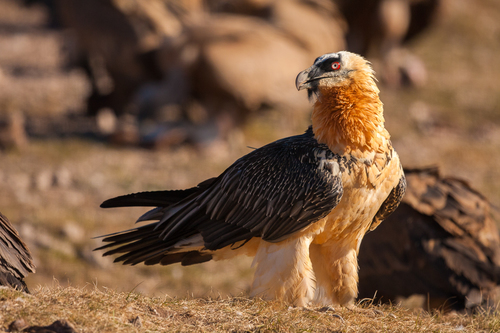
The bearded vulture, also known as the lammergeier and ossifrage, is a very large bird of prey in the monotypic genus Gypaetus. The bearded vulture is the only known vertebrate whose diet consists of 70–90% bone.
🛡️ Conservation Status
near threatened
nt
📌 Etymology
The genus name Gypaetus is from Ancient Greek gupaietos, a corrupt form of hupaietos meaning "eagle" or "vulture". The specific epithet barbatus is Latin meaning "bearded" from barba, "beard". The name "lammergeier" originates from the German word ', which means "lamb-vulture". The name stems from the belief that it attacks lambs.
📌 Taxonomy
The bearded vulture was formally described in 1758 by Carl Linnaeus in the tenth edition of his Systema Naturae. He placed it with the vultures and condors in the genus Vultur and coined the binomial name Vultur barbatus. Linnaeus based his account on the "bearded vulture" that had been described and illustrated in 1750 by George Edwards who had based his hand-coloured etching on a specimen that had been collected at Santa Cruz near the town of Oran in Algeria. Linnaeus specified the type locality as Africa, but in 1914 this was restricted to Santa Cruz by Ernst Hartert.
The bearded vulture is the only species in the genus Gypaetus that was introduced in 1784 by Gottlieb Storr.
📌 Subspecies
Two subspecies are recognised:
* G. b. barbatus includes G. b. hemachalanus and G. b. aureus in southern Europe and northwest Africa to northeast China through the Himalayas to Nepal and west Pakistan
* G. b. meridionalis in southwestern Arabia and northeastern, eastern and southern Africa
📌 Physiology
The acidity of the bearded vulture's stomach acid has been estimated to be around a pH of 1. Large bones are digested in about 24 hours, aided by slow mixing or churning of the stomach contents. Protein retained in the bone matrix makes bones a feasible energy source to that of muscle, with 140g of dry bones containing protein equivalent to 111g of muscle. The high lipid content of bone marrow make fresh bones exceed the energy content of muscle, with fresh bones containing about 108% of the energy of fresh meat by weight. A skeleton left on a mountain will dehydrate and become protected from bacterial degradation, and the bearded vulture can return to consume the remainder of a carcass even months after the soft parts have been consumed by other animals, larvae, and bacteria.
📌 Distribution and habitat
The bearded vulture is sparsely distributed across a vast range. It occurs in mountainous regions in the Pyrenees, the Alps, the Arabian Peninsula, the Caucasus region, the Zagros Mountains and Alborz Mountains in Iran, the Koh-i-Baba in Bamyan, Afghanistan, the Altai Mountains, the Himalayas, Ladakh in northern India, and western and central China. It has been reintroduced in several places in Spain, such as the Sierras de Cazorla, Segura and Las Villas Jaén, the Province of Castellón and Asturias. The resident population as of 2018 was estimated at 1,200 to 1,500 individuals.
In Israel it is locally extinct as a breeder since 1981, but young birds have been reported in 2000, 2004, and 2016. The species is extinct in Romania, the last specimens from the Carpathians being shot in 1927. However, unconfirmed sightings of the bearded vulture happened in the 2000s, and in 2016 a specimen from a restoration project in France also flew over the country before returning to the Alps.
In southern Africa, the total population as of 2010 was estimated at 408 adult birds and 224 young birds of all age classes therefore giving an estimate of about 632 birds.
In Ethiopia, it is common at garbage dumps tips on the outskirts of small villages and towns. Although it occasionally descends to , the bearded vulture is rare below altitudes of and normally resides above in some parts of its range. It typically lives around or above the tree line which are often near the tops of the mountains, at up to in Europe, in Africa and in central Asia. In southern Armenia, it breeds below if cliff availability permits. It has even been observed living at elevations of in the Himalayas and been observed flying at a height of .
There are two records of bearded vultures from the Alps reintroduction schemes which have reached the United Kingdom, with the first sighting taking place in 2016 in Wales and the Westcountry. A series of sightings took place in 2020, when an individual bird was sighted separately over the Channel Island of Alderney after migrating north through France, then in the Peak District, Derbyshire, Cambridgeshire, and Lincolnshire. The bird, nicknamed 'Vigo' by Tim Birch of the Derbyshire Wildlife Trust, originated from the reintroduced population in the Alps. As these two birds were both released captive birds, not wild, they have been placed in Category E ("escapes"), and not added to the formal British bird list.
📌 Behaviour and ecology
===Diet and feeding===
The bearded vulture is a scavenger, feeding mostly on the remains of dead animals. Its diet comprises mammals (93%), birds (6%) and reptiles (1%), with medium-sized ungulates (i.e. hoofed mammals) forming a large part of the diet. This is the only living bird species that specializes in feeding on bones. The bearded vulture can swallow whole or bite through brittle bones up to the size of a lamb's femur and its powerful digestive system quickly dissolves even large pieces. Their favoured variants of bones to consume consist of fattier and elongated bones like tarsal bones and tibias. They contain higher levels of oleic acid that is more nutritional for them than smaller bones, which contain less accessible bone marrow. The bearded vulture will crack bones too large to be swallowed by carrying them in flight to a height of above the ground and then dropping them onto rocks below, which smashes them into smaller pieces and exposes the nutritious marrow. Its old name of ossifrage ("bone breaker") relates to this habit. Less frequently, these birds have been observed trying to break bones (usually of a medium size) by hammering them with their bill directly into rocks while perched.
Bearded vultures sometimes attack live prey: perhaps more often than other vultures. Among these, tortoises seem to be especially favoured depending on their local abundance. Tortoises preyed on may be nearly as heavy as the preying vulture. To kill tortoises, bearded vultures fly with them to some height and drop them to crack open the bulky reptiles' hard shells. Golden eagles have been observed to kill tortoises in the same way. Other live animals, up to nearly their own size, have been observed to be seized predaceously and dropped in flight. Among these are rock hyraxes, hares, marmots and, in one case, a long monitor lizard. Larger animals have been known to be attacked by bearded vultures, including ibex, Capra goats, chamois, and steenbok. These animals have been killed by being surprised by the large birds and battered with wings until they fall off precipitous rocky edges to their deaths; although in some cases these may be accidental killings when both the vulture and the mammal surprise each other. Many large animals killed by bearded vultures are unsteady young, or have appeared sickly or obviously injured. Humans have been anecdotally reported to have been killed in the same way. This is unconfirmed, however, and if it does happen, most biologists who have studied the birds generally agree it would be accidental on the part of the vulture. Occasionally smaller ground-dwelling birds, such as partridges and pigeons, have been reported eaten, possibly either as fresh carrion (which is usually ignored by these birds) or killed with beating wings by the vulture. When foraging for bones or live prey while in flight, bearded vultures fly fairly low over the rocky ground, staying around high. Occasionally, breeding pairs may forage and hunt together. In the Ethiopian Highlands, bearded vultures have adapted to living largely off human refuse.
📌 Reproduction and life cycle
The bearded vulture occupies an enormous territory year-round. It may forage over each day. The breeding period is variable, being December through September in Eurasia, November to June in the Indian subcontinent, October to May in Ethiopia, throughout the year in eastern Africa, and May to January in southern Africa. In a few cases, polyandry has been recorded in the species. The mean productivity of the bearded vulture is 0.43±0.28 fledglings per breeding pair per year and the breeding success averaged 0.56±0.30 fledglings per pair with clutches/year.
The nest is a massive pile of sticks, that goes from around across and deep when first constructed up to across and deep, with a covering of various animal matter from food, after repeated uses. The female usually lays a clutch of 1 to 2 eggs, though 3 have been recorded on rare occasions, but have lived for up to at least 45 years in captivity.
Bearded vulture nests can be used for centuries by multiple generations of birds, as evidenced by the discovery, in the same nest, of objects, such as shoes, dated (by carbon-14) to different periods, spanning from the 13th to the 19th centuries. The nest was located in southern Spain, in an area where the species became extinct around the beginning of the 20th century.
📌 Threats
sherpa holding a slain bearded vulture]]
The bearded vulture is listed as near threatened on the IUCN Red List. It naturally occurs at low densities, with anywhere from a dozen to 500 pairs in each mountain range in Eurasia where it breeds. It is most common in Ethiopia, where an estimated 1,400 to 2,200 pairs are estimated to breed. The declines of bearded vulture populations have been documented throughout its range resulting from a decrease in habitat space, fatal collisions with energy infrastructure, reduced food availability, poisons left out for carnivores and direct persecution in the form of trophy hunting.
📌 Conservation
Mitigation plans have been established to reduce the population declines in bearded vulture populations. One of these plans includes the South African Biodiversity Management Plan that has been ratified by the government to stop the population decline in the short term. Actions that have been implemented include the mitigation of existing and proposed energy structures to prevent collision risks, the improved management of supplementary feeding sites as well to reduce the populations from being exposed to human persecution and poisoning accidents and outreach programmes that are aimed at reducing poisoning incidents.
📌 Reintroduction in the Alps
]]
In the Alps, bearded vultures were being shot as late as 1913, and were completely locally extinct in the Alps by the 1930s. Efforts to reintroduce the bearded vulture began in the 1970s in the French Alps with the release of vultures that had been captured in Afghanistan; but this approach proved unsuccessful as it was too difficult to capture the vultures in the first place, and too many died in transport on their way to France. A second attempt was made in 1987, using a technique called "hacking", in which young individuals (between 90 and 100 days in age) from zoological parks would be taken from the nest and placed in a protected area in the Alps. As they were still unable to fly at that age, the chicks were hand-fed by humans until the birds learned to fly and were able to reach food without human assistance. This method has proven more successful, with over 200 birds released in the Alps from 1987 to 2015, and a bearded vulture population has reestablished itself in the Alps.
📌 In culture
The bearded vulture is considered a threatened species in Iran. Iranian mythology considers the rare bearded vulture (; ) the symbol of luck and happiness. It was believed that if the shadow of a Homa fell on one, he would rise to sovereignty and anyone shooting the bird would die in forty days. The habit of eating bones and apparently not killing living animals was noted by Sa'di in Gulistan, written in 1258, and Emperor Jahangir had a bird's crop examined in 1625 to find that it was filled with bones.
The Greek playwright Aeschylus was said to have been killed in 456 or 455 BC by a tortoise dropped by an eagle who mistook his bald head for a stone. If this incident did occur, the bearded vulture is a likely candidate for the "eagle" in this story.
The ancient Greeks used ornithomancers to guide their political decisions: bearded vultures, or ossifrage, were one of the few species of birds that could yield valid signs to these soothsayers.
In Tibet, corpses are fed to this vulture. The rite is called a "sky burial" and is accompanied by prayers and mantras for the deceased person. There is a specialist assigned to this task which occurs high in the mountains where the vultures swoop down to eat the bones. The birds are blessed too. They are called "jagod" in the Tibetan language.
In the Bible/Torah, the bearded vulture, as the ossifrage, is among the birds forbidden to be eaten (Leviticus 11:13).
In 1944, Shimon Peres and David Ben-Gurion found a nest of bearded vultures in the Negev desert. The bird is called ' in Hebrew, and Shimon Persky liked it so much he adopted it as his surname.