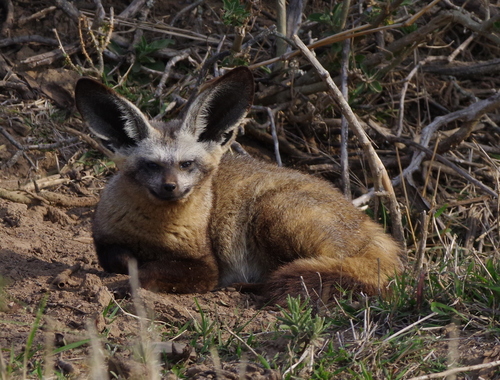
The bat-eared fox is a species of fox found on the African savanna. It is the only extant species of the genus Otocyon, and is the sister species to all other members of the tribe Vulpini, not genetically being a true fox. Fossil records indicate this canid first appeared during the middle Pleistocene. There are two separate populations of the bat-eared fox, each of which makes up a subspecies. The bat referred to in its colloquial name is possibly the Egyptian slit-faced bat, which is abundant in the region and has very large ears. Other vernacular names include big-eared fox, black-eared fox, long-eared fox, Delalande's fox, cape fox, and motlosi.
📌 Etymology
The bat-eared fox's generic name Otocyon is derived from the Greek words otus () for ear and cyon () for dog, while the specific name megalotis comes from the Greek words megas () for large and otus () for ear. The common name for the bat-eared fox is likely taken from the Egyptian slit-faced bat (Nycteris thebaica), due to the bat's similarly large ears and abundance in the bat-eared fox's geographic range. Delalande's fox, cape fox,}} and motlosi.
📌 Taxonomy and evolution
The bat-eared fox is the only living species of the genus Otocyon.
Due to its unusual dentition—, the largest number of teeth known in any non-marsupial land mammal—the bat-eared fox was previously placed in a distinct subfamily of canids, Otocyoninae, as no relationship to any living species of canid could be established.
📌 Phylogeny
Otocyon megalotis is regarded as having affinities with the vulpine line, and Otocyon was placed with high confidence as sister to the clade containing both the raccoon dog (Nyctereutes) and true foxes (Vulpes).
The following cladogram is based on figures by Lindblad-Toh et al., 2005:
|2=Otocyon
}}
|2=
}}
|2=Urocyon
}}
}}
}}
📌 Subspecies
Currently, there are two recognized subspecies:
{| class="wikitable "
|-
! Image !! Subspecies !! Distribution
|-
|||Otocyon megalotis megalotis (Desmarest, 1822) ||Southern Africa
|-
|||Otocyon megalotis virgatus (Cabrera, 1910) ||East Africa
|-
|}
📌 Fossils
Otocyon is poorly represented in the fossil record. It is suggested the genus forms a clade with Prototocyon, an extinct genus of canid. In the Olduvai Gorge, Tanzania, fossils of the related extinct fox species first considered Otocyon recki have been found that date back to the late Pliocene or early Pleistocene. fossil records specifically of Otocyon megalotis have been identified in sediments only as old as the middle Pleistocene. These fossils, known from the Lainyamok locality of Kenya, date back .
📌 Dentition and jaw adaptations
The teeth of the bat-eared fox are much smaller those of other canid species, The bat-eared fox possesses 4-5 lower molar teeth and 3-4 upper molars, a number notable as it is greater than the number of lower or upper molars possessed by any other extant eutherian or canid, respectively. and anchors the large digastric muscle to allow for rapid chewing. The digastric muscle is also modified to allow for opening and closing the jaw five times per second.
📌 Distribution and habitat
, Namibia]]
The bat-eared fox has a disjunct distribution across the arid and semi-arid regions of Eastern and Southern Africa, in two allopatric populations (representing each of the recognized subspecies) separated by approximately . Subspecies O. m. virgatus extends from southern Sudan, Ethiopia and Somalia, through Uganda and Kenya to southwestern Tanzania; O. m. megalotis occurs in the southern part of Africa, ranging from Angola through Namibia and Botswana to South Africa, and extends as far east as Mozambique and Zimbabwe,
Bat-eared foxes are adapted to arid or semi-arid environments. They are commonly found in short grasslands, as well as the more arid regions of the savannas, along woodland edges, and in open acacia woodlands. They prefer bare ground and areas where grass is kept short by grazing ungulates
In addition to raising their young in dens, bat-eared foxes use self-dug dens for shelter from extreme temperatures and winds. They also lie under acacia trees in South Africa to seek shade during the day.
📌 Behavior and ecology
Bat-eared foxes are social animals. They live in pairs or groups, depending on the subspecies. In southern Africa (ssp. megalotis), bat-eared foxes live in monogamous pairs with pups, while those in eastern Africa (ssp. virgatus) may live in pairs, or in stable family groups consisting of a male and up to three closely related females with pups.
In the more northern areas of its range (around Serengeti), they are nocturnal 85% of the time. However, around South Africa, they are nocturnal only in the summer and diurnal during the winter.
📌 Hunting and diet
The bat-eared fox is the only truly insectivorous canid, with a marked preference for harvester termites (Hodotermes mossambicus), they can consume other species of termites, other arthropods such as ants, beetles (especially scarab beetles (dung beetles)),). Berries, seeds, and wild fruit also are consumed. The bat-eared fox refuses to feed on snouted harvester termites, likely because it is not adapted to tolerate the termites' chemical defense.
Bat-eared foxes usually hunt in groups, often splitting up in pairs, with separated subgroups moving through the same general area. When termites are plentiful, feeding aggregations of up to 15 individuals from different families occur. Individuals forage alone after family groups break in June or July and during the months after pups birth.
📌 Reproduction and life cycle
, just outside of Maasai Mara National Reserve|alt=Two small (juvenile) foxes, one looking at the viewer and the other turned away, on a grassy field]]
The bat-eared fox is predominantly socially monogamous, although it has been observed in polygynous groups. The female forages for food, which she uses to maintain milk production, on which the pups heavily depend. Food foraged by the female is not brought back to the pups or regurgitated to feed the pups. and up to 9 years in the wild.
📌 Threats and human interaction
No major threats to bat-eared fox populations exist, though hunting, disease and drought can threaten individuals and lower population numbers on a short term scale. Diseases that affect the bat-eared fox include canine distemper, canine parvovirus, and rabies. Predators to the bat-eared fox are mostly large mammalian carnivores, but they are also prey to large raptors and the Central African rock python. Black-backed jackals pose the greatest threat to young bat-eared foxes, but in breeding areas, adults will engage in mobbing behavior to drive them off.
📌 Conservation
Otocyon megalotis is considered to be a least-concern species by both the International Union for Conservation of Nature and the South African National Biodiversity Institute. Some parts of its range are incidentally protected areas.
📌 Human use and captivity
The bat-eared fox has some commercial use for humans. They are important for harvester termite population control, as the termites are considered pests. They have also been hunted for their fur by Botswana natives. Captive bat-eared foxes are present in zoos in North America, South Africa, Europe, and Asia.