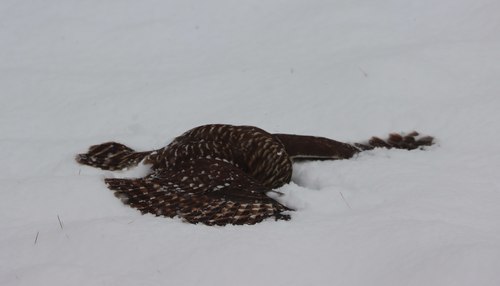
The barred owl, also known as the northern barred owl, striped owl or, more informally, hoot owl or eight-hooter owl, is a North American large species of owl. A member of the true owl family, Strigidae, they belong to the genus Strix, which is also the origin of the family's name under Linnaean taxonomy. Barred owls are largely native to eastern North America, but have expanded their range to the west coast of North America where they are considered invasive. Mature forests are their preferred habitat, but they can also acclimatise to various gradients of open woodlands. Their diet consists mainly of small mammals, but this species is an opportunistic predator and is known to prey upon other small vertebrates such as birds, reptiles, and amphibians, as well as a variety of invertebrates.
π Basics
is now considered a distinct species]]
The barred owl was first described by Philadelphia naturalist Benjamin Smith Barton in 1799. The species was named due to the varied directions the dusky markings take on their underside.
The barred owl is roughly intermediate in size between the larger Ural and the smaller tawny owl, but the structural features of its relatively short and decurved claws more so resemble the tawny species as does their dietary and habitat ecology. However, genetic testing reveals very early divergence (likely at or near their ancestor's entry to North America) between spotted and barred owls. A fossil species once called Strix brea from the early Pleistocene in California does little to resolve the ancestry of modern species, given its ambiguous relation to any living Strix. The fossil species was larger (more similar in size and slenderness to the spotted owl, albeit with a slightly smaller skull and geographically isolated from that species) and longer-legged than either the spotted and barred owls, and is now considered to be in a separate genus, Oraristrix. Pleistocene era fossils of probable barred owls are known from Florida, Tennessee and Ontario.
π Subspecies
such as S. v. georgica from Florida differ from northern barred owls by their darker brown streaks and, more noticeably, their bare toes]]
The subspecies of the barred owl vary mostly by region, with slight to moderate variation by coloring, size and extent of feathering on the toes. Although several have been described in the past, the barred owl may include only three subspecies, subsequent to the separation of the fulvous and cinereous forms.
*S. v. varia (Barton, 1799): The northern barred owl. This race lives throughout the Northeastern United States and the Upper Midwest, ranging as far south as Oklahoma, the Carolinas and northern Georgia. It is also considered to comprise all western "invader" birds found as far west as California and British Columbia. This race is generally the typical mid gray-brown variety of barred owl. This race is fairly large (described as the largest race on average with the probable separation of the cinereous owl). The wing chord and tail length may measure from and in males and and in females. This is the smallest of the three subspecies on average. In this race, the ground coloration tends to pale gingery-cream and the back and head tend to be a pale brown ranging into an almost cinnamon color. The toes can vary from rather bare to slightly bristled. This race is similar to other barred owls in size, perhaps averaging marginally smaller than those in the nominate race, but its bill and feet are larger on average than the preceding two races.
π Vocalization
The barred owl is a powerful vocalist, with an array of calls that are considered "spectacular, loud and emphatic". Calls probably carry well over . Its usual call is a series of eight accented hoots ok-ok-ok-ok ok-ok-buhooh, or the "typical two-phrase hoot" with a downward pitch at the end. The most common mnemonic device for remembering the call is "Who cooks for you, who cooks for you all." At 80% of study posts in Virginia, barred owls responded to playback of this call. A further call is the "ascending type" or the "legato" call, a series of variable notes ending in oo-aw or hoo-aah. Several other calls, although some are not dissimilar variations on the main calls, are known. Some of these vary into cackles, hoots, caws and gurgles, at times described as "sudden demonic laughter", "cat-like screams" and "prolonged outbursts of cackling" and seem to be, among Strix species, an idiosyncrasy endemic to the barred owl.
Another call type is the "mumble", a grumbling, slurred and subtle err-ERR-err, also an up-and-down "twitter" call at a high pitch. Of calls, 87 to 94% are identifiable to sex per one study. They are more responsive than any hawk in the east to playback of calls of their own species. The barred owl is noisy in most seasons but peak vocalization times for barred owls tend to be between late January (in Florida) and early April (in Canada). Two seasonal peaks in vocalizations, one right before breeding and another after the young have dispersed, were detected in Connecticut, with peak vocalizations on nights with extensive cloud cover. Peak times for vocalizations are between 6:00pm and 6:00am, with the least frequent vocalizations around mid-afternoon.
π Distribution and habitat
]]
The barred owl is distributed throughout most of the eastern United States, as well as much of southern Canada. The barred owl has been recorded as ended up as far north as central Labrador, though the species is not yet confirmed to breed in the province. The barred owl ranges in every part of the eastern United States continuously from northernmost Maine down throughout New England, the Mid-Atlantic states, much of the Midwest, the Southeast United States and all of Florida. Arguably and discontinuously from Texas, the species may range into central and southern Mexico but these populations are now often considered a separate species. These initial parts of the range in the eastern and central stretches would be considered as where the species is "native". A wandering barred owl was once seen flying over Lake Michigan from the nearest land.
π Range expansions
, where the species is an "invasive" recent invader]]
The remaining parts of the range are considered where the barred owl introduced itself in the last century or so. The historical lack of trees in the Great Plains presumably acted as a barrier to the range expansion, and recent increases in forests broke down this barrier.
In Canada, the barred owls with range expansion now range through southern Manitoba (excluding the southwest corner), a broad section of south-central Saskatchewan, and east-central and nearly all of western Alberta, now up to High Level. The barred owl has been present in Manitoba at least since 1886, Alberta since 1932 and Saskatchewan since 1948. However, a study in Alberta has shown that barred owls have likely been present for no less than 100 years. This owl species currently ranges through much of British Columbia, where they have been expanding their range since at least 1943, including Vancouver Island and as far north as Fort St. John. The barred owl has had a further northward expansion in the west to southeastern Alaska (Skagway to Ketchikan) and extreme southwestern Yukon. In the western United States they also range into northwestern Montana and northern Idaho. Barred owls were first verified in southwest Montana in 1909 and in northwest Montana in 1921 (although reports of the species may date back to the 1870s) but not in Idaho until 1968. They range broadly in eastern and western Washington (reached by 1965) and western Oregon (reached by 1972) (mostly along the forested corridors hugging the montane areas of the Cascade, Olympic and Blue ranges), and northern California (reached by 1976), now down to the Redwood National Forest, the Sierra Nevada and outer San Francisco.
π Behavior
The barred owl, like most owls, is largely adapted to nocturnality. Peak times in Minnesota were found to be right after sunset and just before dawn. Nonetheless, they are not as fully nocturnal as many owls and rank around 6th amongst 19 regular North American owl species for the regularity of their activity outside of nightfall, especially in particular circumstances such as when a rival or a human impersonator is emitting barred owls calls or whilst hunting. Often daytime activity tends to be early in the morning or around dusk but potentially at any time (overcast days being preferred). This species often spends the daytime hidden away in the dense foliage of a tree, often at minimum above the ground, but sometimes also roosts in a branch close to a broad trunk or in a natural tree hollow. Recently fledged owls sometimes roost in tall grass, usually after falling from the nest tree. They seldom rely on camouflage, instead often flying at the least disturbance and not allowing close approaches, making them potentially difficult to observe. There are some records of barred owls engaging in allopreening, presumably between pairs, with each other in the wild. They are skilled and silent fliers and frequently use routine forest flyways with open understory and low branch densities. In tawny owls in a study from Italy, for instance, they responded mildly or not at all to the calls of neighboring tawny owls known to them but with great aggression to the calls of "stranger" owls. Due to its rather stolidly territorial nature, the barred owl is not normally a migratory species. There is little to no evidence of nomadic behavior as has been recorded in several other owls in the north.
π Dietary biology
Barred owls are opportunistic predators of the woodlands. Like the tawny owl, the barred owl usually hunts from a perch. During hunting efforts, they glide briefly from perch to perch until prey is detected. The barred owl, especially compared to the predominantly arboreal prey of the spotted owl, usually prefers to target small animals that are terrestrial. However, barred owls will also flush and capture night-roosting birds, and capture bats on the wing as well. Although they usually hunt within woodlands, they also occasionally hunt in open terrain, more typical of the hunting areas of a bird like the long-eared owl. While hunting squirrels in the Foothill Model Forest of Alberta, barred owls were seen to make several passes before succeeding. Hunting on the ground is usually done to obtain foods such as invertebrates or amphibians. These owls may wade into shallow water to capture fish and may do an unusual amount of aquatic foraging, as compared to any Strix species or North American owl. A majority of prey of barred owls is eaten outright but, with large prey, the barred owl may eat the head first and then return to consume the remainder of the body. The pellet of the barred owl averages about in diameter and in length. One study from a wide swath of the range found that among 2234 accrued prey items, 76% were mammals, 15.8% were invertebrates, 5.8% were birds and 2.5% were other vertebrates. In four other studies from different parts of the distribution, the mean balance of mammals in diet was around 64.9%, birds at around 13.4%, invertebrates at around 11.4% and different classes of vertebrates (mostly amphibians) at around 10.3%. A compilation study that included a total of 7077 prey items using all methodologies, 71.9% were mammals, 9.5% were birds, 0.6% reptiles, 6% amphibians, 1.89% fish, 1% earthworms, 0.2% gastropods, 6.5% insects and 2.4% crayfish. Many more studies have estimated mean prey masses in westerly areas of sympatry with spotted owls to understand how their diets may conflict.
π Mammals
The predominant small mammals available in forest and woodland edges are generally small rodents, so the barred owl, like other Strix owls, most often relies on rodents as the primary type of food. The diet of barred owls in a much smaller study near Urbana, Illinois during winter was less homogeneous but still led by rodents, especially the meadow vole (32.3%) and white-footed mouse (23.5%). A winter food study in Essex County, New Jersey found that among 118 prey items, meadow voles comprised a great majority of the prey, at 91.5% of the balance.
An unusual lack of diversity in barred owl pellets was found in several years of possibly an aseasonal study in Ann Arbor, Michigan where of 777 prey items, 83.3% were meadow voles. At Edwin S. George Preserve near the University of Michigan, the summer diet was also heavily rodent based, as among 146 prey items 37.9% were white-footed mice, 22.6% were southern bog lemming and 6.84% were meadow voles. In a somewhat larger Michigan study, the North American deermouse, lead the prey at 34.9% of 321 prey items. In Minnesota, the barred owl was counted as one of the leading causes of mortality of prairie voles. Studies of the barred owl diet in 6 urban metropolitan areas of British Columbia found that the diet was dominated by young rats of the invasive Rattus genus, comprising 52.8% of 688 prey items, well ahead of native Townsend's voles, which were secondary at 19.2% of the diet. The average weight rats taken by owls were clearly juveniles, estimated to average , although several could be anywhere from infant rat to adult rat sizes, i.e. about . The mean size of black rats taken in Oregon was , indicating that here large adults of this species were selected.
In different areas, barred owls may regularly hunt the diverse members of the squirrel family, despite their general penchant for diurnality. Smaller squirrel varieties are usually focused on when hunted as supplement prey, such as chipmunks, averaging about among the different species they prey upon, and pine squirrels, which average about twice as large as chipmunks. Usually juvenile specimens are focused on when taking the larger Sciurus tree squirrels, at least in summer, but presumably a mixture of yearling and adult Sciurus will be taken during winter. The issue of temporal activities is less pertinent to the predator of flying squirrels, which are nocturnal. All studies of the diet of barred owls in Pacific Northwest show the importance of the northern flying squirrel to their diet. This flying squirrel was found to comprise from about 10.9% to 20% of the diet of barred owls (either as the most or second most important prey species) and, with a mean weight of when taken, they comprised up to 25.6% of the food biomass for this owl species. Beyond the aforementioned rodent prey, more infrequently rodent prey can including various other cricetid rodents, pocket gophers, mountain beavers (average weight when taken of up to ) and jumping mice.
Secondary prey can include several species of cottontail rabbits (Sylvilagus sp.) and snowshoe hares (Lepus americanus). 3.2% of 7077 prey items from across the range for barred owls were rabbits or hares. Barred owls are also known predators of small mammalian carnivorans, mainly mustelids such as stoats (Mustela erminea) and long-tailed weasels (Neogale frenata). Predation on small American mink (N. vison) have also been reported. Much larger mammals are sometimes recorded in the foods of barred owls, but there are few details known about the age, condition, or circumstances (i.e. they may have been consumed as carrion or, perhaps more likely, young or infirm specimens were taken).
π Birds
No specific variety of bird is subject to the most frequent predation by barred owls and birds are the most diverse class in these owl's prey spectrum, with more than 100 species of bird known to be hunted. The muddy bank nests of cliff swallows are also vulnerable to barred owls, while other swallow species are known to be opportunistically taken.
In more enclosed wooded areas, radio-tagging and video-monitoring of various passerines nests as well as examinations of owl pellets has shed light on the relationship of barred owls with these potential prey resources. Not only was the barred owl found to be a surprisingly routine predator at woodland passerine nests, but that an unexpected bulk of the acts of predation in studies from Missouri and Illinois were carried out during the daytime. Many different forest bird species (most frequently Acadian flycatchers and indigo buntings in Missouri and Illinois) were hunted. These studies indicated that the barred owl may snatch passerines of any age, but recent fledglings are taken preferentially due to their more conspicuous behavior and limited ability to fly away. In Minnesota, about 62% of studied hermit thrush and ovenbird fledglings were taken per one study, with all thrush that nested in the radius of the barred owl's nests failing to produce any young. A similarly high rate of local determent by barred owls has been found for other woodland thrushes like the veery, wood thrush and varied thrush, with the additional finding that pre-dawn singing by certain thrushes, when their escape abilities are dulled by the dim light, leaves them vulnerable to barred owl ambushes. Forest birds seem to recognize the barred owl as a threat, with mobbing behavior evoked easily by playing recordings of their calls in the daytime.
A wide diversity of bird prey may be occasionally hunted by barred owls in different circumstances. Smaller or mid-sized bird prey species known have including different species, though usually a relatively low species diversity and in low numbers, beyond swallows and thrushes of tyrant flycatchers, vireos, chickadees, wrens, mimids, tanagers, other cardinalids and finches. Birds down to the size of the calliope hummingbird, North America's smallest hummingbird at , may be taken by barred owls. Other small-to-medium-sized bird species known as prey for barred owls are: mountain quail, grey partridge, rock dove, band-tailed pigeon, mourning dove, purple gallinule, killdeer, American woodcock, least tern, snowy egret, cattle egret and belted kingfisher. Although they take many chicks of gamebirds, adults of these species are vulnerable as well. Barred owls are also known to take adult spruce grouse of about the same size as the ruffed grouse, as well as much larger species including the common pheasant and the sooty grouse, the latter estimated to average when taken. Barred owls are also known to prey on the young of other, larger birds, such as the American white ibis and wild turkey.
π Other prey
Barred owl predation on reptiles is widely reported but they seldom take large numbers in any given area. The estimated body mass of black racer taken in Oregon was only , well under their mean mature size. Rarer still is barred owl predation on turtles. Much more characteristic than any reptilian prey are amphibians, with various types of frogs, salamanders and similar species reported in this owl's foods. A notable act of successful predation was carried out by a barred owl on a rough-skinned newt, which contains toxins that are often deadly to predators. Apparently, the owl was able to survive after consuming the newt. The rarest variety of vertebrate prey for barred owls is fish. At least five species of fish have been identified in the foods of barred owls, including fairly large fish like brown bullheads and largemouth bass. Crayfish seem to be exclusively taken in the east and Midwest, areas where they comprised 3.4% of all known food studies, and none at all were recorded in the western part of the range. In Missouri, annually up to 31.1% (though, in some years, 0%) of the diet comprised crayfish. Barred owls occasionally feed on snails and slugs, the latter especially in the Pacific Northwest. Another snail, the Pacific sideband, was surprisingly often present in the foods in Oregon as at least 135 were taken. Beyond slugs, other "soft" invertebrates are sometimes hunted, especially earthworms. Earthworms were most prominent in the foods of barred owls in Nova Scotia, where 27.6% of 186 video-monitored prey deliveries in Nova Scotia were worms, the most regularly delivered of all prey types there.
π Interspecies predatory relationships
The barred owl's range overlaps with multiple other predators of similar prey species. Due to the time period barred owls are active, the most interaction occurs with other owl species. Of the owls in North America, about three-quarters are reliant on similar small mammal prey, usually rodents, with a mixture of other prey genera as supplements. In multiple parts of the range, including southwestern Ohio, North Carolina and northern Michigan, the paralleling habitat usage and nesting behavior of the barred owl and red-shouldered hawk has been noted. One of the few respects in which their habitat usage differs is that the barred owl is more adaptive to nesting in suburban areas if they have old growth trees that provide plentiful tree hollows. In contrast, red-shouldered hawks tend to avoid suburban areas whilst nesting, but may acclimate to these areas during the winter. Barred owls seldom alter their range throughout the year and remain more or less constrained to the stands they used during nesting. The red-shouldered hawk averages somewhat smaller and has a more limited diet than barred owls, but probably goes after dangerous prey such as snakes more regularly. Multiple occasions are recorded where the barred owl and red-shouldered hawk have nested in the same area, often within the same grove of trees, remarkably with little to no conflict.
s are the most severe competitor and predator of barred owls]]
One predator that is a major source of conflict for the barred owl is the great horned owl. In general the reforestation at the northern sections of the Great Plains have, on the contrary, benefited barred owls (and may have been a part of allowing their westward expansion) and been perhaps slightly detrimental to the great horned owl.
The great horned owl is indeed likely to be the greatest natural enemy of the barred owl. Other than horned owls, predation of the barred owl seems to be fairly rare outside of the nestling age, both due to the owl's relatively large size and their nesting habits, most often in secluded tree hollows. Both the American marten and the fisher are known to be nest predators of barred owls, in turn appearing to cause the owls to switch nest sites. Other birds of prey may be an occasional threat to barred owls. Northern goshawks have reportedly killed both young and adult barred owls. A well-known instance of a goshawk attack on an adult barred owl concluded with the owl and goshawk killing one another. There are some very rare, singular cases of predation on barred owls (age unknown) by red-tailed hawks, which nonetheless generally appears to be a less menacing co-inhabitant than the goshawk. More surprisingly, a Cooper's hawk, a smaller species of raptor, was observed to apparently prey upon a full-grown barred owl in British Columbia. An American alligator was reported to have preyed on a barred owl in at least one instance.
On the other hand, the barred owl is a significant predator of smaller raptor species as well. Most smaller owls that co-exist with barred owls are at occasional risk of predation. In one instance, a biologist who called in an eastern screech owl (Megascops asio) in Ohio observed it to be immediately captured and consumed by a barred owl. The barred owl is a serious predator of eastern screech owls, but is less deadly to them in general than the great horned owl. Various additional owl species known to be preyed upon by barred owls including the flammulated owl (Psiloscops flammeolus), northern pygmy owl (Glaucidium gnoma), Barred owls have been known to take adults (or full-grown juveniles) of diurnal raptors as well, including snail kites, Cooper's hawks, sharp-shinned hawks and possibly swallow-tailed kites.
π Reproduction
The barred owl's preferred nest site is usually the hollow trunk of a large tree or the broken-off snag from a large tree branch. Hollows or snags may be made by any variety of sources, often due to a disease or storm, with hollows and snags large enough to accommodate these birds usually only occurring in an old-growth tree. In Washington, the most often used nest trees were balsam poplar, Douglas fir and grand fir. In continuous bottomland forest, nests are often about every . Territory lines often remain the same even after the original owls are replaced entirely by a new pair. Nest built by other birds that are most widely used are probably red-shouldered hawk and Cooper's hawks, while those of red-tailed hawks, usually being in more open areas, are used secondarily outside of a local basis. In the south, nests have been found between fronds of palmetto palm leaves, in holes of broken palm stems and rotten snags of the palms. Another was on the roof of a shed in Saskatchewan. Yet another was in an earthen bank in Texas. Locally, barred owls can take to nest boxes but, in general, barred owls take to these less readily than their cousin Strix owls in Europe. Suitable nesting hollows may be used quite often in subsequent years, with records of a single hollow seeing up to 25 years of barred owl use (presumably not by the same owls however). Like all owls, barred owls never construct their owl nest but they may press or dig slightly if soil is present or remove the top leaves from a squirrel drey. Copulation between pairs usually occurs in late winter, February to March, and occurs several times, probably to ensure implantation. The female enters a pre-breeding lethargy stage wherein she is fed by the male. In Minnesota, the mean clutch size was 2.68. There are several accounts of barred owls engaging in fierce nest defense against humans, sometimes reportedly knocking people out of trees.
The average hatchling weighs about . Adult-like feathers begin to appear at six weeks of age, starting at the scapulars, then radiating down across the abdomen and flanks up through the upper breast, with the last wisps of down remaining for up to 4 months. Short flights are typical when the young barred owls are up to around 10 weeks old with longer flights commencing at about 14 weeks. The percentages of successful nests (i.e. at least 1 fledgling produced per attempt), per study were found to be: 86% of 22 clutches in Minnesota (with a mean of 2.42 fledglings per successful attempt), 66% of 114 clutches in Michigan (with a mean of 1.97 fledglings per successful attempt), 25% of 6 clutches in Maryland (with a mean of 1 fledgling per all attempts and 1.48 per successful attempts), 69% of 48 clutches in Nova Scotia (with a mean of 0.25 fledgling per all attempts and 2 per successful attempts) and 50% of 12 nests in Washington state. Little is known about the specific factors that dictate breeding success, but are likely to include the quality of the nesting site, the food supply in the area, the levels of disturbance from outside actors (usually humans) and the maturity of the pair.
π Longevity and parasitism
The barred owl is a naturally long-living bird. Some record lifespans recorded per banding studies in the wild are 18 years 2 months (initial banding Kentucky, died in Ohio) and 24 years and 1 month in Minnesota. There are several records of breeding barred owls nesting successfully for a decade or more. Sometimes deaths occurs due to the defenses of prey. Some cases of cannibalism between adult barred owls have been reported as well. This species, like other forest owls, is vulnerable to the respiratory disease aspergillosis. Spontaneous infections of West Nile fever are also known to kill wild barred owls. Barred owls were the most regularly infected with West Nile Virus of owl species in Georgia, as about 15% of studied barred tested positive (still at a lower rate than some hawks). Cases of Avipoxvirus are also known in barred owls but, as with West Nile virus, the rate of mortality to viral infection is not well-known. A case of follicular thyroid cancer was found in a wild barred owl that was unable to continue to fly. Fatty liver diseases have been recorded for barred owls in captivity. Eye lesions are fairly common in barred owls, but can be survived and possibly surgically corrected.
Parasitism is frequent in barred owls as expected for many different kinds of wild birds. The parasite load of helminths was determined to be higher in larger owls in Florida like the barred and great horned owl and lower in smaller owl species, like eastern screech owl. While parasitic infestations are not typically detected as direct mortality causes, in some severe cases complications or direct death can occur. These cases of mortality are most widely recorded in cases of toxoplasmosis, although generally owls have lower rates of dangerous Toxoplasma parasites than some other species of birds of prey. Of barred owls in one study, 26.7% had Toxoplasma gondii, the cause of toxoplasmosis, upon necropsy study, with adults having it more often than immature birds. Lethal cases of trichomoniasis are also known. The effect of other parasites are more poorly known beyond generally compromising their hosts' condition, but in one case Sarcocystis strixi may have caused paralysis in a barred owl. Other parasites recorded in barred owls include Eimeria varia, Novyella, Neodiplostomum as well as apparently rare species of Centrorhynchus and Tetrameres that were first found within barred owls. Trematode flatworms such as strigeids as well as Tylodelphys and Brachylaima are found in intermediate volume in barred owls relative to other owls. Invertebrates such as hippoboscid flies and Mallophaga are known to infect barred owls as ectoparasites but seldom at severe levels. Concern was expressed that barred owls may compromise spotted owl populations with novel parasites. However, studies of Haemoproteus in barred and spotted owls in northwestern California found that native parasites were finding a new host in barred owls and may have been transmitted from spotted to barred owls but that the barred owl acted as a poor parasite host and may have diluted the parasite levels in owl populations. Furthermore, there was no evidence found that barred owls were spreading parasites to spotted owls.
π Status
)]]
The barred owl is one of the most common owls in North America. It estimated that Canada in total holds about 10,000β50,000 pairs. Canadian Maritimes had highest densities known, with 3600 pairs, being found in 80% of blocks totaling 377; this was a conspicuously higher density than that recorded in Ontario, where they were in 28% of 1824 study blocks. Iowa, Tennessee and Maryland had the highest densities of pairs apparently in the United States, being present from 39 to 47% of blocks.
π Barred owl and northern spotted owl
, Gatineau, Quebec]]
Barred owls are thought to be partly responsible for the recent decline of the northern spotted owl, native to British Columbia, Washington, Oregon, and California. The 2011 Revised Recovery Plan for the Northern Spotted Owl states "Based on the best available scientific information, competition from the barred owl (S. varia) poses a significant and complex threat to the spotted owl." Northern spotted owls were thought to be already declining considerably before barred owls moved into their range, mostly in sync with large-scale logging operations and land development carried out by humans, with their problems now further exacerbated by the barred species's presence. The barred owls of the area additionally prefer wetter, more variable forest areas, down to riparian zones with limited forested land, while the spotted tended to cluster in more homogeneous upland and ancient coniferous forests. However, little is known on the feasibility or benefits of habitat maintenance that favors spotted over barred owls. Habitat management measures are hypothesized to be insufficient to mitigate the negative effect the barred owls are having. In areas where barred owls moved in within of a spotted owl nest area, 39% of spotted owls disappeared and were not seen again, while in areas still free of barred owls (so spared from this interspecific pressure), 11% of spotted owls disappeared and were not found again. While some authors have described the expansion of barred owls into the west as "natural", others state that this is a mischaracterization, as there is little to suggest that the barred owls could have reached the spotted's range without the inadvertent aid of humans β increasing temperatures, wildfire suppression, and tree planting likely facilitated the range increase. When spotted owls and barred owls share the same area, the barred owls generally are more aggressive and out-compete the spotted owls, leading to decreased populations of the native owls. The more aggressive response of barred owls to interspecific stimuli has been verified with experiments incorporating vocalization and owl dummies. Additionally, the adult survival rates appear higher for barred owls (an estimated 91%) than for spotted owls (an estimated 82%). Therefore, the barred owl is considered "demographically superior".
Another potential threat is that barred owls and spotted owls occasionally interbreed, creating hybrids ("sparred owl" or "botted owl"). Only 47 hybrids with barred owls (all between female barred owls and male spotted owls) were found in an analysis of more than 9,000 banded spotted owls; consequently, hybridization between these two species is considered to be "an interesting biological phenomenon that is probably inconsequential compared with the real threatβdirect competition between the two species for food and space". Most hybrids favor their barred owl heritage with similar and more pale overall coloring than spotted owls, though the back tends to be intermediate in color between the two and the beak coloring is variable. However, there has been much variation described. Moreover, no recent hybrids could be detected in a survey of the Cascade Mountains.
π In art
John James Audubon illustrated the barred owl in Birds of America (published in London, 1827β1838) as Plate 46, where it is shown threatening a grey squirrel. The image was engraved and colored by Robert Havell's London workshops. The original aquatint by Audubon is owned by the Brooklyn Museum.