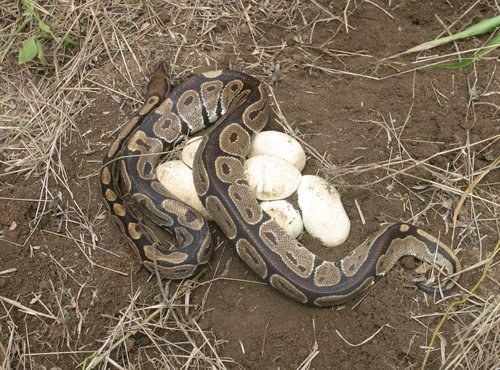
The ball python, also called the royal python, is a python species native to West and Central Africa, where it lives in grasslands, shrublands and open forests. This nonvenomous constrictor is the smallest of the African pythons, growing to a maximum length of 182 cm (72 in). The name "ball python" refers to its tendency to curl into a ball when stressed or frightened.
🛡️ Conservation Status
near threatened
nt
📌 Taxonomy
Python Regius was the scientific name proposed by the biologist George Shaw in 1802 for a pale variegated python from an indistinct place in Africa.
The generic name Python was proposed by François Marie Daudin in 1803 for non-venomous flecked snakes. Between 1830 and 1849, several generic names were proposed for the same zoological specimen described by Shaw, including Enygrus by Johann Georg Wagler, Cenchris and Hertulia by John Edward Gray. Gray also described four specimens that were collected in Gambia and were preserved in spirits and fluid.
📌 Etymology
The specific name regius is a Latin adjective meaning "royal" or "of the king". The English common name "royal python" (used chiefly in Europe) and the specific epithet are usually taken together to mean "royal python". Historical accounts and modern secondary sources have suggested that the epithet and common name may reflect a long-standing cultural association between the species and African rulers — a widely repeated claim is that ancient rulers (sometimes linked to stories about Cleopatra) wore the snakes as living bracelets — but the historical evidence for that precise claim is limited and the attribution is of uncertain veracity; therefore sources treat it as a traditional explanation rather than a proven historical fact.
📌 Distribution and habitat
The ball python is native to west Sub Saharan Africa from Senegal through Cameroon to Sudan and Uganda.
It prefers grasslands, savannas, and sparsely wooded areas.
📌 Behavior and ecology
Ball pythons are typically nocturnal or crepuscular, meaning that they are active during dusk, dawn, and/or nighttime. This species is known for its defense strategy that involves coiling into a tight ball when threatened, with its head and neck tucked away in the middle. This defense behavior is typically employed in lieu of biting, which makes this species easy for humans to handle and has contributed to their popularity as a pet.
In the wild, ball pythons favor mammal burrows and other underground hiding places, where they also aestivate. Males tend to display more semi-arboreal behaviors, whilst females tend towards terrestrial behaviors.
📌 Reproduction
Females are oviparous and lay three to 11 rather large, leathery eggs.
📌 Health and disease
Several infectious agents and husbandry-related conditions are known to affect ball pythons, especially in captive collections. Respiratory disease associated with novel reptile nidoviruses (sometimes called serpentoviruses) has been reported repeatedly in captive ball pythons and other python species; experimental infection studies and outbreak investigations provide strong evidence that these nidoviruses can cause proliferative interstitial pneumonia and fatal respiratory disease in ball pythons. Surveillance and diagnostic studies and reviews summarize nidoviruses as an important emerging pathogen in pythons. Clinical signs commonly reported include increased respiratory effort, open-mouth breathing, nasal/ocular discharge, anorexia and weight loss, and mortality can be high in affected collections.
Other viral agents (for example, ferlaviruses) and bacterial and parasitic infections also contribute to disease in captive animals; poor transport, overcrowding and inadequate biosecurity in trade and ranching operations have been implicated in increased disease risk and mortality. Good husbandry, quarantine, diagnostic testing, and veterinary oversight are emphasised in the literature to reduce disease transmission in collections and during trade.
📌 Threats
The ball python is listed as Near Threatened on the IUCN Red List; it experiences a high level of exploitation and the population is believed to be in decline in most of West Africa.
📌 In captivity
ball python]]
]]
Ball pythons are the most popular pet snake and the second most popular pet reptile after the bearded dragon. According to the IUCN Red List, while captive bred animals are widely available in the pet trade, capture of wild specimens for sale continues to cause significant damage to wild populations.
📌 Breeding
Captive ball pythons are often bred for specific patterns that do not occur in the wild, called "morphs." Breeders are continuously creating new designer morphs, and over 7,500 different morphs currently exist. Most morphs are considered solely cosmetic with no harm or benefit to the individual animal. However, the "spider" morph gene has been linked to neurological disease, typically involving symptoms such as head tremors and lack of coordination that are collectively referred to as "wobble syndrome." Due to the ethical concerns associated with intentionally breeding a color pattern linked to genetic disease, the International Herpetological Society banned the sale of spider morphs at their events beginning in 2018.
📌 In culture
The ball python is particularly revered by the Igbo people in southeastern Nigeria, who consider it symbolic of the earth, being an animal that travels so close to the ground. Even Christian Igbos treat ball pythons with great care whenever they come across one in a village or on someone's property; they either let them roam or pick them up gently and return them to a forest or field away from houses. If one is accidentally killed, many communities on Igbo land still build a coffin for the snake's remains and give it a short funeral. In northwestern Ghana, there is a taboo towards pythons as people consider them a savior and cannot hurt or eat them. According to folklore, a python once helped them flee from their enemies by transforming into a log to allow them to cross a river.