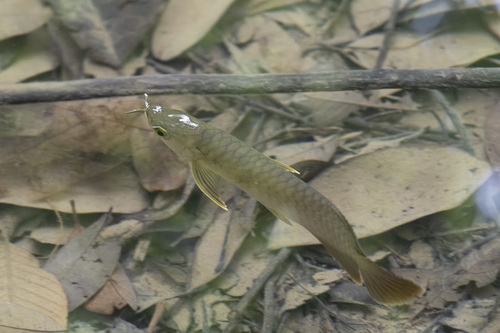
The Asian arowana comprises several phenotypic varieties of freshwater fish distributed geographically across Southeast Asia. While most consider the different varieties to belong to a single species, work by Pouyaud et al. (2003) differentiates these varieties into multiple species. They have several other common names, including Asian bonytongue, dragonfish, and a number of names specific to the different color varieties.
🛡️ Conservation Status
endangered
en
📌 Evolution and taxonomy
Like all members of the Osteoglossidae, Asian arowanas are highly adapted to fresh water and are incapable of surviving in the ocean. Therefore, their spread throughout the islands of Southeast Asia suggests they diverged from other osteoglossids before the continental breakup of Pangaea was complete. Genetic studies have confirmed this hypothesis, showing the ancestor of the Asian arowanas diverged from the ancestor of the Australian arowanas, S. jardinii and S. leichardti, about 140 million years ago, during the Early Cretaceous period. This divergence took place in the eastern margin of Gondwanaland, with the ancestors of Asian arowanas carried on the Indian subcontinent or smaller landmasses into Asia. The morphological similarity of all Scleropages species shows little evolutionary change has taken place recently for these ancient fish.
The first description of this species was published in 1840 by German naturalists Salomon Müller and Hermann Schlegel, under the name Osteoglossum formosum, although later this species was placed in Scleropages with the name S. formosus.
]]
]]
Several distinct, naturally occurring colour varieties are recognised as haplotypes, each found in a specific geographic region. They include:
* The green is the most common variety, found in Indonesia (Kalimantan and Sumatra), Vietnam, Myanmar, Thailand, Cambodia, and Malaysia.
* The silver Asian (not to be confused with the silver arowana, Osteoglossum bicirrhosum) is considered part of the green variety by some. It has two subvarieties, the "grey tail silver" or "Pinoh arowana", and the "yellow tail silver", each found in a different part of the island of Borneo.
* The red-tailed golden is found in northern Sumatra, Indonesia.
* The gold crossback, blue Malayan, or Bukit Merah blue is native to the state of Pahang and the Bukit Merah area in Perak, Peninsular Malaysia.
* The red, super red, blood red, or chili red is known only from the upper part of the Kapuas River and nearby lakes in western Indonesian part of Borneo.
In 2003, a study proposed splitting S. formosus into four separate species. This classification was based on both morphometrics and a phylogenetic analysis using the cytochrome b gene, and includes these species:
* Scleropages formosus was redescribed to include the strain known as the green arowana. The gold crossback, which was not part of the study, was included in this species by default, though it was suspected to be closely related to S. aureus.
* Scleropages macrocephalus described the silver Asian arowana.
* Scleropages aureus described the red-tailed golden arowana.
* Scleropages legendrei described the super red arowana.
The majority of researchers dispute this reclassification, arguing that the published data was insufficient to justify recognizing more than one Southeast Asian species of Scleropages, and that divergent haplotypes used to distinguish the color strains into isolated species were found within a single color strain, contradicting the findings. They are considered monotypic, consisting of closely related haplotypes.
📌 Biology
=== Reproduction ===
Unlike most fish, the Asian arowana reaches sexual maturity relatively late, after 3–4 yr. The females produce few eggs, 30–100, which are quite large. After the eggs are fertilized, the Asian arowana exhibits great parental care with paternal mouthbrooding. Both the fertilized eggs and larvae are brooded within the male's mouth.
📌 Behavior
They spend the day in the protection of Pandanus roots or other structures, and feed at night.
It is normally seen alone or in small groups.
📌 Relationship with humans
===Cultural beliefs===
Asian arowanas are considered to be symbols of good luck and prosperity, especially by those from Continental Asian cultures. This reputation derives from the species' resemblance to the Chinese dragon, considered an auspicious symbol in Chinese mythology. The large metallic scales and double barbels are features shared by the Chinese dragon, and the large pectoral fins are said to make the fish resemble "a dragon in full flight".
📌 Conservation
Asian arowanas are listed as endangered by the current IUCN Red List, with the most recent evaluation taking place in 2019. S. formosus is one of only eight fish species listed on Appendix I. A number of registered CITES breeders are in Asia, and the specimens they produce can be imported into several nations. Other nations restrict or prohibit possession of Asian arowanas; for example, the United States has listed this species under the Endangered Species Act, so it cannot be kept in that country without a permit.
Declining habitat is a major threat. For example, Asian arowanas are now uncommon in the Malay Peninsula, where they were once widely distributed, due to environmental destruction. Certain color varieties are more endangered than others, since the red and gold varieties are both less common, and in higher demand in the aquarium trade. The first of these farms was in Indonesia.
According to author Emily Voigt, the arowana has been cause for kidnappings, canings and even murder.
📌 Care in captivity
Because they can grow up to long, Asian arowanas require large aquaria. They are territorial and may be kept with other Scleropages only in a very large aquarium, provided all fish are of similar size. Like other arowanas, they need a tight-fitting cover to prevent escape. Some captive arowanas are fed Koi fry in an attempt to increase the vibrancy of their natural coloration.
There are over 150 CITES-registered Asian arowana farms in Singapore, Malaysia, Indonesia and other Southeast Asia countries, producing Asian arowana for commercial purposes. But the actual number of Asian arowana farms in the world could be much higher than that, and probably over 350, of which most may not be registered in CITES yet. The total annual revenue of the Asian arowana sector was estimated at over US$200 million globally.
Possession of Scleropages formosus by private citizens is prohibited in Florida and New Mexico.