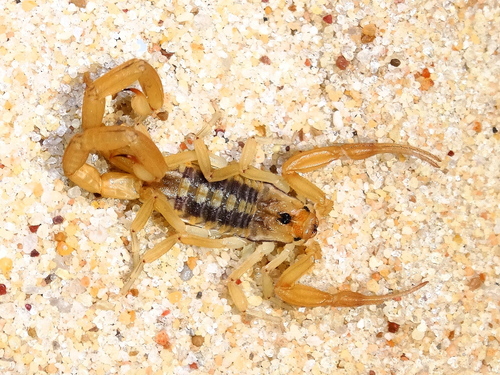
The Arizona bark scorpion is a small light brown scorpion common to the Sonoran Desert in the southwestern United States and northwestern Mexico. An adult male can reach 8 centimetres (3.1 in) of body length, while a female is slightly smaller, with a maximum length of 7 centimetres (2.8 in).
📌 Predators
Arizona bark scorpions are eaten by a wide variety of animals such as pallid bats, birds (especially owls), reptiles (including snakes), other vertebrates (including peccaries and rodents), spiders, and other scorpions. Development, pesticides and the collecting of scorpions for research or the pet trade also reduces the bark scorpion population.
The painful and potentially deadly venom of Arizona bark scorpions has little effect on grasshopper mice. Scientists have found the scorpion toxin acts as an analgesic rather than a pain stimulant in grasshopper mice.
📌 Life cycle
Arizona bark scorpions have a gestation period of several months, are born live, and are gently guided onto their mother's back. The female usually gives birth to anywhere from 25 to 35 young. These remain with their mother until their first molt, which can be up to three weeks after birth. Arizona bark scorpions have a life expectancy of about six years.
Arizona bark scorpions, like most other scorpions, are incredibly resilient. During American nuclear tests scorpions (along with cockroaches and lizards) were found near ground zero with no recorded adverse effects.
📌 Venom
The Arizona bark scorpion is the most venomous scorpion in the United States, and its venom can cause severe pain (coupled with numbness, tingling, and vomiting) in adult humans, typically lasting between 24 and 72 hours.
📌 Antivenom
An antivenom was developed for this species at Arizona State University by Dr. Herbert L. Stahnke, and produced in quantities sufficient to treat individuals within the state of Arizona. This antivenom was not FDA approved, but use within the state of Arizona was allowable and very successful in shortening the duration of symptoms and hospitalization. Production of this antivenom ceased by 2000 and the product was unavailable by 2004. A Mexican-produced antivenom, Anascorp [Antivenin Centruroides (scorpion) F(ab′)2, Laboratorios Silanes, Instituto Bioclon SA de CV], received FDA approval on August 3, 2011, and is now in use.
📌 First aid
Basic first aid measures can be used to help mediate Arizona bark scorpion stings:
* Clean sting site with soap and water
* Apply a cool compress (cool cloth)
* Take acetaminophen (paracetamol) or ibuprofen for local pain and swelling
Arizona poison control centers suggest immediate medical attention if severe symptoms occur, particularly in young children.
📌 UV lighting
]]
Arizona bark scorpions, like most other scorpions, will fluoresce when exposed to a blacklight. This is particularly useful in scorpion detection, since Arizona bark scorpions are active during the night, and can be easily spotted using this method. Typical UV LED flashlights enable the detection of Arizona bark scorpions at a distance of approximately six feet. Newly molted Arizona bark scorpions will not fluoresce under ultraviolet light for a few days after molting.
📌 Control and prevention
Arizona bark scorpions are tan or light beige tone in color and very small, making them difficult to detect especially on natural terrain (rocky land, multiple vegetation and soil textured land). They often look for places to hide, and they will not seek out humans unless provoked or defending young. Several methods of control have historically been used to control Arizona bark scorpions, such as physical barriers (scorpions are unable to climb smooth surfaces), pesticides, glue boards, and removing any scorpion congregation areas in the vicinity of the building.