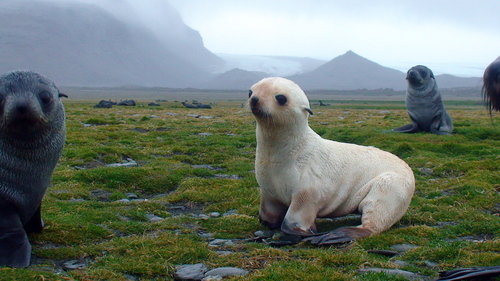
The Antarctic fur seal is one of eight seals in the genus Arctocephalus, and one of nine fur seals in the subfamily Arctocephalinae. Despite what its name suggests, the Antarctic fur seal is mostly distributed in Subantarctic islands and its scientific name is thought to have come from the German vessel SMS Gazelle, which was the first to collect specimens of this species from the Kerguelen Islands.
🛡️ Conservation Status
endangered
en
📌 Taxonomy
The Antarctic fur seal is a member of the genus Arctocephalus. Recently, a proposal was made to reassign this species to the resurrected genus Arctophoca.
Antarctic fur seals may be confused with southern otariids that share their range, like Subantarctic (A. tropicalis), New Zealand (A. forsteri), and South American fur seals (A. australis), and the Juan Fernandez fur seal (A. phillippii), as well as the South American (Otaria flavescens) and New Zealand sea lions (Phocarctos hookeri).
Genetic studies on population structure suggest that there are two genetically distinct regions: a western region including the islands of the Scotia Arc, Bouvet Island, and Marion Islands, and an eastern region, including Kerguelen and Macquarie Islands. Seals from the Crozet Islands and Heard Island are mixtures from both regions.
📌 Distribution
Antarctic fur seals are believed to be the most abundant species of fur seal. The largest congregation occurs on the island of South Georgia in the southern Atlantic Ocean, which holds approximately 95% of the global population. The current best estimate of the South Georgia population is between 4.5 and 6.2 million animals. Bouvet Island has the second largest population with 46,834 animals. However, there are regional differences in population trends: some colonies are increasing in size (e.g. Kerguelen Islands, McDonald Islands), some are stable (e.g. Macquarie Island, Heard Islands), and some are showing a decrease (e.g. Bouvet Island). During winter, Antarctic fur seals range widely from the Antarctic continent to the Falkland Islands, and southern Argentina reaching as far as the Mar del Plata and Gough Island.
📌 Behaviour
]]
Antarctic fur seals are one of the better-studied Southern Ocean predators. However, the vast majority of information has been collected during summer breeding months. The breeding system of the Antarctic fur seal is polygynous, and dominant breeding males mate with as many as 20 females during a successful season. Males establish breeding grounds in October to early November. Females generally reach the colonies in December and give birth to a single pup several days later. Gestation lasts from 8 to 9 months and a high breeding synchrony has been observed across the species' range, concentrating 90% of pup births in a 10-day window. Pups are weaned at about four months old. Juveniles may then spend several years at sea before returning to begin their breeding cycles.
The ecology of Antarctic fur seals during the non-breeding winter is poorly understood. Adult and subadult males may form groups while moulting along the Antarctic Peninsula in late summer and early autumn. Adult females are gregarious but relatively asocial other than the strong bond they establish with their pups, although there are occasional aggressive encounters with nearby females or other pups and brief interactions with adult males to mate. These seals appear to be solitary when foraging and migrating. Seasonal differences in diet have been recorded across colonies, seasons and years. Female Antarctic fur seals can undertake wide-ranging foraging migrations during winter.
📌 Population status
s at Salisbury Plain, South Georgia]]
South Georgia islands, which hold approximately 95% of the global population,
In April 2026, IUCN moved the Antarctic fur seal from Least Concern to Endangered on the IUCN Red list, alongside emperor penguin, as its population has decreased by more than 50% from an estimated 2,187,000 mature seals in 1999 to 944,000 in 2025. The ongoing decline is due to climate change, as rising ocean temperatures and shrinking sea-ice are pushing krill to greater ocean depths in search of colder water, reducing the availability of food for seals.
📌 Threats
Historically the species were decimated by the sealing industry for its fur and its population was driven close to extinction by the 19th century. Since sealing operations ceased in the early 20th century, the species has recovered at different rates across its former geographic range. A 1997 study at South Georgia indicated that several thousand Antarctic fur seals were entangled in man-made debris such as discarded fishing line, nets, packing bands and anything that can form a collar. Consequently, CCAMLR campaigned for compliance with MARPOL provisions relating to waste disposal at sea, and for cutting of any material jettisoned which could form collars to entangle seals. Subsequent monitoring of entangled fur seals confirmed that entanglement is still a persistent problem, but it has halved in recent years. Trawling activities developing around Macquarie Island may affect the prey base of the primarily fish-eating Antarctic fur seals that breed on those islands. Recent work indicates that there is significant overlap between foraging areas and fisheries activities, suggesting a potential for competition for prey resources may exist.
Leopard seals have been noted to take as many as a third of the Antarctic Fur Seal pups born at sites in the South Shetland Islands. Levels of predation may be high enough to cause a population decline at these sites.
As well as the effects of hunting and fishing, the numbers of humans visiting the Antarctic and sub-Antarctic each year for tourism and scientific expeditions have risen. This increase in visits has led to greater interaction between the local fauna and humans. With this greater interaction comes the risk of affecting the territoriality of seals especially during the mating season. This can also increase the possibility of 'exotic' injuries to humans. In 2015 a man was rescued from a South Georgia Island by British Forces after receiving a serious bite from a fur seal. Due to the remote location of where these injuries occur, this can lead to complications in getting people to a physician with the relevant experience in treating exotic animal bites. This issue is compounded by the complexity of fur seal behavior and how serious a bite can be and the risk of transfer of diseases.
The implication for Antarctic Fur Seals but this species is considered to be one of several pinnipeds at high risk of future disease outbreaks because of their tendency to congregate in large dense aggregations and the effect of environmental changes associated with global warming on the spread of diseases.
Finally, the 19th century population bottleneck led to reduced genetic diversity, leaving it again more vulnerable to disease and stresses of climate change. In particular, the Antarctic fur seal's primary prey base, krill, could be reduced as a result of ocean acidification, or the distribution could be altered by climate change.
📌 Conservation status
The conservation status of this species was classified as Least Concern until 2026, when the IUCN reclassified its status as Endangered. The animal is also listed in Appendix 2 of CITES.