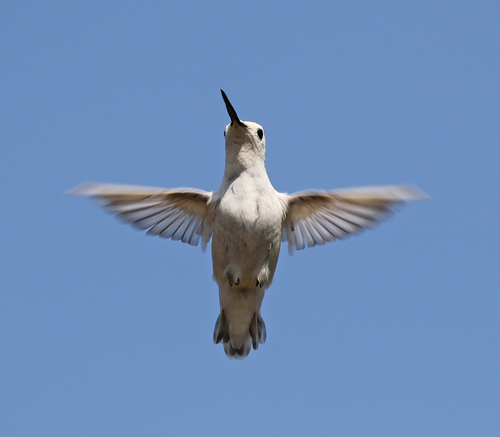
Anna's hummingbird is a North American species of hummingbird named after Anna Masséna, Duchess of Rivoli.
📌 Taxonomy
Anna's hummingbird was formally described and illustrated in 1829 by the French naturalist René Lesson in his Histoire naturelle des Oiseaux-Mouches from a specimen that had been collected in California. Lesson placed it in the genus Ornismya and coined the binomial name Ornismya anna. Anna's hummingbird is now placed in the genus Calypte that was introduced in 1856 by the English ornithologist John Gould. Gould did not explain the derivation of the genus name but it is probably from the Ancient Greek kaluptrē meaning "woman's veil" or "head-dress" (from kaluptō meaning "to cover"). The specific epithet anna was chosen to honour Anne d'Essling who married the ornithologist François Victor Massena, 3rd Duke of Rivoli. The species is monotypic: no subspecies are recognised.
📌 Population statistics
According to a 2021 estimate, there are 8 million Anna's hummingbirds in the western United States and Canada, with the population increasing since 1970. As of 2021, the International Union for Conservation of Nature Red List of Threatened Species lists Anna's hummingbird among species of least concern.
📌 Distribution and habitat
Anna's hummingbird is found along the western coast of North America, from southern Canada to northern Baja California, and inland to southern and central Arizona, extreme southern Nevada and southeastern Utah, and western Texas. They tend to be permanent residents within their range. However, birds have been spotted far outside their range in such places as southern Alaska, Idaho, Saskatchewan, New York, Florida, Louisiana, and Newfoundland.
In response to rising temperatures at low elevations during climate change in the 21st century, Anna's hummingbirds have expanded their range into the cooler summer environments of higher-altitude (up to ) mountainous terrains of California, such as the Sierra Nevada.
📌 Northern range expansion
Anna's hummingbirds have the northernmost year-round range of any hummingbird. Birds have been recorded in Alaska as early as 1971, and resident in the Pacific Northwest since the 1960s, particularly increasing as a resident population during the early 21st century.
While their range was originally limited to the chaparral of California and Baja California, it expanded northward to Oregon, Washington, and British Columbia, and east to Arizona in the 1960s and 70s. This rapid expansion is attributed to the widespread planting of non-native species, such as eucalyptus, as well as the use of urban bird feeders, in combination with the species' natural tendency for extensive postbreeding dispersal.
In the Pacific Northwest, the fastest growing populations occur in regions with breeding-season cold temperatures similar to those of its native range. Although quantitative data are absent, it is likely that a sizable percentage of Anna's hummingbirds in the Pacific Northwest still do migrate south for winter, as of 2017.
torpor during winter; , near Vancouver, British Columbia. The bird remained in torpor with an unchanged position for more than 12 hours.]]
📌 Torpor
Anna's hummingbirds with inadequate stores of body fat or insufficient plumage are able to survive periods of subfreezing weather by lowering their metabolic rate and entering a state of torpor.
When studied in colder temperatures at mountainous elevations, Anna's hummingbirds used torpor more frequently and for longer periods than at lower elevations.
📌 Behavior
===Foraging===
]]
This species consumes tree sap, nectar from flowers, insects, and sugar-water mixes from feeders. Anna's hummingbirds capture flying insects or eat insects trapped in spider webs, sometimes even the spiders themselves.
📌 Pollination
While collecting nectar, Anna's hummingbird assists in plant pollination.
Anna's hummingbirds can shake their bodies 55 times per second to shed rain while in flight, or in dry weather, to remove pollen or dirt from feathers. Each twist lasts four-hundredths of a second and applies 34 times the force of gravity on the bird's head.
📌 Locomotion
During hovering flight, Anna's hummingbirds maintain high wingbeat frequencies accomplished by their large pectoral muscles via recruitment of motor units. The pectoral muscles that power hummingbird flight are composed exclusively of fast glycolytic fibers that respond rapidly and are fatigue-resistant.
📌 Song and courtship
Unlike most northern temperate hummingbirds, the male Anna's hummingbird sings during courtship. The song is thin and squeaky, interspersed with buzzes and chirps, and is drawn to over 10 seconds in duration. During the breeding season, males can be observed performing an aerial display dive over their territories. When a female flies onto a male's territory, the male rises up about before diving over the female. As the male approaches the bottom of the dive, it reaches an average speed of , which is 385 body lengths per second. At the bottom of the dive, the male travels , and produces an audible sound produced by the tail feathers, described by some as an "explosive squeak".
📌 Breeding
Open-wooded or shrubby areas and mountain meadows along the Pacific coast from British Columbia to Arizona make up C. anna's breeding habitat. The female raises the young without the assistance of the male. The female bird builds a nest in a shrub or tree, in vines, or attached to wires or other artificial substrates. The round, diameter nest is constructed of plant fibers, downy feathers and animal hair; the exterior is camouflaged with chips of lichen, plant debris, and occasionally urban detritus such as paint chips and cigarette paper.
📌 Hybridization
Anna's hummingbirds may hybridize with other species, especially the congeneric Costa's hummingbird.
The specimens were the hybrid offspring of an Anna's hummingbird and an Allen's hummingbird. A single bird collected in Santa Barbara, California, was described and named Trochilus violajugulum (Jeffries, 1888), or violet-throated hummingbird. It was later determined to be a hybrid between an Anna's hummingbird and a black-chinned hummingbird.
📌 Urbanization
In the 2017 Vancouver Official City Bird Election, Anna's hummingbird was named the official bird of the city of Vancouver, British Columbia.
Anna's hummingbirds are non-migrating residents of Seattle where they live year-round through winter, enduring extended periods of subfreezing temperatures, snow, and high winds.