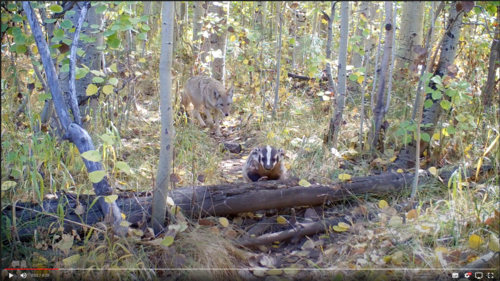
The American badger is a North American badger similar in appearance to the European badger, although not closely related. It is found in the western, central, and northeastern United States, northern Mexico, and south-central Canada to certain areas of southwestern British Columbia.
📌 Taxonomy
The American badger is a member of the Mustelidae, a diverse family of carnivorous mammals that also includes weasels, otters, ferrets, and the wolverine. The American badger belongs to the Taxidiinae, one of four subfamilies of mustelid badgers – the other three being the Melinae (four species in two genera, including the European badger), the Helictidinae (five species of ferret-badgers) and the Mellivorinae (the honey badger); the so-called stink badgers are mephitids. The American badger's closest relative is the prehistoric Chamitataxus. Among extant mustelids, the American badger is sister to all other species; its lineage is thought to have split off from the rest of the Mustelidae about 18 million years (Ma) ago, following the split of mustelids from procyonids about 29 Ma ago.
The recognized subspecies include:
{| class="wikitable "
|-
! Image !! Subspecies !! Distribution
|-
||| T. t. taxus (the nominate subspecies) ||central Canada and the central U.S.
|-
||| T. t. jacksoni || southern Great Lakes region, including southern Ontario
|-
||| T. t. jeffersoni ||Alberta and the northwestern U.S.
|-
||| T. t. berlandieri ||southwestern U.S. and northern Mexico.
|-
|}
The ranges of the subspecies overlap considerably, with intermediate forms occurring in the areas of overlap.
In Mexico, this animal is sometimes called tlalcoyote. The Spanish word for badger is tejón, but in Mexico this word is also used to describe the coati. This can lead to confusion, as both coatis and badgers are found in Mexico.
📌 Behavior
American badgers are generally nocturnal; however, in remote areas with no human encroachment they are routinely observed foraging during the day. Seasonally, a badger observed during daylight hours in the spring months of late March to early May often represents a female foraging during daylight and spending nights with her young. Badgers do not hibernate but may become less active in winter. A badger may spend much of the winter in cycles of torpor that last around 29 hours. They do emerge from their burrows when the temperature is above freezing.
📌 Life cycle
Badgers are normally solitary animals but are thought to expand their territories in the breeding season to seek out mates. Mating occurs in late summer and early fall, with some males breeding with more than one female. American badgers experience delayed implantation, with pregnancies suspended until December or as late as February. Young are born from late March to early April Juvenile dispersal movements are erratic. a captive example lived at least 15 years and five months.
📌 Plant communities
American badgers are most commonly found in treeless areas, including tallgrass and shortgrass prairies, grass-dominated meadows and fields within forested habitats, and shrub-steppe communities. In the Southwest, plant indicators of the Sonoran and Transition life zones (relatively low, dry elevations) commonly associated with American badgers include creosotebush
(Larrea tridentata), junipers (Juniperus spp.), gambel oak (Quercus gambelii), willows (Salix spp.), cottonwoods (Populus spp.), ponderosa pine (Pinus ponderosa), grasses, and sagebrushes (Artemisia spp.). In Kansas, they are common in tallgrass prairie dominated by big bluestem (Andropogon gerardi), little bluestem (Schizachyrium scoparium), and Indian grass (Sorghastrum nutans). In Montana in 1990, badgers were present in Glacier National Park in fescue (Festuca spp.) grasslands. In Manitoba, they occur in grassland extensions within aspen (Populus spp.) parklands.
📌 Cover requirements
American badgers require cover for sleep, concealment, protection from weather, and natal denning. They typically enlarge foraged out gopher or other prey holes, or other animal burrows. Their dens range from about 4 feet to 10 feet in depth and 4 feet to 6 feet in width. A female American Badger may create 2 to 4 burrows in proximity with a connecting tunnel for concealment and safety for her young. Displaced soil from digging out the burrow characteristically appears in front of the burrow entrance, and a view from a distance reveals a mound-like roof of the burrow, with the living and concealment space created underneath the raised-roof appearing mound.
During summer and autumn, badgers range more frequently, with mating season generally in November, and burrowing patterns reflect 1 to 3 burrows may be dug from foraged out prey holes in a day, used for a day to a week, and then abandoned, with possible returns later, and other small wildlife utilizing abandoned burrows in the interim. Where prey is particularly plentiful, they will reuse dens, especially in the fall, sometimes for a few days at a time. In winter, a single den may be used for most of the season. Natal dens are dug by the female and are used for extended periods, but litters may be moved, probably to allow the mother to forage in new areas close to the nursery. Natal dens are usually larger and more complex than diurnal dens.
📌 Predation
While the American badger is an aggressive animal with few natural enemies, it is still vulnerable to other species in its habitat. Predation on juvenile specimens by golden eagles (Aquila chrysaetos), coyotes (Canis latrans) has been reported. Bears (Ursus spp.) and gray wolves (Canis lupus) occasionally kill adult American badgers, while cougars (Puma concolor), according to a 2019 study, apparently are the main predators of adults, hunting them much more frequently than the other carnivorans, with a documented case where the badger is one of the main prey of a radio-collared cougar.
American badgers are trapped by humans for their pelts. Their fur is used for shaving and painting brushes.
📌 Conservation status
In May 2000, the Canadian Species at Risk Act listed each of the subspecies Taxidea taxus jacksoni and T. t. jeffersonii as an endangered species in Canada. The nominate subspecies was additionally deemed to be of "Special Concern" in November 2012. The subspecies T. t. jeffersonii, which resides in British Columbia, was subsequently divided into two populations, a western one in the Okanagan Valley-Cariboo region and an eastern one in East Kootenay, with each receiving an endangered listing. The Canadian population of T. t. jacksoni is isolated from other badgers in a small area of southwestern Ontario near the border with the United States south of the Niagara Peninsula, although a population may also exist in the northwest of the province.
The California Department of Fish and Game designated the American badger as a California species of special concern.