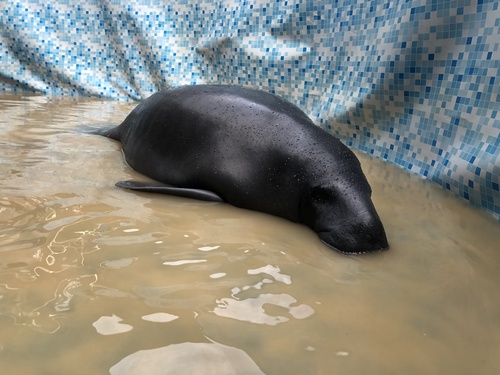
The Amazonian manatee, commonly referred to as cowfish in Brazil, is a species of manatee that lives in the Amazon Basin in Brazil, Peru, Colombia and Ecuador. It has thin, wrinkled brownish or gray colored skin, with fine hairs scattered over its body and a white chest patch. It is the smallest of the three extant species of manatee.
🛡️ Conservation Status
vulnerable
vu
📌 Taxonomy
The specific name, inunguis is Latin for "nailless". The genus name Trichechus, comes from Latin meaning "hair", referencing the whiskers around the manatee's mouth.
📌 Physical characteristics
The Amazonian manatee is the smallest member of the manatee family and can be distinguished by its smoother rubbery skin and lack of vestigial nails on its flippers.
Amazonian manatees are large, cylindrically shaped mammals, with forelimbs modified into flippers, no free hind-limbs, and the rear of the body in the form of a flat, rounded, horizontal paddle. The flexible flippers are used for aiding motion over the bottom, scratching, touching, and even embracing other manatees, and moving food into and cleaning the mouth.
The Amazonian manatee lacks nails on its flippers, setting it apart from other manatees.
📌 Behavior and biology
The Amazonian manatee is the only sirenian that lives exclusively in freshwater habitat. The species relies on changes in the peripheral circulation for its primary mechanism for thermoregulation by using sphincters to deflect blood flow from areas of the body in close contact with water. They also rely on subcutaneous fat to reduce heat loss.
Manatees have nostrils, not blowholes like cetaceans, which close when underwater to keep water out and open when above water to breathe. Although manatees can remain under water for extended periods, surfacing for air about every five minutes is common. The longest documented submergence of an Amazonian manatee in captivity is 14 minutes. Only its nostrils protrude from the surface of the water while it searches river and lake bottoms for vegetation.
📌 Reproduction and lifecycle
The Amazonian manatee is a seasonal breeder with a gestational period of 12–14 months and a prolonged calving period. Most births take place between December and July, with about 63% between February and May, during a time of rising river levels in their native region. After the calf is born, it will begin to eat while staying with its mother for 12 – 18 months.
Wild individuals have a lifespan of about 30 years.
📌 Population and distribution
As of 1977 the population count of the Amazonian manatee was estimated to be around 10,000.
Amazonian manatees occur through most of the Amazon River drainage, from the headwaters, in Colombia, Ecuador and Peru to the mouth of the Amazon (close to the Marajó Island) in Brazil over an estimated seven million square kilometers.
The Amazonian manatee is completely aquatic and never leaves the water. They are mainly solitary but sometimes they will gather in small groups consisting of up to eight individuals. They engage in long seasonal movements, moving from flooded areas during the wet season to deep water-bodies during the dry season
Natural predators include jaguars, sharks, and crocodiles.
📌 Illegal hunting
The main threat to the Amazonian manatee is illegal hunting. They are hunted for subsistent and local use, not commercially. The hunting has led to the large decline in the population and low population numbers. Between 1935 and 1954, over 140,000 manatees are estimated to have been killed. Despite the laws in place against hunting, hunting continues to occur even in protected areas. Traditional harpoons are the most common weapon used against the manatees, but in Ecuador they are also known to be caught in Arapaima fish traps.
They are mainly hunted for their high value meat but the fat and skin are also used for cooking and in medicines. The meat is sold locally to neighbors or at produce markets. It can be illegally sold as sausage or mixira in public markets in Brazil and Ecuador. Mixira is a meat preserved in its own fat and is expensive which drives the hunters.
Between 2011 and 2015, 195 manatees were killed for meat in a single region of Brazil. In another region, 460 were killed in a protected area between 2004 and 2014.
📌 Conservation
on Marajó]]
The IUCN red list ranks the Amazonian manatee as vulnerable. Population declines are primarily a result of hunting, as well as calf mortality, climate change, and habitat loss. However, due to their murky water habitat it is difficult to gain accurate population estimates.
There are no national management plans for the Amazonian Manatee, except in Colombia. As of 2008, the INPA takes care of 34 captive manatees and the CPPMA is caring for 31 manatees. The manatee has been protected by Peruvian law since 1973, via Supreme Decree 934-73-AG, prohibiting hunting and commercial use of the manatee.
Hunting remains the largest problem and continues in much of its range, even within reserves. In 1986, it was estimated that the hunting levels in Ecuador were unsustainable and it would be gone from this country within 10–15 years. While hunting still occurs, an increasing risk to its continued survival in Ecuador is now believed to be the risk of oil spills. The oil exploration also means an increase in boat traffic on the rivers.
The Amazonian manatees of Peru have experienced much of their decline due to hunting by human populations for meat, blubber, skin and other materials that can be collected from the manatee. Such hunting is carried out with harpoons, gillnets, and set traps. Much of this hunting occurs in the lakes and streams near the Pacaya-Samiria National Reserve in northeastern Peru. The species is slow-moving, docile, and is often found feeding at the surface of the lakes and rivers it inhabits. Manatees are also at risk from pollution, accidental drowning in commercial fishing nets, and the degradation of vegetation by soil erosion resulting from deforestation. Additionally, the indiscriminate release of mercury in mining activities threatens the entire aquatic ecosystem of the Amazon Basin.