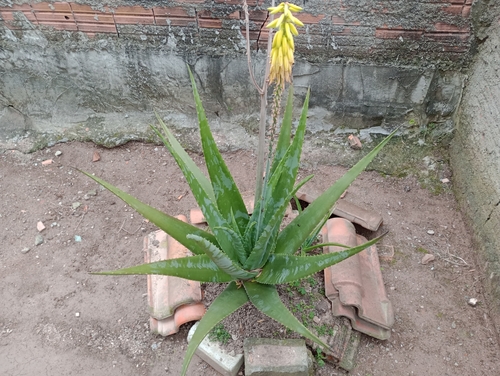
Aloe vera is a succulent plant species of the genus Aloe. It is widely distributed and is considered an invasive species in many regions of the world.
📌 Etymology
The genus name Aloe is derived from the Arabic word alloeh, meaning "bitter and shiny substance", or from Hebrew ahalim, plural of ahal. The specific epithet vera comes from verus meaning "true" in Latin.
📌 Common names
Common names use aloe with a region of its distribution, such as Chinese aloe, Cape aloe, or Barbados aloe.
📌 Taxonomy
The species has several synonyms: Aloe barbadensis Mill., Aloe indica Royle, Aloe perfoliata L. var. vera, and Aloe vulgaris Lam. Some literature identifies the white-spotted form of Aloe vera as Aloe vera var. chinensis, and the spotted form of Aloe vera may be conspecific with A. massawana. The species was first described by Carl Linnaeus in 1753 as Aloe perfoliata var. vera. It was described again in 1768 by Nicolaas Laurens Burman as Aloe vera in Flora Indica on 6 April and by Philip Miller as Aloe barbadensis some ten days after Burman in the Gardener's Dictionary.
Techniques based on DNA comparison suggest Aloe vera is closely related to Aloe perryi, a species endemic to Yemen. Similar techniques using chloroplast DNA sequence comparison and inter simple sequence repeat profiling have also suggested it is closely related to Aloe forbesii, Aloe inermis, Aloe scobinifolia, Aloe sinkatana, and Aloe striata. With the exception of the South African species A. striata, these Aloe species are native to Socotra (Yemen), Somalia, and Sudan.
📌 Leaves
The leaves are thick and fleshy, green to grey-green, with some varieties showing white flecks on their upper and lower stem surfaces. The margin of the leaf is serrated with small white teeth.
Aloe vera leaves contain phytochemicals, which are often studied for possible bioactivity. Some examples of phytochemicals include lignans, phytosterols, polyphenols, acetylated mannans, polymannans, anthraquinones C-glycosides, anthrones, and other anthraquinones such as emodin and various lectins.
📌 Flowers
The aloe's flowers are produced in summer on a spike that grows up to tall. Each flower is pendulous with a yellow tubular corolla long.
📌 Roots
Like other Aloe species, Aloe vera forms arbuscular mycorrhiza, a root symbiosis that allows the plant better access to mineral nutrients in the soil.
📌 Distribution
Aloe vera is considered to be native to the southeastern region of the Arabian Peninsula in the Hajar Mountains in northeastern Oman and eastern U.A.E. However, since being widely cultivated around the world, the plant has become naturalized in North Africa as well as in Sudan and its neighboring countries, in the Canary Islands, Cape Verde, and the Madeira Islands. and in wild areas across Spain, especially in the region of Murcia.
The species was introduced to China and parts of southern Europe in the 17th century. The current distribution, including in arid, temperate, and tropical regions of temperate continents , may be the result of cultivation.
📌 Cultivation
]]
Aloe vera has been widely grown as an ornamental plant, popular with modern gardeners as a topical medicinal plant The species is relatively resistant to most insect pests, though spider mites, mealy bugs, scale insects, and aphid species may cause a decline in plant health. This plant has earned the Royal Horticultural Society's Award of Garden Merit.
In pots the species requires well drained, sandy potting soil and bright, sunny conditions. Aloe plants can turn red from sunburn under too much direct sun, though gradual acclimation may help. The use of a good-quality commercial propagation aoil mix or packaged "cacti and succulent mix" is recommended, as they allow for good drainage. Terra cotta pots are preferable for being porous. Cuba, the Dominican Republic, China, Mexico, India, Jamaica, Kenya, Tanzania, South Africa, Spain, and the United States, with much of the output going toward the cosmetics industry.
📌 Uses
Two substances from Aloe vera – a clear gel and its yellow latex – are used to manufacture commercial products.
There is conflicting evidence over whether Aloe vera is effective in treating wounds or burns. Topical use of aloe products may relieve symptoms of certain skin disorders like psoriasis, acne, or rashes, but it may also cause an allergic reaction in some people.
Aloe vera gel is used commercially as an ingredient in yogurts, beverages, and some desserts, but ingesting aloe latex or whole leaf extract at high or prolonged doses can be toxic. Use of topical aloe vera in small amounts is likely to be safe.
📌 Topical medication and potential side effects
Aloe vera may be prepared as a lotion, gel, soap, or cosmetics product for use on skin as a topical medication. The gel has an acid pH of 4.4 to 4.7, possibly causing a burning sensation or rash when applied to skin.
For people with allergies to Aloe vera, skin reactions may include contact dermatitis with mild redness and itching, difficulty with breathing, or swelling of the face, lips, tongue, or throat.
📌 Dietary supplement
Aloin, a bitter-tasting compound found in the semi-liquid latex of some Aloe species, was a common ingredient in over-the-counter (OTC) laxative products in the United States until 2002. The Food and Drug Administration banned it when manufacturers failed to provide the necessary safety data.
Aloe vera and its (alcohol) extracts have potential toxicity, with side effects occurring at certain dose levels when ingested or applied topically. Chronic ingestion of aloe (at a rate of 1 gram per day) causes adverse effects including hematuria, weight loss, and cardiac or kidney disorders. The extracts and quantities typically used for such purposes are associated with toxicity in a dose-dependent way.
📌 Traditional medicine
Aloe vera is used in traditional medicine as a skin treatment. Early records of its use appear from the fourth millennium BCE. A beverage or ointment using aloe flesh may have been used for various illnesses in Caribbean regions during the 20th century.
📌 Commodities
Aloe vera is used on facial tissues where it is promoted as a moisturizer and anti-irritant to reduce chafing of the nose. Cosmetic companies commonly add sap or other derivatives from Aloe vera to products such as makeup, tissues, moisturizers, soaps, sunscreens, incense, shaving cream, or shampoos. A review of academic literature notes that its inclusion in many hygiene products is due to its "moisturizing emollient effect". The cosmetic industry limits the anthraquinone content of aloe extracts to 50 ppm.
📌 Toxicity
Orally ingested non-decolorized aloe vera leaf extract was listed by the California Office of Environmental Health Hazard Assessment among "chemicals known to the state to cause cancer or reproductive toxicity", possibly resulting from the anthraquinones.
Use of aloe vera on the skin is generally not associated with significant side effects. Oral ingestion of aloe vera is potentially toxic, and may cause abdominal cramps and diarrhea, which in turn can decrease the absorption of drugs.
📌 Interactions with prescribed drugs
Ingested aloe products may have adverse interactions with prescription drugs, such as those used to treat blood clots, diabetes, heart disease and potassium-lowering agents (such as digoxin), and diuretics, among others.