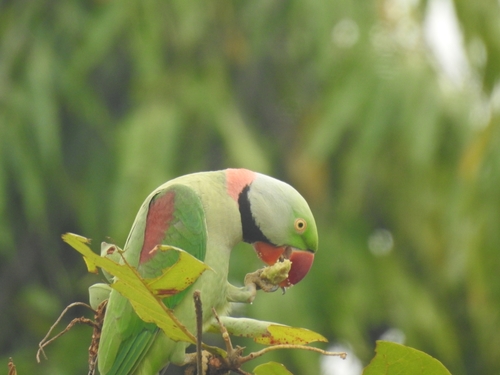
The Alexandrine parakeet, also known as the Alexandrine parrot, is a medium-sized parrot in the genus Psittacula of the family Psittaculidae, native to South Asia and Southeast Asia. It is named after Alexander the Great, who transported numerous birds from Punjab to various European and Mediterranean countries and regions, where they were prized by the royalty, nobility and warlords.
🛡️ Conservation Status
near threatened
nt
📌 Taxonomy and etymology
The Alexandrine parakeet was first described by French zoologist Mathurin Jacques Brisson as Psittaca Ginginiana or "La Perruche de Gingi" (The Gingi's Parakeet) in 1760; after the town of Gingee in southeastern India, which was a French outpost then. The birds may, however, merely have been held in captivity there. Carl Linnaeus redescribed the Alexandrine parakeet in 1766 as Psittacus eupatria.
The genus name Psittacula is a diminutive of the Latin word psittacus meaning "parrot", and the specific name eupatria () is derived from the ancient Greek eu- meaning "well" and patriá meaning "descent".
In 2019, a genetic study revived the genus Palaeornis, formerly viewed as a synonym of the current genus Psittacula. Some organisations – including the IUCN – have accepted the new taxonomy. If this were to be taken into account, this could mean that the Alexandrine parakeet is the only living member of the now-revived genus.
📌 Phylogeny
Genetic analysis of the mitochondrial cytochrome b sequences of Psittacula parakeets has shown that the Alexandrine parakeet diverged from the lineage that gave rise to the rose-ringed parakeet (Psittacula krameri) and the Mauritius parakeet (Psittacula eques) about 5 million years ago.
📌 Subspecies
Five subspecies of the Alexandrine parakeet are currently recognized
:{| class="wikitable"
|+
! Subspecies
! Distribution
! Notes
|-
| align="center" ; | Alexandrine parakeet
| Western India, South India and Sri Lanka.
| 'Nominate' subspecies: Main type-(sub)species for the whole group.
|-
| align="center" ; | Large Indian parakeet
| Eastern Afghanistan, Pakistan, North India, Central India, East India, Nepal, and Bhutan.
| It is larger than the nominate subspecies, and more greyish-green. The back of the head and cheeks are tinged blue. Adult males have a broader black stripe across the lower cheek.
|-
| align="center" ; | Large Burmese parakeet
| Northeast India, Bangladesh, and Myanmar.
| It has a smaller beak than the nominate subspecies. Males look like however the neck and underparts are more yellowish and there is a narrow blue stripe on the hindneck.
|-
| align="center" ; | Large Andaman parakeet
| Andaman Islands and Coco Islands.
| It is slightly larger than the nominate subspecies, and has a larger beak and brighter shoulder patch. Males have a narrow blue stripe above the nape band.
|-
| align="center" ; | Thai rose-ringed parakeet
| Vietnam, Cambodia, Laos, and Thailand.
| It is smaller than the nominate subspecies and has a paler shoulder patch. It also has a yellowish face and neck. Males look like however the back of the head and nape are tinged blue.
|}
📌 Ecology and behaviour
The Alexandrine parakeet lives in forests, woodlands, agricultural lands and mangrove forests at elevations of up to . It eats a variety of wild and cultivated seeds, buds, fruits and nuts. Flocks can cause extensive damage to ripening fruits and grain crops like maize and jowar. It usually lives in small flocks, but forms larger groups in areas where food is abundant or at communal roosts.
📌 Breeding
Alexandrine parakeets breed from November to April in their native range. They usually nest in tree hollows, but sometimes use tree holes excavated by themselves or cracks in buildings. Females lay 2 to 4 white, blunt oval-shaped eggs, measuring . The average incubation period is 24 days. The chicks fledge at about 7 weeks of age, and are dependent on their parents until 3 to 4 months of age.
📌 Aviculture
Alexandrine parakeets are relatively popular pet birds due to their long lifespan in captivity (up to 40 years),
Color variants including lutino, albino, and blue are well-established in captivity.
The World Parrot Trust recommends that captive Alexandrine parrots be kept in a metal or welded mesh enclosure of minimum length .
📌 Conservation
The Alexandrine parakeet is listed as near threatened by the International Union for Conservation of Nature (IUCN) because of its steep population decline in its native range due to habitat loss, persecution and excessive capture to cater to the demands of the illegal wildlife trade. It is sporadic in South India, uncommon in Bangladesh, and declining in North Bengal and certain parts of Sri Lanka. It has suffered the greatest population declines in the Sindh and Punjab provinces of Pakistan, Laos, northwestern and southwestern Cambodia, and Thailand.|thumb|288x288px]]The sale of Alexandrine parakeets is not banned in Pakistan, and they can be found being openly sold in the markets of Lahore and Rawalpindi. Their sale is banned in India, and yet they are sold in broad daylight in urban bird markets, suggesting that the Indian government is allocating insufficient resources for their protection.
📌 Culture
Sri Lanka, Vietnam, Thailand, Mongolia and Iran have issued postage stamps depicting the Alexandrine parakeet.