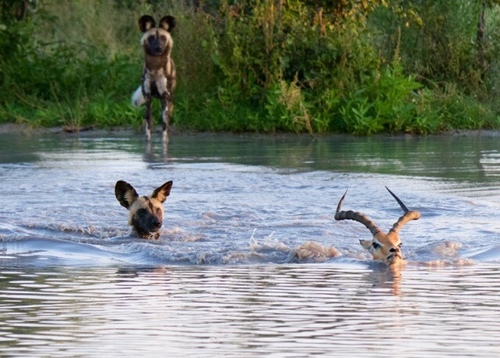
The African wild dog, also called painted dog and Cape hunting dog, is a wild canine native to sub-Saharan Africa. It is the largest wild canine in Africa, and the only extant member of the genus Lycaon, which is distinguished from Canis by dentition highly specialised for a hypercarnivorous diet and by a lack of dewclaws.
π‘οΈ Conservation Status
endangered
en
π Etymology and naming
The English language has several names for the African wild dog, including African hunting dog, Cape hunting dog, painted hunting dog, painted dog, painted wolf, and painted lycaon. "wild dog" is thought by conservation groups to have negative connotations that could be detrimental to its image; one organisation promotes the name "painted wolf",
whilst the name "painted dog" has been found to be the most likely to counteract negative perceptions.
π Taxonomic and evolutionary history
===Taxonomy===
|cladogram=">
|2=Wolf
}}
}}
|2=Coyote
}}
|2=African wolf
}}
|2=Golden jackal
}}
|2=Ethiopian wolf
}}
|2=Dhole
}}
|2=African wild dog
}}
|2=
|label1=2.6
}}
}}
}}
}}
The earliest written reference for the species appears to be from Oppian, who wrote of the thoa, a hybrid between the wolf and leopard, which resembles the former in shape and the latter in colour. Solinus's Collea rerum memorabilium from the third century AD describes a multicoloured, wolf-like animal with a mane native to Ethiopia.
The African wild dog was scientifically described in 1820 by Coenraad Jacob Temminck after examining a specimen from the coast of Mozambique, which he named Hyaena picta. It was later recognised as a canid by Joshua Brookes in 1827 and renamed Lycaon tricolor. The root word of Lycaon is the Greek Ξ»Ο
ΞΊΞ±Ξ―ΞΏΟ (lykaios), meaning wolf-like. The specific epithet pictus (Latin for painted), which derived from the original picta, was later returned to it, in conformity with the International Rules on Taxonomic Nomenclature.
Paleontologist George G. Simpson placed the African wild dog, the dhole, and the bush dog together in the subfamily Simocyoninae on the basis of all three species having similarly trenchant carnassials. This grouping was disputed by Juliet Clutton-Brock, who argued that other than dentition, too many differences exist among the three species to warrant classifying them in a single subfamily.
π Evolution
of Xenocyon, a possible ancestral genus]]
The African wild dog possesses the most specialized adaptations among the canids for coat colour and diet and for pursuing its prey through its cursorial (running) ability. It has a graceful skeleton, and the loss of the first digit on its forefeet increases its stride and speed. This adaptation allows it to pursue prey across open terrain for long distances. The teeth are generally carnassial-shaped, and its premolars are the largest relative to body size of any living carnivoran with the exception of the spotted hyena. On the lower carnassials (first lower molars), the talonid has evolved to become a cutting blade for flesh slicing, with a reduction or loss of the postcarnassial molars. This adaptation also occurs in the two other hypercarnivorous canids β the dhole and the bush dog. The African wild dog exhibits some of the most varied coat colours among mammals. Individuals differ in patterns and colours, indicating a diversity of the underlying genes. The purpose of these coat patterns may be an adaptation for communication, concealment, or temperature regulation. A 2019 study indicated that the lycaon lineage diverged from Cuon and Canis 1.7 million years ago through this suite of adaptations, and these occurred at the same time as large ungulates (its prey) diversified. The findings also suggest that the African wild dog is largely isolated from gene transfer with other canid species. This connection was rejected by one author because C. (X.) falconeris lack of the first metacarpal is a poor indication of phylogenetic closeness to the African wild dog, and the dentition was too different to imply ancestry.
π Admixture with the dhole
, a possible ancestor of the modern African wild dog]]
The African wild dog has 78 chromosomes, the same number as those of species in the genus Canis. In 2018 whole genome sequencing was used to compare the dhole (Cuon alpinus) with the African wild dog. Strong evidence was found of ancient genetic admixture between the two species. Today, their ranges are remote from each other, but during the Pleistocene era, the dhole could be found as far west as Europe. The study proposes that the dhole's distribution may have once included the Middle East, from where it may have admixed with the African wild dog in North Africa. However, no evidence has been found of the dhole having existed in the Middle East or North Africa.
π Subspecies
, five subspecies are recognised by Mammal Species of the World:
{| class="wikitable collapsed" style="width:100%;"
|-
!Subspecies
!Description
!Synonyms
|- style="vertical-align:top;"
| style="width:180px;" |Cape wild dog L. p. pictus
|The nominate subspecies is also the largest, weighing .
|cacondae (Matschie, 1915), fuchsi (Matschie, 1915), gobabis (Matschie, 1915), krebsi (Matschie, 1915), lalandei (Matschie, 1915), tricolor (Brookes, 1827), typicus (A. Smith, 1833), venatica (Burchell, 1822), windhorni (Matschie, 1915), zuluensis (Thomas, 1904)
|-style="vertical-align: top;"
|East African wild dog L. p. lupinus
|This subspecies is distinguished by its very dark coat with very little yellow.
|ebermaieri (Matschie, 1915)
|-style="vertical-align: top;"
|West African wild dog }}
|The West African wild dog used to be widespread from western to central Africa, from Senegal to Nigeria. Now, only two subpopulations survive, one in the Niokolo-Koba National Park of Senegal and the other in the W National Park of Benin, Burkina Faso, and Niger. It is estimated that 70 adult individuals are left in the wild.
|mischlichi (Matschie, 1915)
|}
Although the species is genetically diverse, these subspecific designations are not universally accepted. East African and Southern African wild dog populations were once thought to be genetically distinct, based on a small number of samples. More recent studies with a larger number of samples showed that extensive intermixing has occurred between East African and Southern African populations in the past. Some unique nuclear and mitochondrial alleles are found in Southern African and northeastern African populations, with a transition zone encompassing Botswana, Zimbabwe, and southeastern Tanzania between the two. The West African wild dog population may possess a unique haplotype, thus possibly constituting a truly distinct subspecies. The original Serengeti and Maasai Mara population of painted dogs is known to have possessed a unique genotype, but these genotypes may be extinct.
π Distribution and habitat
The African wild dog occurs foremost in Southern and East Africa.
It inhabits mostly savannas and arid zones, generally avoiding forested areas. At least one record exists of a pack being sighted on the summit of Mount Kilimanjaro. A stable population comprising more than 370 individuals is present in Kruger National Park.
π Behaviour and ecology
=== Social and reproductive behaviour ===
The African wild dog have strong social bonds, stronger than those of sympatric lions and spotted hyenas; thus, solitary living and hunting are extremely rare in the species. It lives in permanent packs consisting of two to 27 adults and yearling pups. The typical pack size in the Kruger National Park and the Maasai Mara is four or five adults, while packs in Moremi and Selous Game Reserves contain eight or nine. However, larger packs have been observed and temporary aggregations of hundreds of individuals may have gathered in response to the seasonal migration of vast springbok herds in Southern Africa. Males and females have separate dominance hierarchies, with the latter usually being led by the oldest female. Males may be led by the oldest male, but these can be supplanted by younger specimens; thus, some packs may contain elderly male former pack leaders. The dominant pair typically monopolises breeding.
African wild dog populations in East Africa appear to have no fixed breeding season, whereas those in Southern Africa usually breed during the AprilβJuly period. The copulatory tie characteristic of mating in most canids has been reported to be absent or very brief (less than one minute) in African wild dog, possibly an adaptation to the prevalence of larger predators in its environment. The gestation period lasts 69β73 days, with the interval between each pregnancy being 12β14 months typically. The African wild dog produces more pups than any other canid, with litters containing around six to 16 pups, with an average of 10, thus indicating that a single female can produce enough young to form a new pack every year. Because the amount of food necessary to feed more than two litters would be impossible to acquire by the average pack, breeding is strictly limited to the dominant female, which may kill the pups of subordinates. After giving birth, the mother stays close to the pups in the den, while the rest of the pack hunts. She typically drives away pack members approaching the pups until the latter are old enough to eat solid food at three to four weeks of age. The pups leave the den around the age of three weeks and are suckled outside. The pups are weaned at the age of five weeks, when they are fed regurgitated meat by the other pack members. By seven weeks, the pups begin to take on an adult appearance, with noticeable lengthening in the legs, muzzle, and ears. Once the pups reach the age of eight to 10 weeks, the pack abandons the den and the young follow the adults during hunts. The youngest pack members are permitted to eat first on kills, a privilege which ends once they become yearlings.
When separated from the pack, an African wild dog becomes depressed and can die as a result of broken heart syndrome.
π Male/female ratio
Packs of African wild dogs have a high ratio of males to females. This is a consequence of the males mostly staying with the pack whilst female offspring disperse and is supported by a changing sex-ratio in consecutive litters. Those born to maiden females contain a higher proportion of males, second litters are half and half and subsequent litters biased towards females with this trend increasing as females get older. As a result, the earlier litters provide stable hunters whilst the higher ratio of dispersals amongst the females stops a pack from getting too big.
π Sneeze communication and 'voting'
Populations in the Okavango Delta have been observed 'rallying' before setting out to hunt. Not every rally results in a departure, but departure becomes more likely when more individual dogs 'sneeze'. These sneezes are characterized by a short, sharp exhale through the nostrils. When members of dominant mating pairs sneeze first, the group is much more likely to depart. If a dominant dog initiates, around three sneezes guarantee departure. When less dominant dogs sneeze first, if enough others also sneeze (about 10), then the group will go hunting. Researchers assert that wild dogs in Botswana "use a specific vocalization (the sneeze) along with a variable quorum response mechanism in the decision-making process [to go hunting at a particular moment]".
π Inbreeding avoidance
Because the African wild dog largely exists in fragmented, small populations, its existence is endangered. Inbreeding avoidance by mate selection is a characteristic of the species and has important potential consequences for population persistence. Inbreeding is rare within natal packs. Inbreeding may have been selected against evolutionarily because it leads to the expression of recessive deleterious alleles. Computer simulations indicate that all populations continuing to avoid incestuous mating will become extinct within 100 years due to the unavailability of unrelated mates. Thus, the impact of reduced numbers of suitable unrelated mates will likely have a severe demographic impact on the future viability of small wild dog populations.
π Hunting and diet
]]
The African wild dog is a specialised pack hunter of common medium-sized antelopes. It is a primarily diurnal predator and hunts by approaching prey silently, then chasing it in a pursuit clocking at up to for 10β60 minutes.
A species-wide study showed that by preference, where available, five prey species were the most regularly selected, namely the greater kudu, Thomson's gazelle, impala, Cape bushbuck and blue wildebeest. More specifically, in East Africa, its most common prey is the Thomson's gazelle, while in Central and Southern Africa, it targets impala, reedbuck, kob, lechwe and springbok, However, certain packs in the Serengeti specialized in hunting adult plains zebras weighing up to quite frequently. Another study claimed that some prey taken by wild dogs could weigh up to . This includes African buffalo juveniles during the dry season when herds are small and calves less protected. One pack was recorded to occasionally prey on bat-eared foxes, rolling on the carcasses before eating them. African wild dogs rarely scavenge, but have on occasion been observed to appropriate carcasses from spotted hyenas, leopards, cheetahs, lions, and animals caught in snares. An analysis of 1,119 chases by a pack of six Okavango wild dogs showed that most were short distance uncoordinated chases, and the individual kill rate was only 15.5 percent. Because kills are shared, each dog enjoyed an efficient benefitβcost ratio. A compilation of success rates for different prey species, of different ages and under various success parameters, found that the average hunting success rate for African wild dogs is 31.2%, which seems to debunk the idea of a success rate of over 80% that would make the species "the most efficient hunters".
Small prey such as rodents, hares and birds are hunted singly, with dangerous prey such as cane rats and Old World porcupines being killed with a quick and well-placed bite to avoid injury. Small prey is eaten entirely, while large animals are stripped of their meat and organs, leaving the skin, head, and skeleton intact. The African wild dog is a fast eater, with a pack being able to consume a Thomson's gazelle in 15 minutes. In the wild, the species' consumption is per African wild dog a day, with one pack of 17β43 individuals in East Africa having been recorded to kill three animals per day on average.
Unlike most social predators, African wild dogs will regurgitate food for other adults as well as young family members. Pups old enough to eat solid food are given first priority at kills, eating even before the dominant pair; subordinate adult dogs help feed and protect the pups.
π Enemies and competitors
]]
Lions dominate African wild dogs and are a major source of mortality for both adults and pups. Population densities are usually low in areas where lions are more abundant. One pack reintroduced into Etosha National Park was wiped out by lions. A population crash in lions in the Ngorongoro Conservation Area during the 1960s resulted in an increase in African wild dog sightings, only for their numbers to decline once the lions recovered. However, a few cases have been reported of old and wounded lions falling prey to African wild dogs. On occasion, packs of wild dogs have been observed defending pack members attacked by single lions, sometimes successfully. One pack in the Okavango in March 2016 was photographed by safari guides waging "an incredible fight" against a lioness that attacked a subadult dog at an impala kill, which forced the lioness to retreat, although the subadult dog died. A pack of four wild dogs was observed furiously defending an old adult male dog from a male lion that attacked it at a kill; the dog survived and rejoined the pack.
African wild dogs commonly lose their kills to larger predators. Spotted hyenas are important kleptoparasites with African wild dog densities being negatively correlated with high hyena populations. In the Selous Game Reserve, it has been reported that African wild dogs lose 2% of their kills to spotted hyenas, less than 1% to lions, and another less than 1% to larger packs of their own species. It has been estimated that a 25% kill loss rate would require African wild dogs to spend 7.6β12 hours per day hunting to recover the wasted energy, which is unfeasible and makes them extremely vulnerable to kleptoparasitism. Beyond piracy, cases of interspecific killing of African wild dogs by spotted hyenas are documented. African wild dogs are apex predators, only fatally losing contests to larger social carnivores.
π Threats
The African wild dog is primarily threatened by habitat fragmentation, which results from humanβwildlife conflict, transmission of infectious diseases and high mortality rates; it has been exterminated in large parts of North and West Africa, and its population has greatly reduced in Central Africa, Uganda and much of Kenya.
π Conservation
The non-governmental organization African Wild Dog Conservancy began working in 2003 to conserve the African wild dog in northeastern and coastal Kenya, a convergence zone of two biodiversity hotspots. This area largely consists of community lands inhabited by pastoralists. With the help of local people, a pilot study was launched confirming the presence of a population of wild dogs largely unknown to conservationists. Over the next 16 years, local ecological knowledge revealed this area to be a significant refuge for African wild dogs and an important wildlife corridor connecting Kenya's Tsavo National Parks with the Horn of Africa in an increasingly human-dominated landscape. This project has been identified as a wild dog conservation priority by the IUCN/SSC Canid Specialist Group.
π In culture
=== Ancient Egypt ===
from the Naqada III period depicting African wild dogs, Louvre]]
Depictions of African wild dogs are prominent on cosmetic palettes and other objects from Egypt's predynastic period, likely symbolising order over chaos and the transition between the wild and the domestic dog. Predynastic hunters may have identified with the African wild dog, as the Hunters Palette shows them wearing the animals' tails on their belts. By the dynastic period, African wild dog illustrations became much less represented, and the animal's symbolic role was largely taken over by the wolf.
π Ethiopia
According to Enno Littmann, the people of Ethiopia's Tigray Region believed that injuring a wild dog with a spear would result in the animal dipping its tail in its wounds and flicking the blood at its assailant, causing instant death. For this reason, Tigrean shepherds used to repel wild dog attacks with pebbles rather than with edged weapons.
π San people
The African wild dog also plays a prominent role in the mythology of Southern Africa's San people. In one story, the wild dog is indirectly linked to the origin of death, as the hare is cursed by the moon to be forever hunted by African wild dogs after the hare rebuffs the moon's promise to allow all living things to be reborn after death. Another story has the god Cagn taking revenge on the other gods by sending a group of men transformed into African wild dogs to attack them, though who won the battle is never revealed.
π Ndebele
The Ndebele have a story explaining why the African wild dog hunts in packs: in the beginning, when the first wild dog's wife was sick, the other animals were concerned. An impala went to hare, who was a medicine man. Hare gave Impala a calabash of medicine, warning him not to turn back on the way to Wild Dog's den. Impala was startled by the scent of a leopard and turned back, spilling the medicine. A zebra then went to Hare, who gave him the same medicine along with the same advice. On the way, Zebra turned back when he saw a black mamba, thus breaking the gourd. A moment later a terrible howling was heard: Wild Dog's wife had died. Wild Dog went outside and saw Zebra standing over the broken gourd of medicine, so Wild Dog and his family chased Zebra and tore him to shreds. To this day, African wild dogs hunt zebras and impalas as revenge for their failure to deliver the medicine that could have saved Wild Dog's wife.
π In media
===Documentary===
* A Wild Dog's Tale (2013), a single painted dog (named Solo by researchers) befriends hyenas and jackals in Okavango, hunting together. Solo feeds and cares for jackal pups.
* The Pale Pack, Savage Kingdom, Season 1 (2016), was the story of Botswana African wild dog pack leaders Teemana and Molao written and directed by Brad Bestelink, and narrated by Charles Dance premiered on National Geographic.
* Dynasties (2018 TV series), episode 4, Produced by Nick Lyon: Tait is the elderly matriarch of a pack of painted wolves in Zimbabwe's Mana Pools National Park. Her pack is driven out of their territory by Tait's daughter, Blacktip, the matriarch of a rival pack in need of more space for their large family of 32. Their combined territory also shrunk over Tait's lifetime due to the expansion of human, hyena and lion territories. Tait leads her family into the territory of a lion pride in the midst of a drought, with Blacktip's pack in an eight month long pursuit. When Tait died, the pack was observed performing a rare "singing", the purpose of which is unclear.