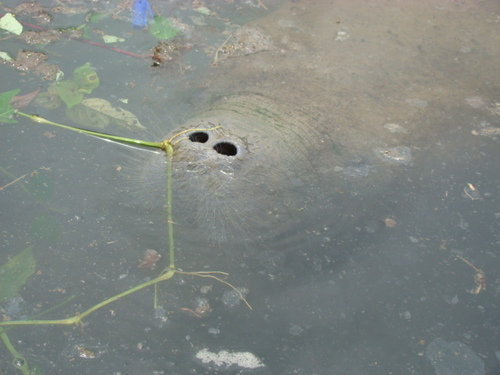
📌 Range and habitat
African manatees inhabit the widest ranges of habitats of any sirenian species, ranging from offshore islands in the Atlantic to rivers in the western Sahel, equatorial rainforest rivers, and so on. It has been reported that coastal populations ascend rivers during the rainy season and descend again during the dry season. The movement and habitat of the African manatee has been threatened by the building of agricultural and hydroelectric dams along rivers that isolate populations, such as the Akosombo Dam in Ghana. The Diama Dam has permanently isolated the Senegal River manatee population from the coast, as has the Felou Dam in Mali.
African Manatees can be found in West African regions: Angola, Benin, Cameroon, Chad, the Republic of the Congo, the Democratic Republic of the Congo, Côte d'Ivoire, Equatorial Guinea, Gabon, The Gambia, Ghana, Guinea, Guinea-Bissau, Liberia, Mali, Mauritania, Niger, Nigeria, Senegal, Sierra Leone, and Togo. Manatees are found in brackish waters to freshwater: in oceans, rivers, lakes, coastal estuaries, reservoirs, lagoons, and bays on the coast. African manatees rarely inhabit waters with a temperature below
Manatees have been found as far as offshore, where there are shallow coastal flats and calm mangrove creeks filled with seagrass. Inland lakes where manatees dwell include Lake Volta, the Inner Niger River Delta in Mali, Lake Léré, and Lake de Tréné. Due to fluctuating flow rates and water levels in rivers, some of these permanent lakes serve as refuges for manatees in connecting rivers during the dry season. From north to south, the river systems that contain manatees include: the Senegal, Saloum, Gambia, Casamance, Cacheu, Mansôa, Geba, Buba, Tombali, Cacine, Kogon, Konkouré, Sierra Leone, Great Scarcies, Little Scarcies, Sherbro, Malem, Waanje, Sewa, Missunado, Cavalla, St. Paul, Morro, St. John, Bandama, Niouniourou, Sassandra, Comoé, Bia, Tano, Volta, Mono, Oueme, Niger, Mekrou, Benue, Cross, Katsena Ala, Bani, Akwayafe, Rio del Rey, Ngosso, Andokat, Mene, Munaya, Wouri, Sanaga, Faro, Chari, Bamaingui, Bahr-Kieta, Logoné, Mitémélé, Gabon, Ogooué, Lovanzi, Kouilou, Congo, Dande, Bengo, and Cuanza. Manatees move up these rivers until they are unable to proceed because of shallow waters or strong waterfalls.
The areas with the highest manatee populations are Guinea-Bissau, the lagoons of Côte d'Ivoire, the southern portions of the Niger River in Nigeria, the Sanaga River in Cameroon, the coastal lagoons in Gabon, and the lower parts of the Congo River. As part of a study completed in Côte d'Ivoire to assess where the majority of African manatees favor living, a sample of African manatees was radio-tagged and tracked. The tracking observed most of the sample in coastal lagoons, mangroves, and other herbaceous growths. They were also found in the grassy estuaries of big rivers with mangroves and in protected coastal spots with less than of water containing both mangroves and marine macrophytes.
📌 Evolution and legends
The West African manatee is a descendant of trichechids found in coastal South America during the Pliocene Epoch. Although they tend to stay in freshwater, theory suggests that, through transoceanic currents, the species reached West Africa during the late Pliocene. The West African manatee's appearance is thought to be the result of these currents and species movement. The African manatee's ancestors passed down advantageous migration and food traits. The African manatee is not restricted to a certain area, and does not have to rely heavily on only one ecosystem for support. This evolution of the African manatee's diversity may be part of its key attribute to survival. They are more diverse than other manatees due to their ability to survive in salt water, although they do need access to fresh water for drinking purposes.
According to people of western Africa, Maame Water (also spelled Mami Wata), a recurring character in many coastal legends, is a goddess of the sea and a symbol of wealth and beauty. Maame Water also flips over canoes and entices their occupants to visit her kingdom. Scientists from the Institute of Aquatic Biology of the Centre for Scientific and Industrial Research (CSIR) and the Wildlife Department in Ghana have concluded that Maame Water is based on the West African manatee. According to Dr. Mamaa Entsua-Mensah, who performs research for CSIR, when female African manatees surface for air, they resemble goddesses. Entsua-Mensah explains that the female manatee's breasts create the illusion of a woman-fish.
Among the Serer people of Senegal, the Gambia and Mauritania, the manatee is regarded as sacred and highly respected, because in the Serer creation myth, it is viewed as the guardian of the secrets of the future.
📌 Threats
The African manatee is a vulnerable species because of its meat, oil, bones, and skin, which can bring great wealth to poachers. Specifically they are used to make walking sticks and toy spinning tops. In some countries, such as Nigeria and Cameroon, African manatees are sold to zoos, aquariums, online as pets, and they are sometimes shipped internationally. Anyone visiting such countries will notice manatee meat being sold on the streets and in marketplaces, but the lack of law enforcement protects the poachers from punishment. Residents of countries such as Mali and Chad use the oil of the African manatee in belief that it can cure ailments such as ear infections, rheumatism, and skin conditions.
Many of the African manatees that venture up the Niger River starve to death. At certain times each year, the Niger River dries up due to the hot temperatures and lack of rain. Many manatees migrate there during the rainy season. When the water dries up the manatees are unable to get to other bodies of water.
Manatees do not have many true predators. Apart from humans, they are threatened by sharks and crocodiles but this is rare because of a difference in habitat. In West Africa Crocodiles make up the majority of manatee predators besides humans.
📌 Conservation
, Japan]]
From November 2004 until December 2007, the West African Manatee Conservation Project completed Phase I. During this phase, residents of six African countries (Mauritania, Senegal, The Gambia, Guinea, Guinea-Bissau, and Sierra Leone) created a database of previously unknown information about the species (such as population, economic value, and habitat range) by conducting surveys in their countries. Other African countries also contributed reports that broadened the collective knowledge of the African manatee. Because of the work done during this phase, the general public, young children, and experienced scientists alike are receiving better information than ever before as to how to protect the African manatees. Phase I also allowed for up-close examination of the African manatee's way of life through field work.
Due to the large-scale success of Phase I, a Phase II is to be enacted by Wetlands International. During Phase II, the information collected in Phase I will be even more widely distributed around the areas in which the African manatee lives. Phase II will focus on furthering the existing research and adjusting legislation and education.
The African manatee is listed on Appendix I of the Convention on International Trade in Endangered Species (CITES), meaning international export or import is strictly regulated. Laws exist to protect the African manatee in every country in which it lives, but these laws are not well enforced. Due to this mass lack of enforcement and minimal education, the African manatee population is being steadily depleted.