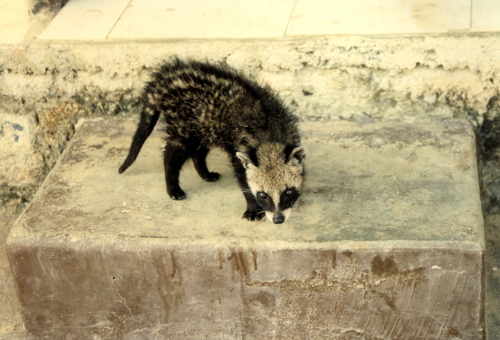
The African civet is a large viverrid native to sub-Saharan Africa, where it is considered common and widely distributed in woodlands and secondary forests. It has been listed as least concern on the IUCN Red List since 2008. In some countries, it is threatened by hunting, and wild-caught individuals are kept for producing civetone for the perfume industry.
📌 Taxonomy and evolution
Viverra civetta was the scientific name introduced in 1776 by Johann Christian Daniel von Schreber when he described African civets based on previous descriptions and accounts. Schreber is therefore considered the binomial authority.
The following subspecies were proposed in the 20th century:
*C. c. congica described by Ángel Cabrera in 1929 was a zoological specimen from the upper Congo River.
*C. c. schwarzi was proposed by Cabrera in 1929 for African civet specimens from East Africa.
*C. c. volkmanni also described by Lundholm in 1955 was a specimen from the vicinity of Otavi in Namibia.
A 1969 study noted that this civet showed enough differences from the rest of the viverrines in terms of dentition to be classified under its own genus.
📌 Evolution
A 2006 phylogenetic study showed that the African civet is closely related to the genus Viverra. It was estimated that the Civettictis-Viverra clade diverged from Viverricula around 16.2 Mya; the African civet split from Viverra 12.3 Mya. The authors suggested that the subfamily Viverrinae should be bifurcated into Genettinae (Poiana and Genetta) and Viverrinae (Civettictis, Viverra, and Viverricula). The following cladogram is based on this study.
}}
}}
|2=
}}
}}
📌 Etymology
The generic name Civettictis is a fusion of the French word and the Greek word ictis, meaning "weasel". The specific name civetta and the common name "civet" come from the French or the Arabic or ("civet cat").
📌 Local and indigenous names
*In Tigrinya: (')
*In Akan:
*In Luganda: ,
*In Yoruba: ,
*In Igbo:
📌 Characteristics
The African civet has a coarse and wiry fur that varies in colour from white to creamy yellow to reddish on the back. The stripes, spots, and blotches are deep brown to black. Horizontal lines are prominent on the hind limbs, spots are normally present on its midsection and fade into vertical stripes above the forelimbs. Its muzzle is pointed, ears small and rounded. A black band stretches across its small eyes, and two black bands are around its short broad neck. Following the spine of the animal extending from the neck to the base of the tail is the erectile dorsal crest. The hairs of the erectile crest are longer than those of the rest of the pelage. Only the binturong is likely heavier among the world's viverrids. Its shoulder height averages . Both male and female have perineal and anal glands, which are bigger in males.
📌 Distribution and habitat
African civets typically sleep during the day in the tall grasses near water sources in central and southern Africa. It often inhabits savannahs, forests, and sometimes near rivers as the tall grasses and thickets present provide them with necessary cover during the day.
In Gabon's Moukalaba-Doudou National Park, it was photographed close to forested areas during a survey in 2012.
In Batéké Plateau National Park, it was recorded in gallery forest along the Mpassa River during surveys conducted between June 2014 and May 2015.
In the Republic of Congo, it was recorded in the Western Congolian forest–savanna mosaic of Odzala-Kokoua National Park during surveys in 2007.
In the transboundary Dinder–Alatash (Sudan and Ethiopia) protected area complex it was recorded during surveys between 2015 and 2018. It is also frequently spotted in Ethiopia's northern Degua Tembien massif.
📌 Behaviour and ecology
African civets deposit their feces in large piles called latrines, or specifically "civetries". The latrines are characterized by fruits, seeds, exoskeletons of insect and millipede rings, and occasionally clumps of grass. The role of civet latrines as a mechanism of seed dispersal and forest regeneration is still being researched. Like felids, male African civets scent mark by spraying urine backwards.
African civets are typically solitary creatures. They use their perineal gland secretion to mark their territories around their civetries. These markings typically follow common routes and paths and lie within 100 meters of civetries 96.72% of the time.
If an African civet feels threatened, it raises its dorsal crest to make itself look larger and thus more formidable and dangerous to attack. This behavior is a predatory defense.
📌 Feeding
Research in southeastern Nigeria revealed that the African civet has an omnivorous diet. It feeds on rodents like giant pouched rats (Cricetomys), Temminck's mouse (Mus musculoides), Tullberg's soft-furred mouse (Praomys tulbergi), greater cane rat (Thryonomys swinderianus), and typical striped grass mouse (Lemniscomys striatus), amphibians and small reptiles like Hallowell's toad (Amietophrynus maculatus), herald snake (Crotaphopeltis hotamboeia), black-necked spitting cobra (Naja nigricollis), common agama (Agama agama), and Mabuya skinks, birds, millipedes, and insects such as Orthoptera, Coleoptera, and Blattodea, as well as carrion, eggs, fruits (such as Strychnos), berries and seeds.
African civets can take prey as large as hares but can be somewhat clumsy killers with sizable prey.
Green grass is also frequently found in feces, and this seems to be linked to the eating of snakes and amphibians.
📌 Reproduction
Captive females are polyestrous. Mating lasts 40 to 70 seconds.
📌 Threats
In 2006, it was estimated that about 9,400 African civets are hunted yearly in the Nigerian part and more than 5,800 in the Cameroon part of the Cross–Sanaga–Bioko coastal forests.
Skins and skulls of African civets were found in 2007 at the Dantokpa Market in southern Benin, where it was among the most expensive small carnivores. Local hunters considered it a rare species, indicating that the population declined due to hunting for trade as bushmeat.
The African civet has historically been hunted for the secretion of its perineal glands. This substance, marketed as civet oil, has been used as a basic ingredient for many perfumes for hundreds of years. The writer Daniel Defoe once invested in a scheme to raise civets in captivity for their secretions.
The population of African civet in Botswana is listed under Appendix III of the Convention on International Trade in Endangered Species of Wild Fauna and Flora (CITES).